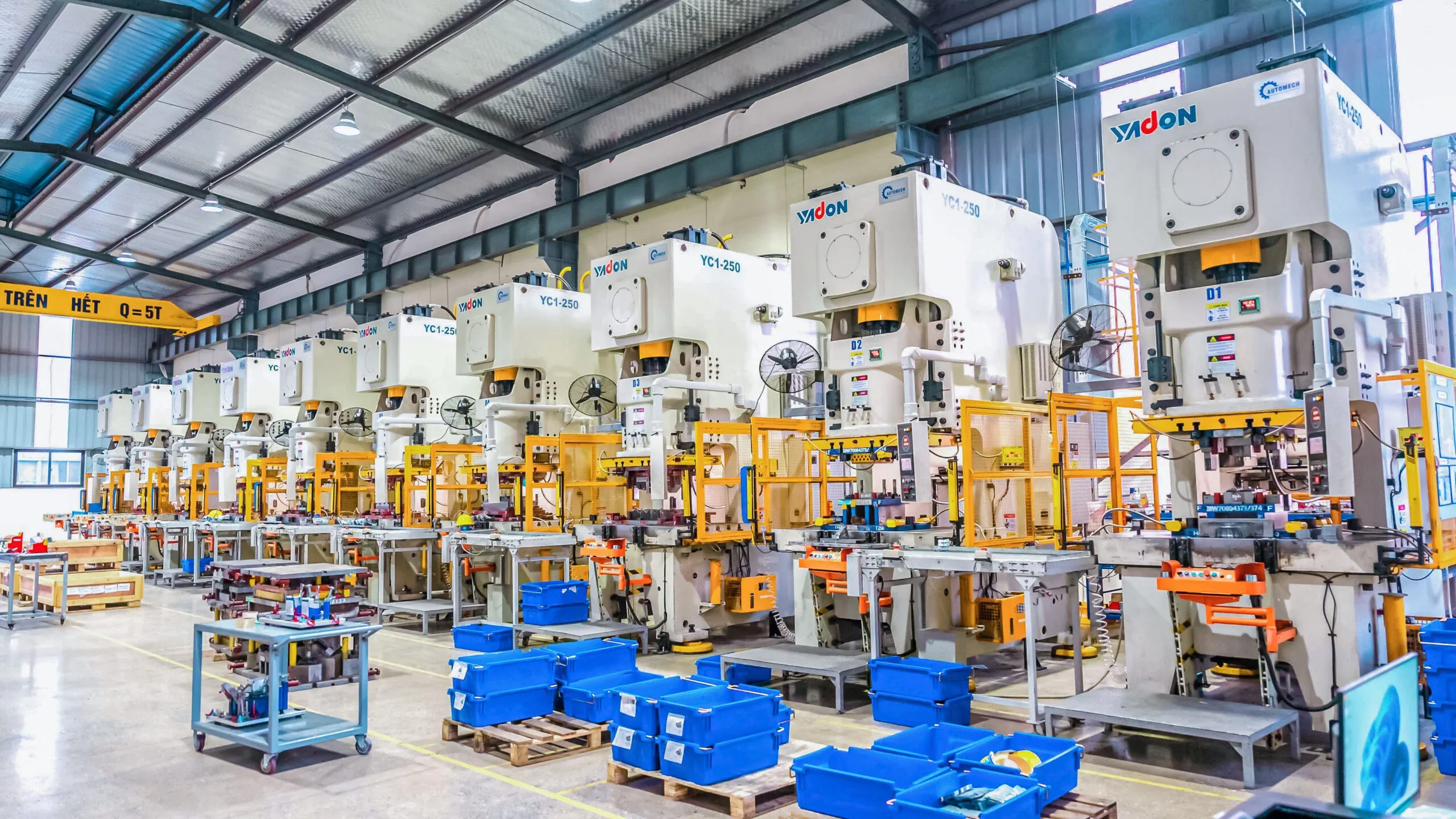
Automotive stamping Vietnam has emerged as a vital manufacturing capability for global automotive OEMs and Tier suppliers seeking high-precision, cost-efficient sheet metal components. As international automakers expand their production footprints and optimize global procurement, Vietnam offers an advantageous blend of modern press infrastructure, skilled toolmaking engineering, and strategic supply chain integration. From prototype development to high-volume progressive die stamping, Vietnamese contract manufacturers provide turnkey solutions that satisfy stringent international standards.
1. Automotive Stamping Vietnam: Automotive Metal Stamping Solutions for Global OEMs
1.1. What is automotive stamping in Vietnam?
1.1.1. Definition of automotive metal stamping
Automotive metal stamping is a high-speed cold-forming manufacturing process that utilizes dedicated stamping dies and high-tonnage mechanical, hydraulic, or servo presses to cut, shape, bend, and draw sheet metal into vehicle components. The process converts flat steel or aluminum coils into complex structural, functional, and exterior automotive parts without melting the parent metal.
1.1.2. Role of stamping in automotive manufacturing
Stamping serves as the backbone of modern automotive vehicle construction. It manufactures the structural components that make up the vehicle body-in-white (BIW), powertrain brackets, passenger safety cages, and chassis crossmembers, delivering the impact absorption, torsional rigidity, and dimensional repeatability required for automotive assembly lines.
1.1.3. Automotive stamping from prototype to mass production
Vietnamese stamping facilities support every stage of vehicle development. Suppliers utilize flexible laser cutting, CNC punch presses, and soft-tool modular dies for initial functional prototyping and physical crash testing before engineering hardened multi-station progressive or transfer dies capable of producing millions of components throughout a multi-year vehicle lifecycle.
1.2. Automotive stamping capabilities in Vietnam
1.2.1. Sheet metal stamping
Sheet metal stamping in Vietnam encompasses a wide variety of single-operation, compound, and modular die configurations. Facilities process thin-to-medium gauge steel and aluminum sheets into durable covers, splash shields, and structural mounting brackets with balanced mechanical strength.
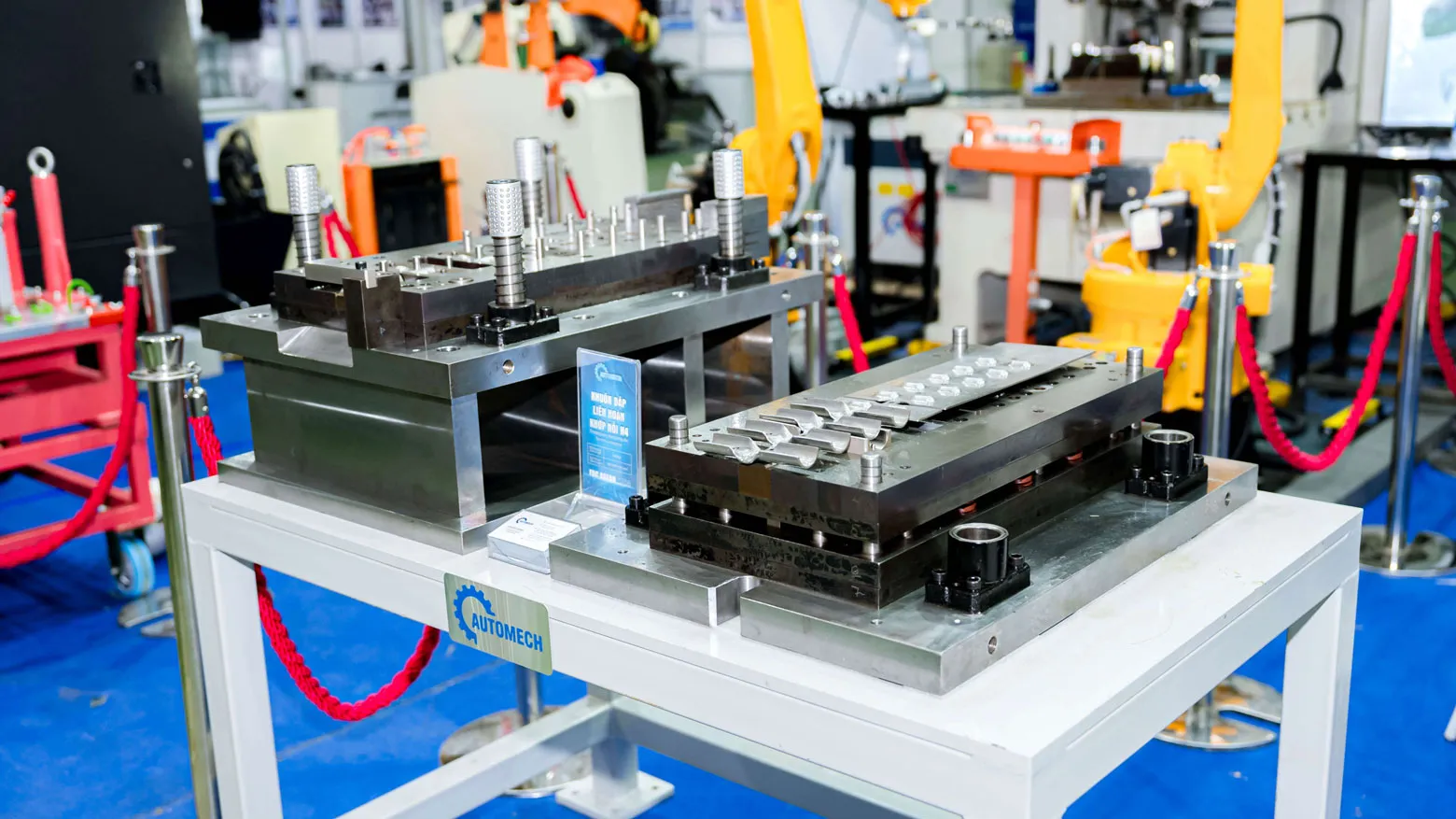
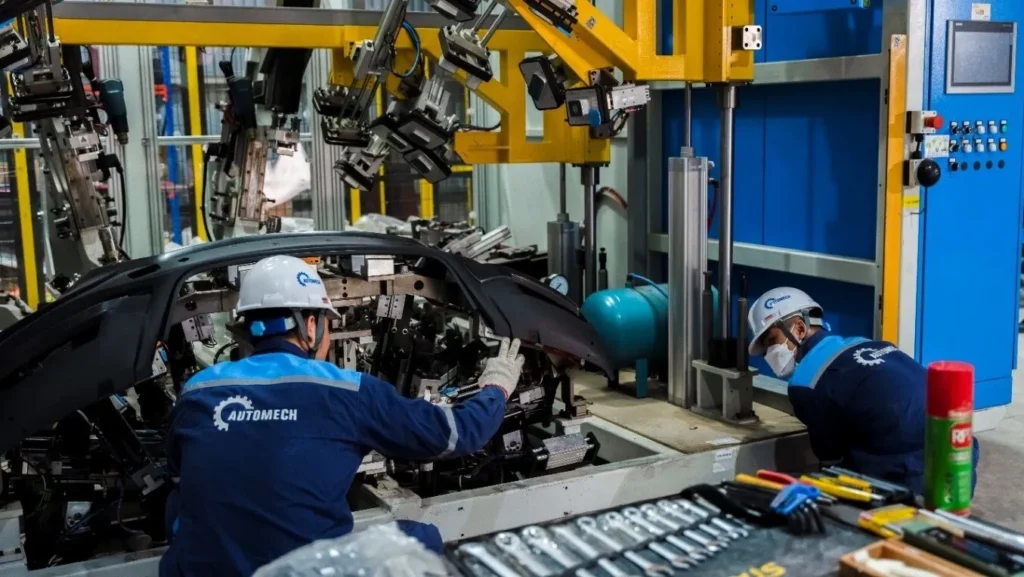
Automotive Stamping Vietnam plays a vital role in manufacturing high-quality automotive components
1.2.2. Precision metal stamping
Precision metal stamping delivers tight-tolerance automotive parts held within ± 0.01 mm to ± 0.02 mm. Utilizing high-speed presses, ground tungsten carbide die inserts, and guided stripper plates, precision stamping produces fine-edge electronic connectors, sensor brackets, and powertrain clips free of excessive burrs.
1.2.3. Progressive die stamping
Progressive die stamping feeds continuous coiled sheet metal through synchronized inline stations within a single die block. Each stroke executes cutting, piercing, and forming operations concurrently, completing a finished automotive component at the final cutoff station at speeds ranging from 100 to over 500 parts per minute.
1.2.4. High-volume automotive stamping
Equipped with automated decoilers, multi-roll levelers, and dynamic servo feeders, high-volume stamping press lines in Vietnam provide continuous, uninterrupted output. Automated scrap evacuation and in-die optical sensors ensure continuous production runs tailored to large-scale international OEM platform schedules.
1.3. Automotive stamping supply chain in Vietnam
1.3.1. OEM and Tier 1/Tier 2 supplier support
Vietnam’s precision stamping ecosystem actively supports Tier 1 and Tier 2 automotive supply chains. Contract manufacturers supply stamped components directly to modular systems integrators producing seating mechanisms, exhaust systems, chassis subframes, and electric vehicle battery enclosures.
1.3.2. Tooling, stamping and assembly integration
Leading Vietnamese suppliers offer integrated manufacturing models that combine in-house tool and die design, high-speed press stamping, and automated secondary assembly. By integrating robotic resistance spot welding, automated hardware insertion, and protective surface finishing under one roof, manufacturers eliminate multi-vendor logistics risks.
1.3.3. Export manufacturing for US and European markets
Vietnamese stamping manufacturers maintain extensive experience exporting components to North America and Western Europe. Suppliers adhere to international commercial standards, prepare comprehensive Level 3 PPAP documentation, and apply protective Vapor Corrosion Inhibitor (VCI) packaging to ensure safe transoceanic transit.
2. Automotive Metal Stamping Processes and Technologies
2.1. Core automotive stamping operations
2.1.1. Blanking and piercing
Blanking cuts the exterior perimeter geometry of a component from flat sheet coils, while piercing punches internal mounting holes, alignment slots, and clearance cutouts. Maintaining uniform punch-to-die clearances ensures clean shear walls and eliminates loose slugs during rapid cycling.
2.1.2. Bending and forming
Bending uses mechanical force along linear axes to form flanges and achieve the required bending angles, and channels. Forming shapes metal along contoured or non-linear profiles without cutting material fibers, adding structural stiffening ribs and offsets that increase component rigidity.
2.1.3. Drawing and deep drawing
Drawing forces flat sheet metal into female die cavities using a mechanical punch. Deep drawing stretches the sheet metal into seamless, hollow cylindrical or rectangular profiles-such as vehicle oil pans, motor enclosures, and battery cell containers-without side-wall necking or bottom fractures.
2.2. Advanced stamping processes
2.2.1. Progressive die stamping
Progressive stamping maintains the component on a continuous carrier strip as it indexes through sequential forming operations inside a single tool set. This automated workflow delivers high dimensional repeatability, low direct labor expenses, and maximum cost efficiency for large orders.
2.2.2. Transfer stamping
Transfer stamping processes pre-cut discrete sheet metal blanks. Mechanical transfer rails or multi-axis robotic arms physically grip and advance workpieces between separate die stations, accommodating large automotive structural panels, deep draw shells, and heavy crossmembers.
2.2.3. Precision and high-speed stamping
High-speed precision presses operate at high frequencies while maintaining dynamic stability. Precision stamping cells utilize counterbalanced press rams, acoustic tonnage monitors, and micro-metric shut-height controls to prevent die wear during high-speed production.
2.3. Production engineering
2.3.1. Stamping press selection and press tonnage
Selecting the proper press depends on component geometry, material tensile strength, and sheet thickness. Press capacity calculations account for shear forces, forming resistance, stripper spring pressure, and a 20% to 30% safety margin, deploying press machinery ranging from 100 tons to 1,300+ tons.
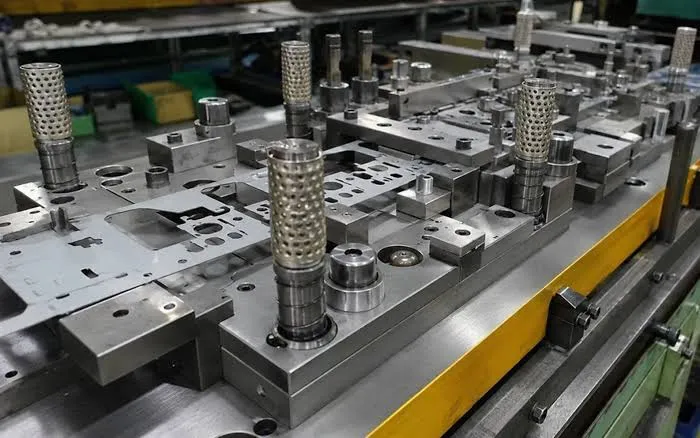
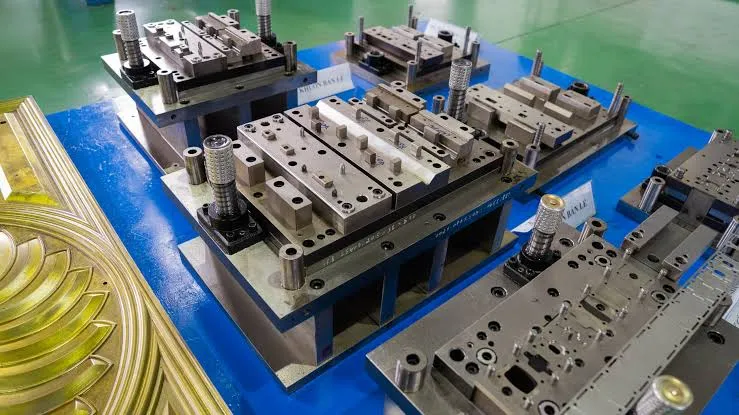
Automotive Stamping Vietnam helps reduce material waste and improve production efficiency
2.3.2. Progressive die design and strip layout
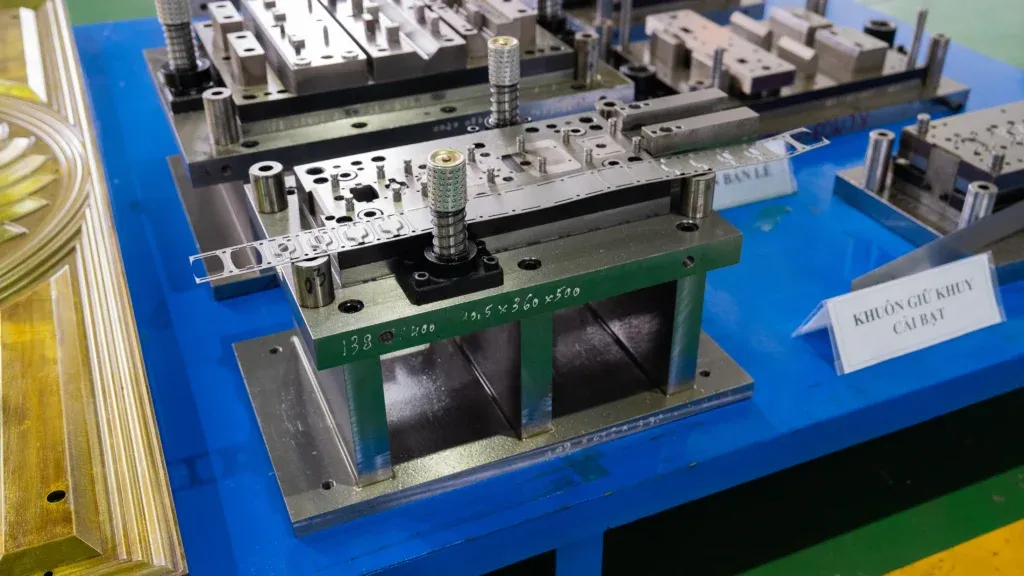
Tooling engineers utilize 3D CAD/CAM software to model strip progression layouts. Engineers balance cutting and forming forces across sequential stations, position pilot locating pins accurately, and design carrier ribbons to ensure balanced press loads.
2.3.3. Material utilization and scrap reduction
Computer-aided blank nesting algorithms optimize coil width and station pitch to achieve material utilization rates above 75% to 85%. Minimizing carrier web widths and consolidating adjacent blank perimeters directly reduces raw material expenditure per part.
3. Automotive Stamped Parts Manufactured in Vietnam
3.1. OEM metal stamping parts
3.1.1. Automotive sheet metal parts
Vietnamese stamping facilities manufacture functional and structural sheet metal parts, including door interior panels, wheelhouse stiffeners, firewall brackets, and aerodynamic underbody splash shields built strictly to OEM CAD models.
3.1.2. Structural and reinforcement components
Structural reinforcement stampings reinforce vehicle safety zones during collision events. Stamped from advanced high-strength steels, these parts reinforce bumper crash boxes, B-pillar inner webs, roof rails, and door intrusion beams to ensure passenger cabin integrity.
3.1.3. Chassis and mounting components
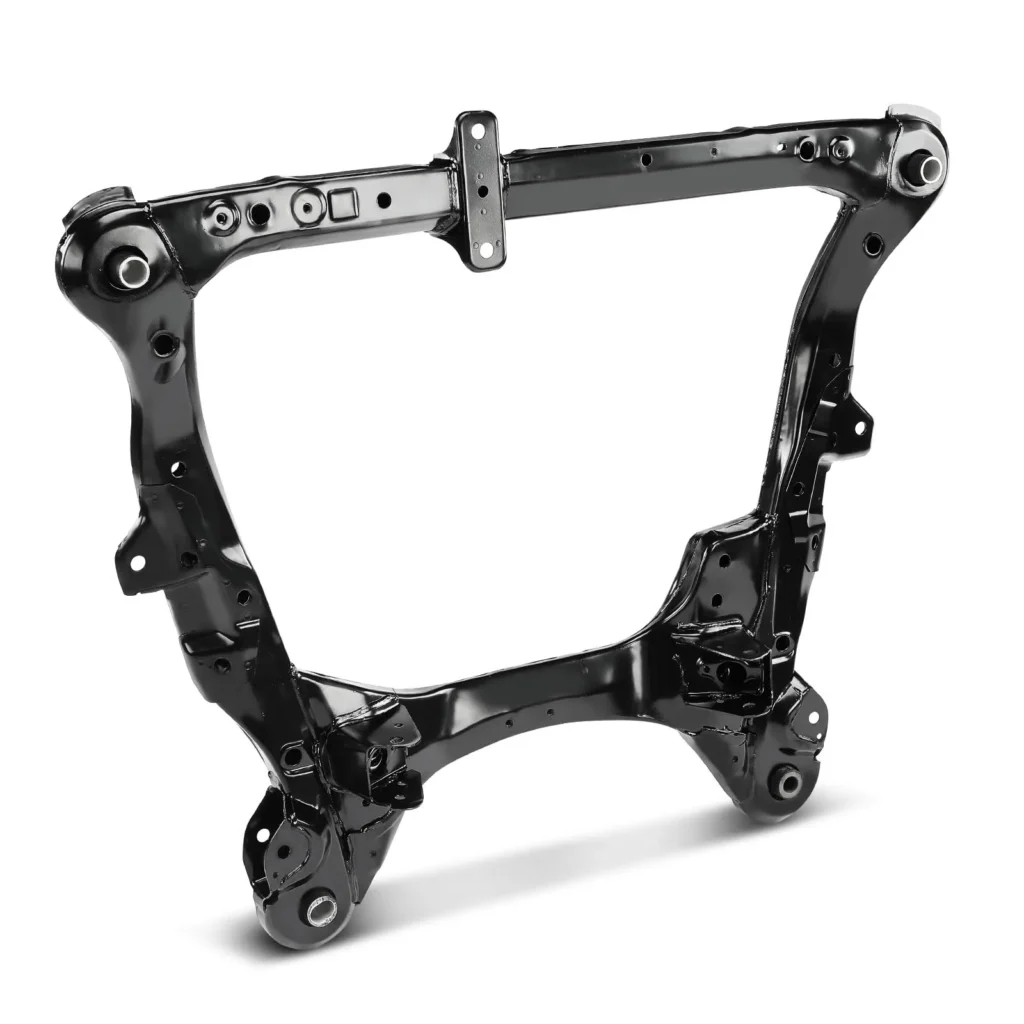
Chassis stampings include heavy-duty subframe crossmembers, control arm reinforcement gussets, and steering gear mounting plates. Heavy press lines process thick-gauge steel sheets (up to 6.0 mm) to deliver dynamic fatigue resistance under cyclic vehicle loads.
3.2. Automotive bracket stamping
3.2.1. Mounting brackets
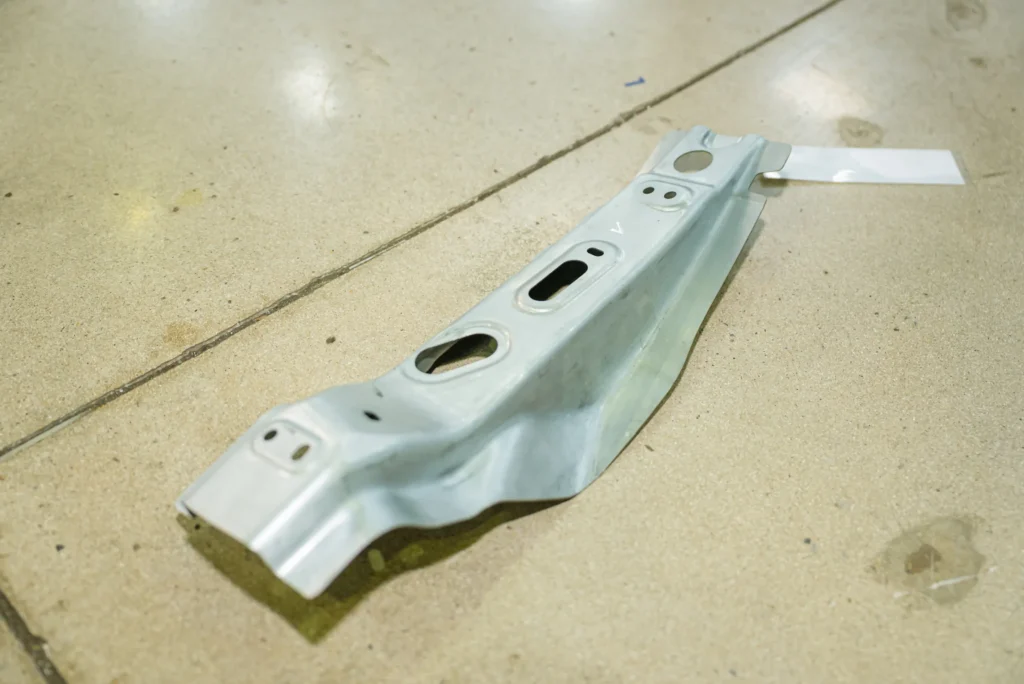
Mounting brackets secure electronic control units (ECUs), powertrain modules, radiator assemblies, and hydraulic lines within tight vehicle envelopes. Progressive stamping dies produce mounting brackets with integrated clearance holes and alignment tabs held to tight tolerances.
3.2.2. Support brackets
Support brackets carry static and dynamic loads across engine bays and vehicle underbodies. Stamped with embossed ribs and formed flanges, these brackets support exhaust systems, alternators, and transmission linkages against mechanical road vibrations.
3.2.3. Seat and interior brackets
Vehicle seating systems rely on stamped seat track runners, recliner gear plates, height adjuster brackets, and seatbelt anchor linkages. Precision stamping ensures smooth mechanical articulation, tight tooth clearances, and passenger safety compliance.
3.3. EV and new-energy vehicle components
3.3.1. Battery-related stamped components
Electric mobility platforms utilize stamped copper and aluminum busbars, battery module tie rods, cell terminal interconnects, and cooling plate covers. These parts demand burr-free edges, high coplanarity, and clean surfaces free of conductive debris.
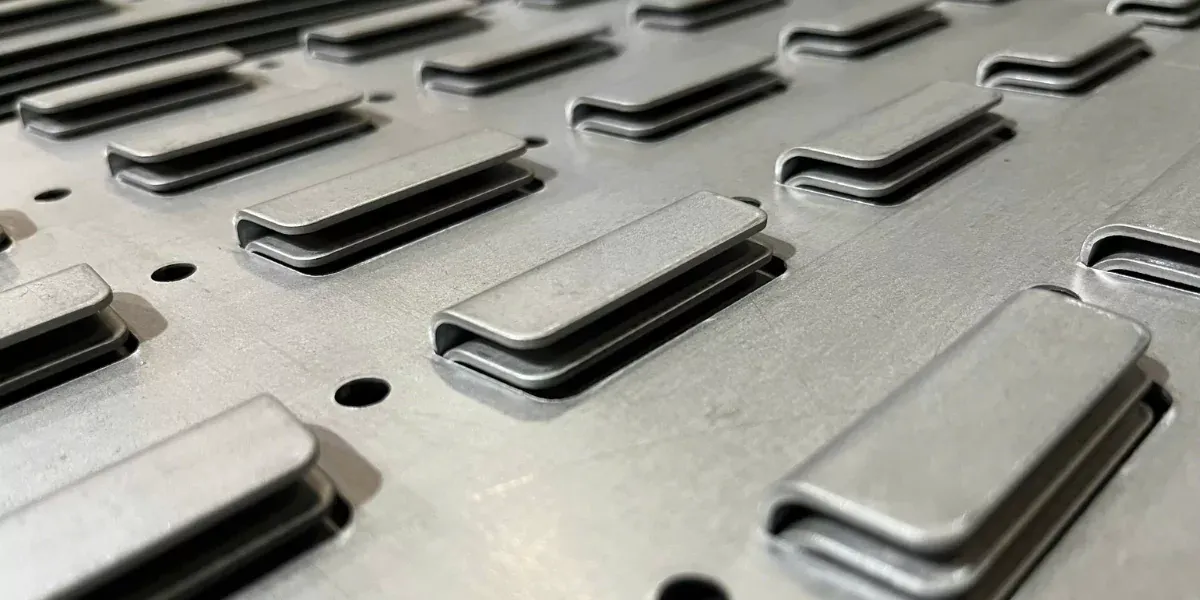
Automotive Stamping Vietnam supports the production of precision metal parts for the automotive industry
3.3.2. Structural EV components
EV architectures require rigid structural stampings to house and protect high-voltage battery packs. Heavy-tonnage presses stamp high-strength steel and structural aluminum into perimeter protection frames, bottom armor plates, and internal pack crossmembers.
3.3.3. Lightweight sheet metal components
To offset heavy battery weights, automotive engineers utilize lightweight stamped aluminum components (5052 and 6061 alloys) for inverter enclosures, electronic shielding covers, and body closure reinforcements, supporting extended vehicle driving ranges.
3.4. Automotive stamping assembly
3.4.1. Welding integration
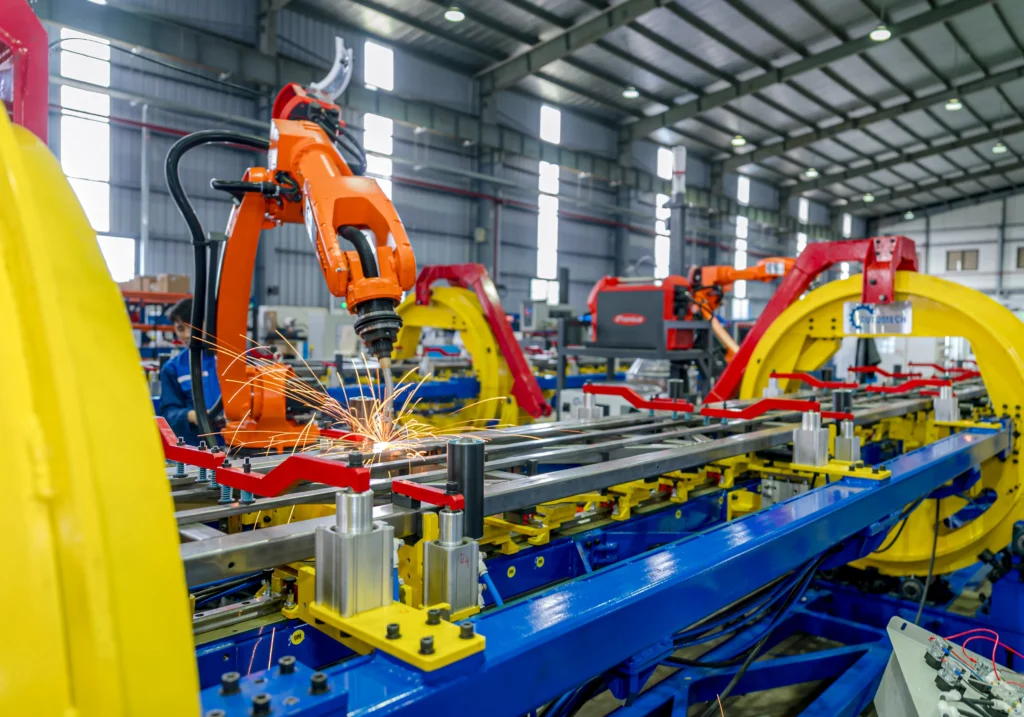
Leading stamping manufacturers integrate secondary welding processes into the production workflow. Automated resistance spot welding, robotic MIG/TIG welding, and fiber laser welding join individual stamped brackets and panels into rigid chassis sub-assemblies.
3.4.2. Fixture-controlled assembly
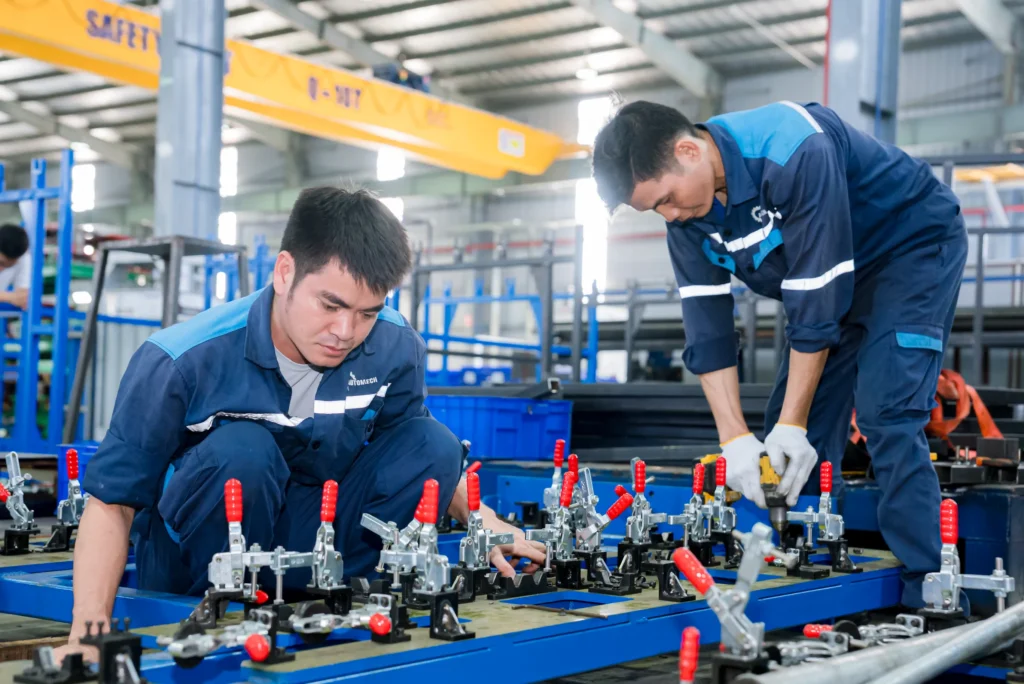
Custom welding fixtures utilize CNC-machined locating blocks, hardened dowel pins, and pneumatic toggle clamps to hold stamped sub-components in precise alignment. Rigid fixture structures counteract thermal weld distortion and ensure final assembly dimensions remain within drawing limits.
3.4.3. Stamped-part subassemblies
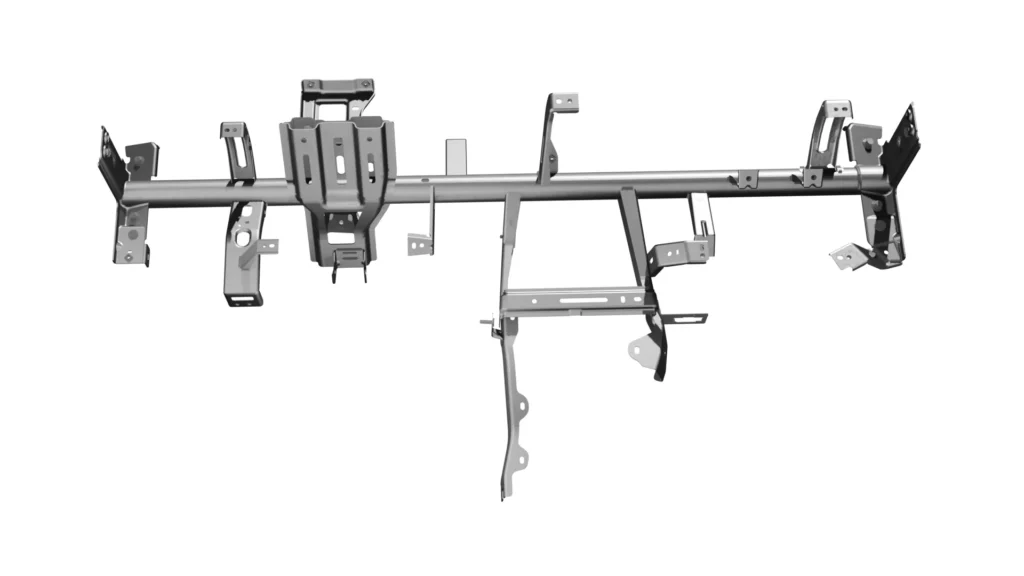
Turnkey sub-assemblies-such as dashboard cross-beams, pedal bracket units, and seat track frames-are assembled directly within dedicated manufacturing cells. Single-source delivery reduces supply chain complexity and consolidates quality accountability for global OEMs.
4. Materials, Tooling and Quality Requirements
4.1. Materials used in automotive stamping
4.1.1. Carbon steel and stainless steel
Cold-rolled low-carbon steel (SPCC, SECC) provides an economical foundation for bracketry and general vehicle hardware due to its high formability. Austenitic and ferritic stainless steels (SUS304, SUS409) deliver corrosion and heat resistance for vehicle exhaust systems and engine heat shields.
4.1.2. High-strength automotive steel
High-Strength Low-Alloy (HSLA) steels and Advanced High-Strength Steels (AHSS)-including Dual-Phase (DP600, DP800) and Martensitic grades-deliver yield strengths exceeding 500 to 1,000 MPa. These materials allow engineers to down-gauge sheet thickness while preserving vehicle crash-energy absorption.
4.1.3. Material thickness and formability
Automotive stampings utilize strip thicknesses ranging from 0.6 mm for exterior panels to over 6.0 mm for heavy structural brackets. Evaluating material formability, work-hardening exponents (n-value), and plastic strain ratios (r-value) ensures the metal deforms without localized thinning or cracking.
4.2. Automotive stamping tooling
4.2.1. Stamping die selection
Tooling selection depends on production volume and part geometry. Progressive dies are selected for high-volume components with multi-stage features, transfer dies are chosen for large structural panels, and compound dies are utilized for flat parts requiring high concentricity.
4.2.2. Tool and die manufacturing
Toolrooms machine die shoes, punches, and die cavities from premium tool steels (AISI D2, DC53, SKD11) using high-speed CNC milling and precision wire EDM equipment. Die components undergo vacuum heat treatment to achieve hardness ratings of 58 to 62 HRC.
4.2.3. Die maintenance and tool life optimization
Tool life is extended by applying Physical Vapor Deposition (PVD) wear coatings such as TiAlN or DLC to cutting punches. Structured preventive maintenance schedules govern toolroom regrinding, guide pillar lubrication, and nitrogen spring inspection to prevent unexpected press downtime.
4.3. Dimensional and surface requirements
4.3.1. Dimensional tolerance
Automotive stampings adhere to strict geometric dimensioning and tolerancing (GD&T). Precision stamping dies hold linear dimensions within ± 0.01 mm to ± 0.05 mm and hole center-to-center distances within ± 0.02 mm, ensuring seamless fitment in automated robotic assembly cells.
4.3.2. Springback control
High-strength steels and structural aluminum alloys exhibit pronounced elastic springback upon punch retract. Tool designers integrate calculated over-bending cam angles, bottoming relief steps, and localized coining beads into forming cavities to hold drawing angles within ± 0.25°.
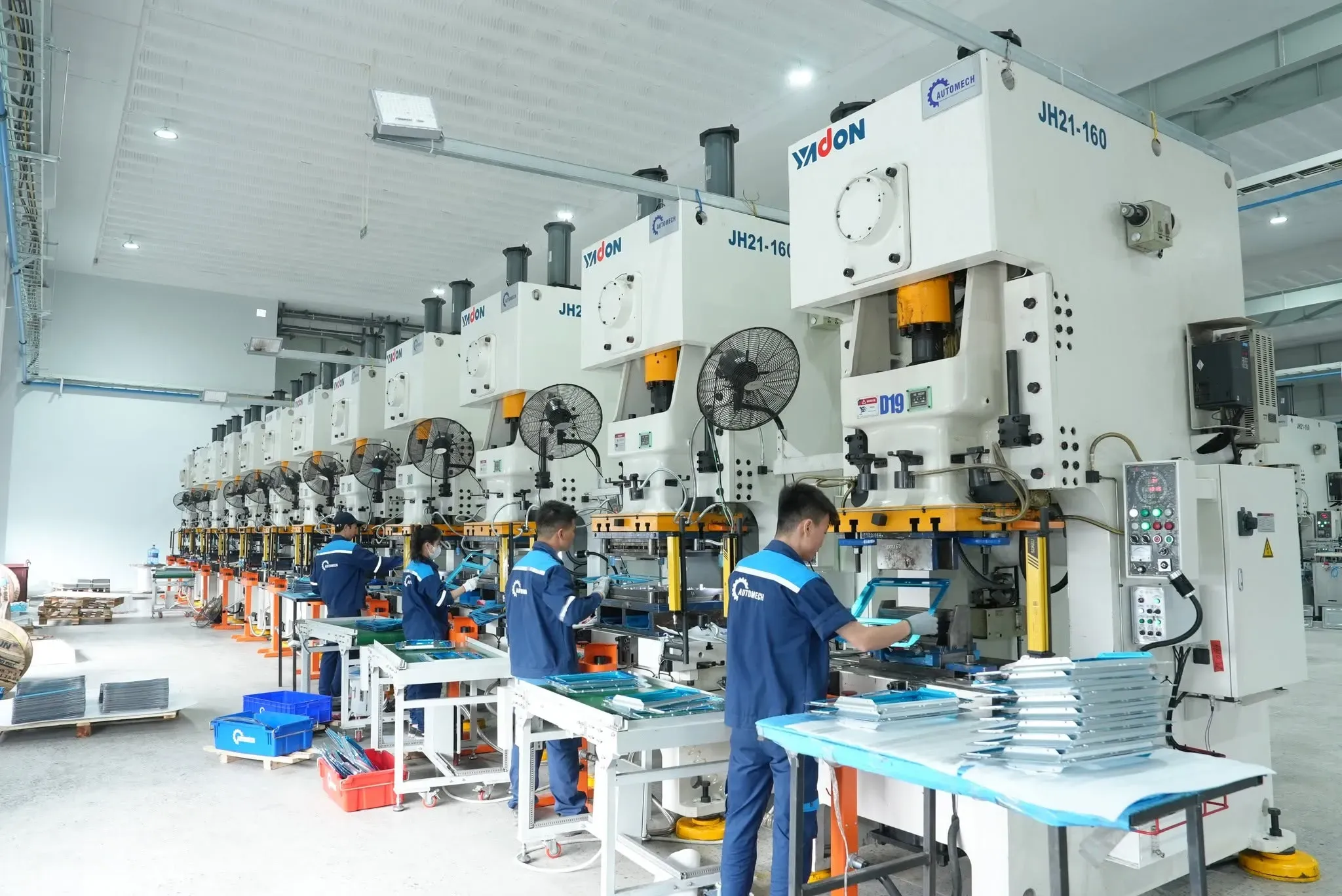
Automotive Stamping Vietnam helps manufacturers improve production efficiency and product consistency
4.3.3. Burr control and surface finish
Maintaining punch-to-die cutting clearances below 5% to 10% of material thickness restricts exit burr heights to under 10% of sheet gauge. Polished die surfaces and synthetic forming lubricants preserve mill finishes, achieving smooth surface roughness profiles (Ra < 0.4 μm) free of scratches or galling.
5. Automotive Stamping Quality Control and Compliance
5.1. Quality inspection systems
5.1.1. CMM inspection
Coordinate Measuring Machines (CMM) located in climate-controlled testing laboratories (~ 20 °C) inspect finished production samples. Multi-axis tactile probing verifies critical hole centers, true positions, and complex surface contours directly against 3D CAD models.
5.1.2. Gauge and optical inspection
Custom attribute checking fixtures, drop gauges, and automated optical vision systems provide fast 100% dimensional verification on the shop floor. In-line digital cameras inspect hole presence, slot geometries, and perimeter edge burrs at full production speeds.
5.1.3. First Article Inspection
Before mass production starts, quality engineers conduct a comprehensive First Article Inspection (FAI) on initial stamped parts off the tool. FAI reports verify that die shut-height calibration, strip pitch, and punch offsets yield fully conforming components.
5.2. In-process quality control
5.2.1. SPC
Statistical Process Control (SPC) protocols govern continuous production runs. Press operators sample parts at defined hourly intervals, logging critical dimensions into X-bar and R control charts to maintain process capability indices (Cpk1.67).
5.2.2. MSA
Measurement Systems Analysis (MSA), including Gage Repeatability and Reproducibility (Gage R&R) studies, verifies that inspection fixtures and operator techniques introduce minimal measurement error. Maintaining Gage R&R values below 10% ensures valid inspection data.
5.2.3. Control Plan
A comprehensive Control Plan defines inspection gates, measuring equipment, sampling frequencies, and reaction protocols across every manufacturing phase-from raw coil receiving and press stamping to secondary deburring, welding, and export packaging.
5.3. Automotive quality management
5.3.1. ISO 9001
ISO 9001 establishes the foundational Quality Management System (QMS), standardizing operating procedures, raw material verification, equipment calibration, and structured continuous improvement (PDCA) routines across all manufacturing operations.
5.3.2. IATF 16949
IATF 16949 enforces automotive-specific quality management requirements focused on defect prevention, supply chain variation reduction, automated error-proofing (Poka-Yoke), and complete raw material-to-part traceability.
5.3.3. PPAP, APQP and FMEA
Automotive quality systems implement core tools to ensure defect-free manufacturing:
- APQP: Advanced Product Quality Planning aligns cross-functional teams from tool design through production launch.
- FMEA: Design and Process FMEA identify potential failure modes in tooling and press operations before production begins.
- PPAP: Level 3 Production Part Approval Process packages provide objective evidence that production lines can consistently meet all engineering requirements.
5.3.4. Production traceability
Digital quality management systems maintain complete batch traceability for every production lot. Laser-etched DataMatrix barcodes or stamped batch numbers link finished stampings directly to raw material master coil heat numbers, press operator shifts, and tool maintenance logs.
6. Automotive Stamping Production Models and Capacity
6.1. Prototype and development stamping
6.1.1. Prototype production
Prototype stamping enables automotive engineers to validate component form, fit, and physical performance prior to committing capital to production tooling. Using laser cutting, CNC press brake forming, and modular soft-tool dies, suppliers produce small batches (10 to 500 units) that replicate mass-production material properties for vehicle crash testing and assembly fit-up trials.
6.1.2. Tooling validation
Tooling validation bridges design engineering and physical manufacturing. By measuring material thinning, localized necking, and springback deviations on soft-tool sample stampings, toolmakers verify CAD simulation models and calibrate punch clearances before cutting hardened tool steels for progressive or transfer production dies.
6.1.3. Pilot production
Pilot production runs evaluate full-scale manufacturing readiness under production press speeds. Stamping several thousand parts on tryout press lines validates material feeding stability, sensor interlocks, scrap evacuation, and process capability indices (Cpk1.67), ensuring zero-defect stability prior to commercial vehicle launch.
6.2. High-volume automotive stamping
6.2.1. Progressive die production
Progressive die stamping delivers maximum manufacturing throughput for vehicle platform orders requiring 50,000 to millions of parts annually. Operating at speeds between 100 and 500+ strokes per minute, automated multi-station progressive dies perform continuous piercing, forming, coining, and blanking, separating completed parts at the final cutoff station with minimal direct labor.
6.2.2. Production consistency and repeatability
High-volume progressive tooling maintains micron-level dimensional repeatability across multi-shift production schedules. Hardened pilot pins locate the continuous coil strip before each press stroke, ensuring that critical hole positions, bend angles, and perimeter profiles match engineering drawings throughout the entire production lifecycle.
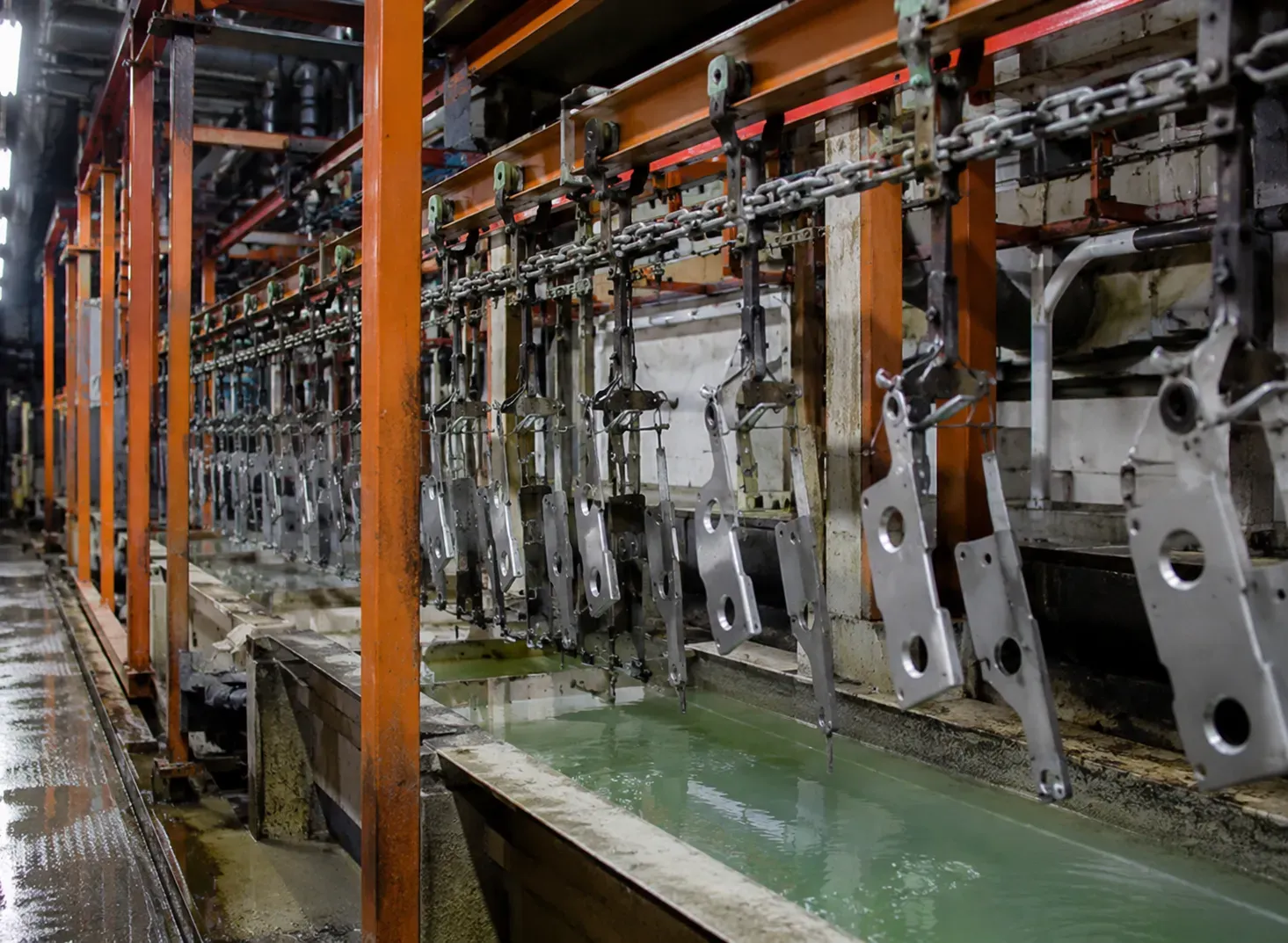
Automotive Stamping Vietnam applies advanced stamping technologies to meet demanding automotive standards
6.2.3. Tool life and preventive maintenance
Maintaining consistent output during high-volume runs requires structured tool maintenance. Stamping dies incorporate premium tool steels (DC53, SKD11) and Physical Vapor Deposition (PVD) wear coatings such as TiAlN. Preventive maintenance schedules track stroke counts, initiating toolroom regrinding and component inspection every 50,000 to 100,000 cycles to prevent burr growth and punch chipping.
6.3. Mass production and assembly
6.3.1. Production capacity planning
Effective capacity planning balances stamping press tonnage, automated coil inventory, and shift scheduling against OEM monthly release forecasts. Advanced Enterprise Resource Planning (ERP) systems coordinate raw material master coil deliveries and press changeovers, maximizing Overall Equipment Effectiveness (OEE) while maintaining production agility.
6.3.2. Stamping-to-assembly integration
Synchronizing high-speed stamping presses directly with automated secondary assembly cells prevents work-in-progress (WIP) accumulation. Stamped brackets, reinforcements, and panels transfer immediately to robotic welding, clinching, or hardware insertion cells, creating a lean, continuous manufacturing flow.
6.3.3. OEM delivery and supply planning
Automotive stamping suppliers in Vietnam support global OEM procurement through Just-In-Time (JIT) and Vendor-Managed Inventory (VMI) frameworks. Maintained buffer stocks and automated shipping notifications ensure uninterrupted component supply to domestic and international assembly facilities.
7. Why Source Automotive Stamping from Vietnam?
7.1. Vietnam as an automotive manufacturing destination
7.1.1. Supporting industry ecosystem
Vietnam’s industrial manufacturing sector has developed a robust supporting ecosystem for metalworking, precision toolmaking, and metal finishing. Industrial clusters across northern and southern provinces house specialized facilities for vacuum heat treatment, electro-plating, cataphoresis (E-coating), and raw coil slitting, providing full supply chain support for stamping operations.
7.1.2. Automotive manufacturing supply chain
The expansion of domestic automotive manufacturers and international Tier 1 assembly plants in Vietnam has driven significant capital investment into tier-level manufacturing. Local precision stamping suppliers produce structural BIW parts, chassis components, and EV battery assemblies that integrate seamlessly into global automotive platforms.
7.1.3. Export manufacturing capabilities
Vietnam benefits from an extensive network of bilateral and multilateral Free Trade Agreements (such as the EVFTA and CPTPP) that reduce trade barriers and lower import tariffs into Western markets. Deep-water container ports (including Lach Huyen in the north and Cai Mep in the south) provide direct ocean shipping routes to North America and Western Europe.
7.2. Vietnam vs China for automotive stamping
7.2.1. Manufacturing and tooling capabilities
While China has long maintained a mature toolmaking base, Vietnam’s leading stamping manufacturers operate modern facilities equipped with imported high-speed CNC milling centers, precision wire EDM machinery, and high-tonnage mechanical press lines. Vietnamese toolrooms design, build, and maintain progressive and transfer dies that match international engineering benchmarks at lower operational costs.
7.2.2. Quality management and engineering support
Vietnamese contract stamping suppliers enforce strict adherence to IATF 16949 quality management systems, utilizing standardized APQP frameworks, FMEA risk prevention, and Level 3 PPAP documentation packages. Engineering teams provide bilingual technical communication, rapid DFM feedback, and direct CAD/CAM engineering collaboration with Western procurement teams.
7.2.3. Lead time and export logistics
Toolmaking lead times in Vietnam average 6 to 10 weeks from final CAD approval to First Article Inspection. Established maritime corridors provide efficient transoceanic container shipping, reaching United States West Coast ports in approximately 18 to 22 days and European gateway terminals with reliable weekly sailing schedules.
| Strategic Parameter | Automotive Stamping in Vietnam | Automotive Stamping in China |
| Operational & Labor Cost | Highly competitive cost structure | Higher operational overhead and rising labor costs |
| Trade & Tariff Exposure | Favorable tariffs via global FTAs; minimal trade barriers | Elevated trade tariffs, anti-dumping duties, and trade friction |
| Supply Chain Role | Primary “China+1” diversification hub | Established conventional production base |
| Quality Framework | IATF 16949 certified; full Level 3 PPAP compliance | IATF 16949 certified; mature quality infrastructure |
| Toolmaking Capability | Modern wire EDM, CNC machining, and tryout facilities | Broad domestic tool and die ecosystem |
7.3. China+1 automotive stamping strategy
7.3.1. Supply chain diversification
Relying on a single manufacturing origin exposes international automotive supply chains to regional disruptions, geopolitical risks, and unexpected tariff fluctuations. Establishing contract stamping operations in Vietnam provides immediate geographic diversification and supply chain resilience.
7.3.2. Dual-source and supplier risk management
Automotive OEMs increasingly mandate dual-sourcing strategies for multi-year vehicle programs. Partnering with a qualified Vietnamese stamping supplier creates production redundancy, ensuring component availability in the event of regional logistics bottlenecks or material shortages.
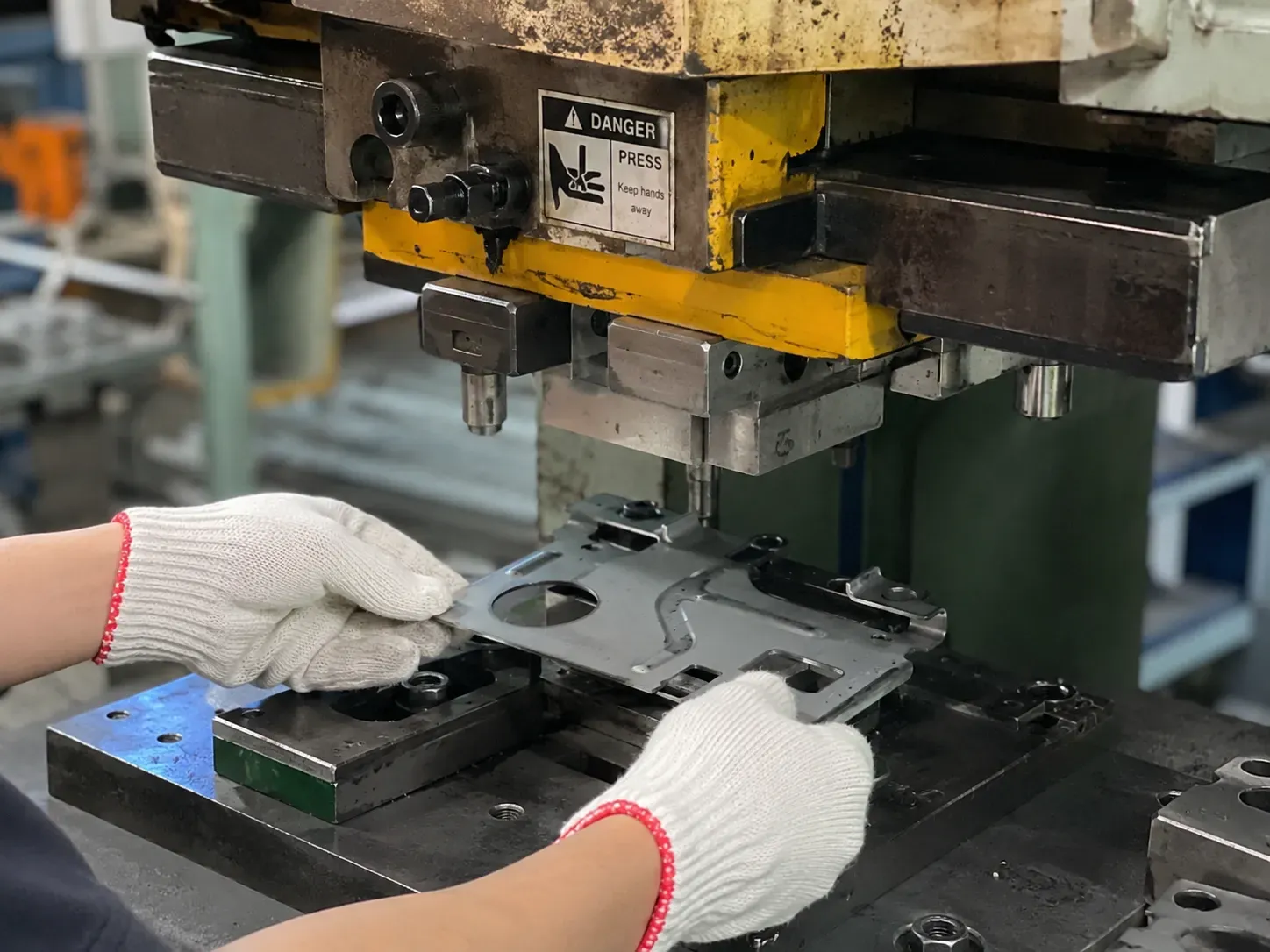
Automotive Stamping Vietnam enables high-volume production of complex metal components
7.3.3. Long-term automotive stamping partnerships
Vietnamese suppliers focus on building multi-year, collaborative manufacturing partnerships. Transparent tooling amortization models, joint engineering development, and long-term capacity reservations provide international automotive buyers with stable pricing and dependable production allocations.
8. How to Choose an Automotive Stamping Supplier in Vietnam
8.1. Technical capability checklist
8.1.1. Press capacity and production equipment
Verify that the manufacturer operates a comprehensive press fleet covering mechanical, hydraulic, and servo presses with capacities ranging from 100 tons to over 1,300 tons. The supplier should operate automated tandem press lines and progressive high-speed presses equipped with servo coil feeders and straighteners.
8.1.2. Progressive die and tooling capability
Confirm that the supplier maintains an in-house toolroom equipped with multi-axis CNC machining centers, precision wire EDM equipment, and tryout presses. In-house tool design and maintenance ensures direct control over die precision, fast engineering revisions, and rapid die sharpening.
8.1.3. Engineering and DFM support
Select a supplier whose engineering team provides early Design for Manufacturability (DFM) reviews. Engineers must possess the software tools and technical expertise to perform finite element forming simulations, verify bend clearances, and optimize strip layouts before die steel is cut.
8.2. Quality and automotive compliance
8.2.1. ISO 9001 and IATF 16949
Ensure the supplier maintains active ISO 9001 and IATF 16949 certifications. These standards verify that the facility operates structured quality management procedures, error-proofing (Poka-Yoke) systems, and documented process controls tailored to automotive manufacturing.
8.2.2. PPAP and traceability capability
Verify that the supplier’s quality assurance department is proficient in submitting complete Level 3 PPAP packages, including Process Flow Diagrams, PFMEA, Control Plans, Gage R&R studies, and initial process capability analyses (Cpk1.67). Full batch traceability must link finished parts to raw material heat certificates.
8.2.3. Inspection and laboratory equipment
Ensure the manufacturer operates a climate-controlled quality laboratory (~ 20 °C) equipped with Coordinate Measuring Machines (CMM), optical vision profile projectors, surface roughness testers, and tensile test equipment to validate complex GD&T parameters.
8.3. Supplier and sourcing evaluation
8.3.1. Prototype-to-mass-production capability
Choose a contract manufacturer capable of supporting the complete vehicle development roadmap. The supplier should provide soft-tool prototype stampings for vehicle testing before engineering hardened, high-volume production progressive dies.
8.3.2. Export experience and supplier audit readiness
Prioritize suppliers with a proven history of passing rigorous OEM on-site quality audits (such as VDA 6.3) and exporting to North America and Europe. The supplier must demonstrate professional export packaging capabilities, including Vapor Corrosion Inhibitor (VCI) bagging and ocean-freight palletizing.
8.3.3. RFQ responsiveness and cost transparency
Prompt technical communication, structured DFM proposals, and open-book cost breakdowns for tooling NRE and piece-part pricing indicate a dependable, professional contract manufacturing partner.
9. Automotive Stamping Pricing and RFQ Process
9.1. Factors affecting automotive stamping costs
9.1.1. Material type, thickness and utilization
Raw material choice establishes baseline component costs. Advanced High-Strength Steels (AHSS) and structural aluminum alloys carry market price premiums over commercial cold-rolled carbon steel. Strip nesting layout and carrier web design dictate raw material utilization; achieving utilization rates above 80% significantly lowers material costs.
9.1.2. Part geometry and production volume
Component complexity dictates press tonnage requirements, station count, and cycle speeds. High-volume automotive programs (100,000+ units annually) amortize non-recurring engineering (NRE) setup and tooling investments across the production run, driving unit costs down to fractions of a dollar.
9.1.3. Die complexity and tooling requirements
Tooling investment corresponds to the number of forming stations, punch geometries, and die materials. Multi-station progressive dies utilizing vacuum-hardened tool steels (DC53, SKD11) or tungsten carbide inserts require higher upfront capital but eliminate manual handling and lower piece-part rates over the lifecycle of the vehicle platform.
9.2. Tooling and production cost optimization
9.2.1. Progressive die cost
Tooling costs are optimized by balancing station progression to fit standard press bed dimensions. Eliminating unnecessary forming stations and utilizing modular die inserts reduces machining hours and lowers upfront toolmaking expenses.
Automotive Stamping Vietnam contributes to the development of the automotive supporting industry
9.2.2. Scrap reduction
Advanced CAD strip layout software optimizes component angular orientation along the strip. Minimizing the progression pitch and reducing carrier ribbon widths reduces scrap skeleton volume, generating direct raw material savings on large OEM contracts.
9.2.3. Tool life and maintenance cost
Specifying wear-resistant PVD coatings (TiAlN) and incorporating commercial off-the-shelf standard components (such as Misumi or Dayton punches and guide pins) lowers tooling maintenance costs. Modular insert designs allow toolmakers to replace localized wear sections without building entirely new dies.
9.3. Automotive stamping RFQ process
9.3.1. Submit CAD files and technical drawings
A complete RFQ package requires 3D CAD models (STEP, IGES) alongside 2D PDF technical drawings indicating critical tolerances, material callouts, thread specifications, and geometric dimensioning and tolerancing (GD&T) datums.
9.3.2. DFM and stamping feasibility review
Upon receiving an RFQ, engineering teams evaluate the design using finite element forming software. The review analyzes material stretch limits, thinning risks, springback behavior, and press tonnage requirements to confirm manufacturability.
9.3.3. Tooling and production quotation
The supplier issues a formal quotation detailing non-recurring tooling fabrication costs, piece-part pricing across annual volume tiers, prototype sample lead times, and mass-production delivery milestones.
9.3.4. Prototype, validation and production approval
Following tool fabrication, the supplier submits First Article Inspection (FAI) sample parts alongside full Level 3 PPAP documentation for customer approval. Once the customer signs the Part Submission Warrant (PSW), the tooling is formally approved for automated mass production.
10. Automotive Stamping Partner in Vietnam – Automech
10.1. Automotive stamping manufacturing capabilities
10.1.1. Sheet metal and precision metal stamping
Established in 2020, Automech (Automech Mechanical Equipment and Solutions Joint Stock Company) provides comprehensive automotive metal stamping services. Operating modern mechanical, hydraulic, and servo press machinery, Automech processes flat sheets and coils into high-precision structural and functional components with tight dimensional tolerances.
10.1.2. Progressive die stamping
Automech designs, builds, and operates automated progressive die stamping systems. Equipped with automated decoilers, levelers, and servo roll feeders, the company’s progressive press lines deliver high-speed, continuous manufacturing for automotive brackets, reinforcements, and safety components.
10.1.3. OEM metal stamping parts
Automech manufactures custom stamped components tailored strictly to OEM engineering drawings and 3D CAD data. From initial DFM review through volume production, every component is manufactured to comply with strict international automotive quality requirements.
10.2. Integrated tooling and manufacturing support
10.2.1. Automotive stamping tooling
Automech operates modern toolrooms capable of engineering cold stamping dies, welding jigs, assembly fixtures, and inspection gauges. Factory 1 in Bac Ninh (10,500 m²) houses high-speed CNC machining centers, precision wire EDM machinery, and dedicated tryout presses for die manufacturing and validation.
10.2.2. Tool and die engineering
Automech’s in-house engineering and R&D team provides complete tool design services using advanced 3D CAD/CAM software. Engineers model multi-station strip progressions, simulate metal flow, and calculate springback compensation to ensure stable die performance during mass production.
10.2.3. Welding and automotive stamping assembly
Automech provides turnkey assembly integration, combining press stamping with secondary joining processes. Production assets include automated 800-ton to 1,300-ton tandem stamping press lines with ABB industrial robots, alongside robotic welding cells equipped with KUKA articulated robots and Fronius welding systems.
10.3. Engineering and quality support
10.3.1. DFM and stamping feasibility review
Automech conducts thorough upfront Design for Manufacturability (DFM) reviews to identify opportunities for material optimization, bend radius standardization, and die complexity reduction before tool steel is cut.
10.3.2. Quality inspection and traceability
Operating under ISO 9001 and IATF-aligned quality systems, Automech maintains climate-controlled testing laboratories (~ 20 °C) equipped with Coordinate Measuring Machines (CMM) and optical profile projectors. Complete batch traceability links every finished component to raw material test certificates and press operator records.
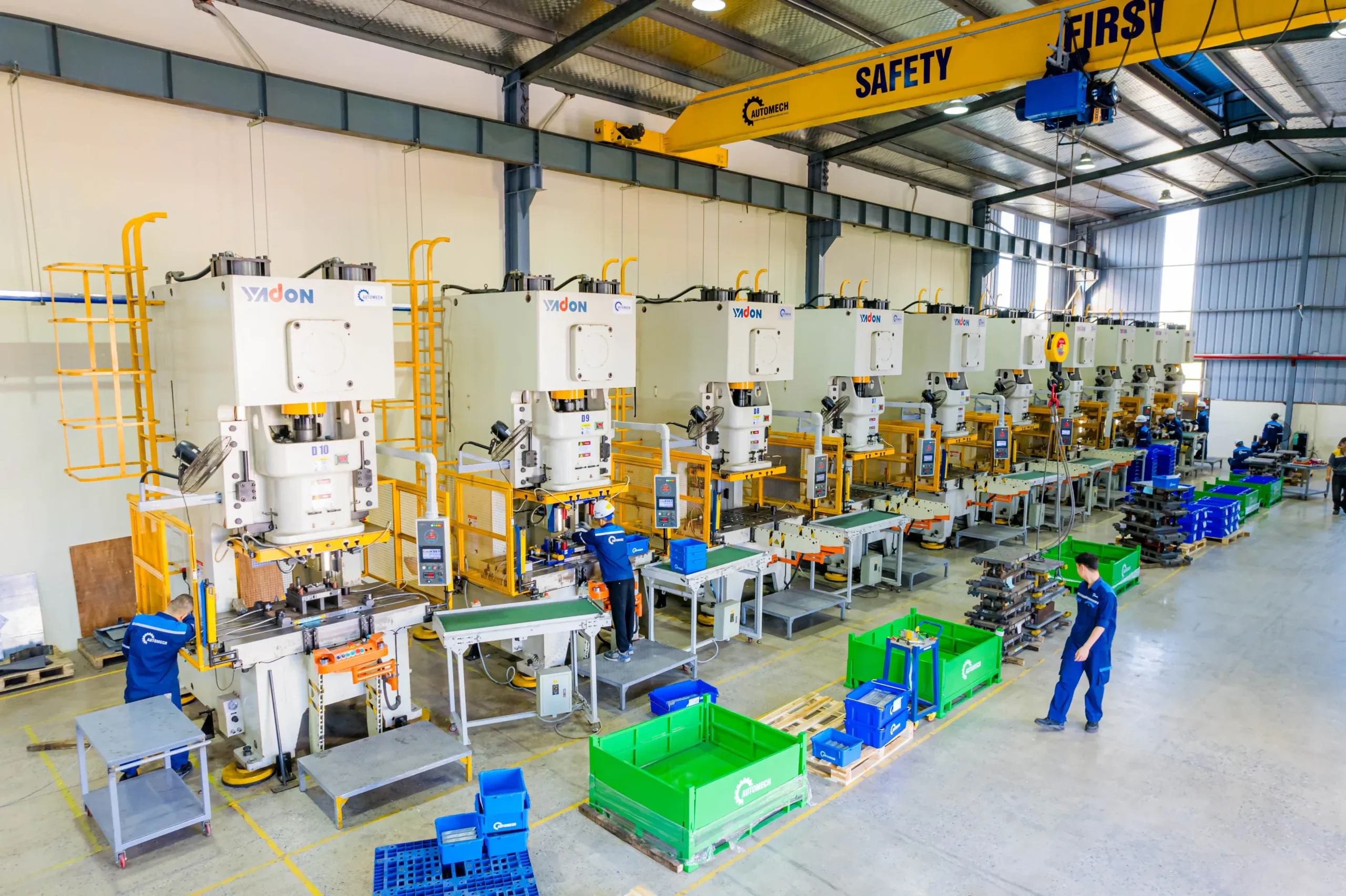
Automotive Stamping Vietnam combines precision tooling and stamping equipment to optimize manufacturing processe
10.3.3. Prototype-to-mass-production support
Automech supports every stage of the automotive product lifecycle. Factory 1 in Bac Ninh focuses on custom tooling, jigs, and prototype trial production, while Factory 2 in Bac Ninh (10,000 m², inaugurated June 2026) is dedicated to high-volume automotive parts manufacturing with an 80% target automation rate.
10.4. International OEM sourcing
10.4.1. Export manufacturing for US buyers
Automech’s manufacturing systems and engineering documentation comply with North American automotive standards. Components are prepared with protective Vapor Corrosion Inhibitor (VCI) packaging and ocean-freight palletizing for direct export to the United States.
10.4.2. Export manufacturing for European buyers
Automech adheres to European technical norms and environmental regulations. Utilizing direct maritime shipping corridors from northern Vietnam’s deep-water ports, the company ensures reliable delivery schedules for European automotive Tier suppliers.
10.4.3. OEM, Tier 1 and Tier 2 supplier support
Automech has demonstrated proven execution capabilities across major industrial manufacturing programs for leading enterprises, including VinFast, VinES, Hoa Phat, Kim Long Motors, and Seojin. The company provides full-lifecycle contract manufacturing backed by nationwide technical service hubs in Hanoi, Bac Ninh, Hai Phong, Da Nang, Hue, and Ho Chi Minh City.
10.5. RFQ and conversion pathways
10.5.1. Request automotive stamping RFQ
Initiate your automotive component quotation by submitting project requirements through Automech’s online portal to receive transparent tooling and piece-price estimates from the engineering team.
10.5.2. Upload CAD and technical drawings
Share your 3D CAD files (STEP, IGES) and 2D engineering drawings (PDF) detailing critical tolerances, GD&T callouts, and material specifications for rapid engineering assessment.
10.5.3. Request tooling and cost analysis
Request an in-depth tooling feasibility analysis and strip nesting evaluation to identify cost-reduction opportunities prior to capital expenditure.
10.5.4. Contact automotive engineering team
Connect directly with Automech’s mechanical engineers and toolmakers to discuss custom progressive die configurations, press tonnage allocations, and production scheduling for your vehicle program.
11. Automotive Stamping Vietnam FAQ
11.1. What is automotive stamping in Vietnam?
11.1.1. Automotive stamping capabilities and applications
Automotive stamping in Vietnam encompasses the cold-forming manufacturing of precision sheet metal components for passenger cars, commercial vehicles, and electric mobility platforms. Utilizing high-tonnage mechanical, hydraulic, and progressive presses, Vietnamese suppliers produce structural body parts, chassis brackets, and electric vehicle battery components adhering to international automotive engineering standards.
11.2. What automotive parts can be produced using metal stamping?
11.2.1. Brackets, structural parts and sheet metal components
Common stamped automotive components include body-in-white (BIW) reinforcement pillars, floor pan crossmembers, bumper crash boxes, engine mounting brackets, chassis suspension links, seat recliner plates, EV battery tray frames, and protective underbody heat shields.
11.3. Why is Vietnam becoming an automotive stamping sourcing destination?
11.3.1. Manufacturing, engineering and export considerations
Vietnam has become a preferred sourcing destination due to its competitive production cost structure, skilled engineering workforce, modern pressworking infrastructure, and direct access to global maritime shipping routes. Free Trade Agreements and a stable regulatory environment make Vietnam an ideal hub for global automotive procurement.
11.4. Is Vietnam a good alternative to China for automotive stamping?
11.4.1. China+1 and supply chain diversification
Vietnam is a proven, highly viable alternative to China under corporate “China+1” supply chain diversification strategies. Vietnamese contract manufacturers provide modern toolroom capabilities, IATF-compliant quality management, and lower tariff exposure, mitigating supply chain risks while maintaining high product quality.
11.5. What certifications should an automotive stamping supplier have?
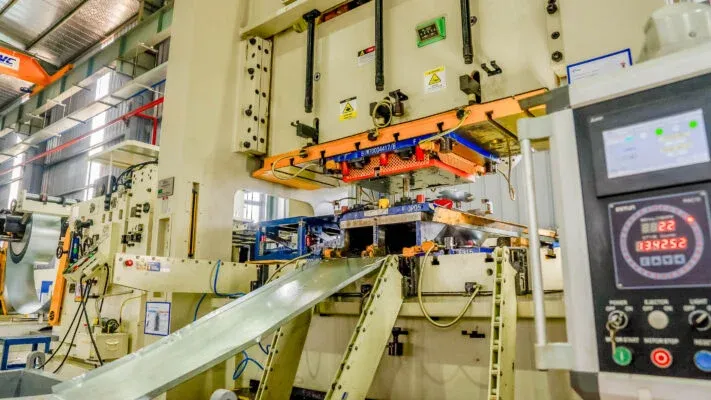
Automech provides stamping equipment and automation solutions to support Automotive Stamping Vietnam and meet the evolving needs of automotive manufacturers
11.5.1. ISO 9001, IATF 16949 and automotive quality systems
A qualified automotive stamping partner must hold an active ISO 9001 certification for foundational quality management and an IATF 16949 certification for automotive-specific defect prevention, automated error-proofing, and full batch traceability.
11.6. How do I choose an automotive stamping supplier in Vietnam?
11.6.1. Technical, quality and sourcing checklist
Evaluate potential suppliers based on press tonnage range (100T to 1,300T+), in-house wire EDM toolroom assets, active IATF 16949 certification, climate-controlled CMM inspection labs, upfront DFM engineering support, robotic welding capabilities, and proven export experience serving Western OEMs.
11.7. How do I request an automotive stamping RFQ?
11.7.1. CAD drawings, specifications, volume and delivery requirements
To request an accurate quotation, provide 3D CAD models (STEP/IGES) and 2D engineering drawings (PDF) detailing critical tolerances and GD&T requirements. Specify exact raw material grades, sheet thickness, required surface finishing, annual production volume forecasts, delivery milestones, and quality documentation requirements (such as Level 3 PPAP).
Automotive stamping Vietnam has emerged as a vital manufacturing capability for global automotive OEMs and Tier suppliers seeking high-precision, cost-efficient sheet metal components. As international automakers expand their production footprints and optimize global procurement, Vietnam offers an advantageous blend of modern press infrastructure, skilled toolmaking engineering, and strategic supply chain integration. From prototype development to high-volume progressive die stamping, Vietnamese contract manufacturers provide turnkey solutions that satisfy stringent international standards.
Automech Mechanical Equipment and Solutions Joint Stock Company
Head Office: No. 285 Phuc Loi Street, Phuc Loi Ward, Hanoi City
Da Nang Branch: No. 20 Nguyen Sinh Sac Street, Hoa Khanh Ward, Da Nang City
Ho Chi Minh Branch: No. 84, Street No. 10, Van Phuc Urban Area, Hiep Binh Ward, Ho Chi Minh City
Factory No. 1: Automech Automation Equipment, Mold & Tool Manufacturing Factory – Automech Demo Center: Dinh Tram Industrial Park, Nenh Ward, Bac Ninh City, Vietnam
Factory No. 2: Automech Parts Manufacturing & Component Fabrication Factory: Viet Nhat Industrial Cluster, Xuan Cam Commune, Bac Ninh City, Vietnam
Hotline: 0987 899 347
Website: https://automechmfg.com/
Fanpage: https://www.facebook.com/automech.mfg/
YouTube: https://www.youtube.com/@Automechmfg