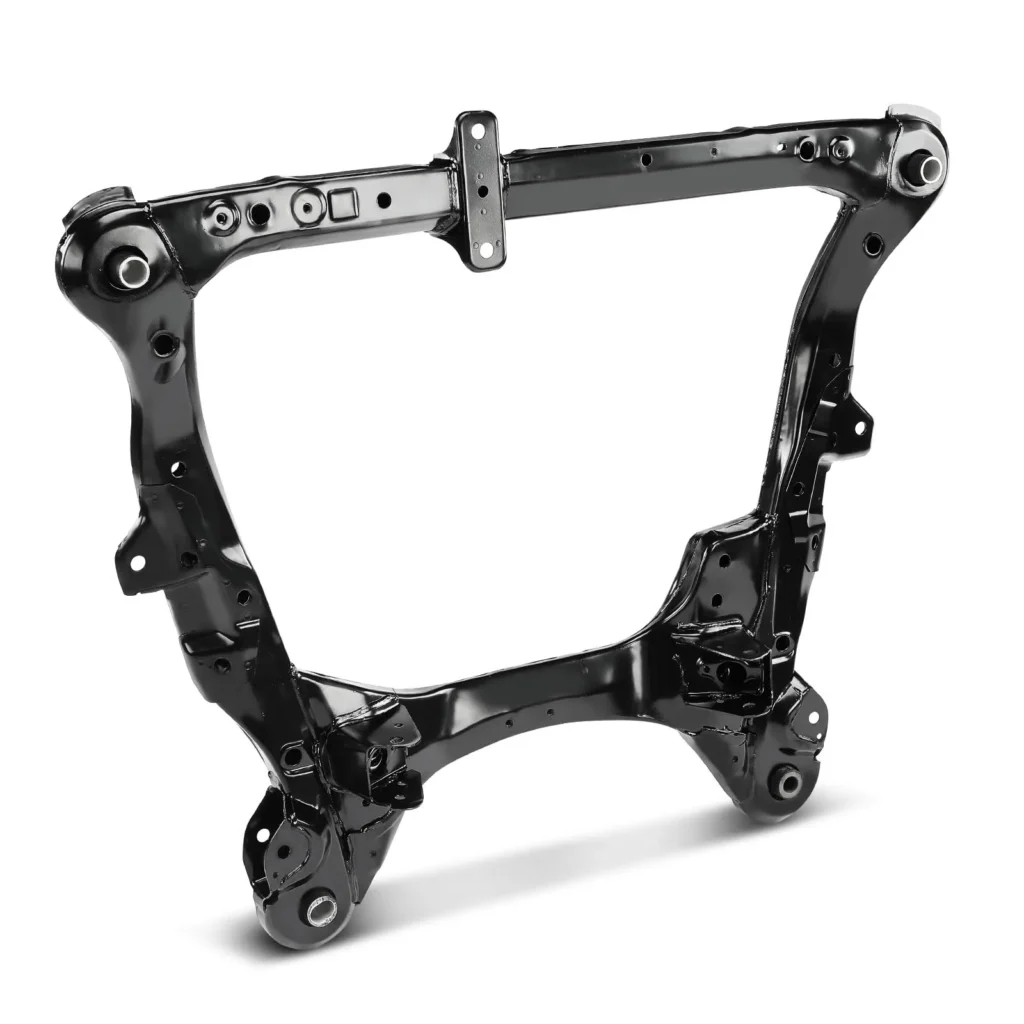
Global automotive manufacturers are increasingly searching for an automotive stamping partner Vietnam to strengthen supply chain resilience, reduce escalating production costs, and secure long-term manufacturing capacity. As the automotive industry shifts toward electrification, lightweight vehicle architectures, and diversified sourcing models, Vietnam has emerged as a premium destination for precision automotive metal stamping, progressive die tooling development, and complex welded assemblies.
For original equipment manufacturers (OEMs), Tier 1 suppliers, and global procurement teams, selecting the right manufacturing partner is a long-term investment in structural quality, engineering scalability, and macroeconomic stability. This comprehensive guide details why Vietnam is becoming a preferred automotive stamping hub and how global buyers can identify the right manufacturing partner to anchor their future growth.
1. Introduction: Why Global OEMs Need a Reliable Automotive Stamping Partner
1.1 Global automotive supply chain transformation
The modern automotive supply chain is experiencing unprecedented structural volatility. The combined pressures of rapid vehicle electrification, geopolitical realignment, and strict regulatory changes mean that legacy procurement strategies are no longer sufficient to maintain a competitive market edge.
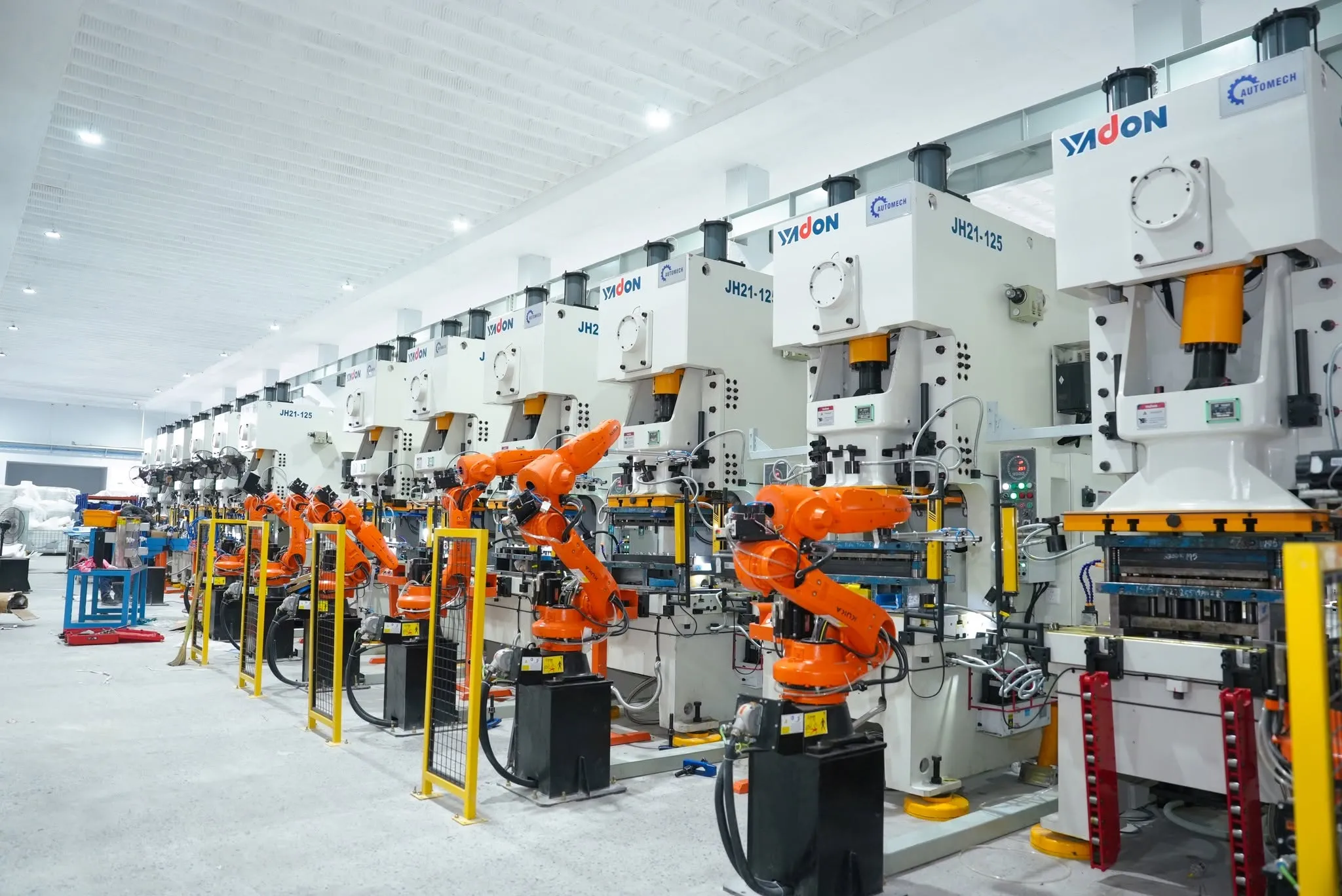
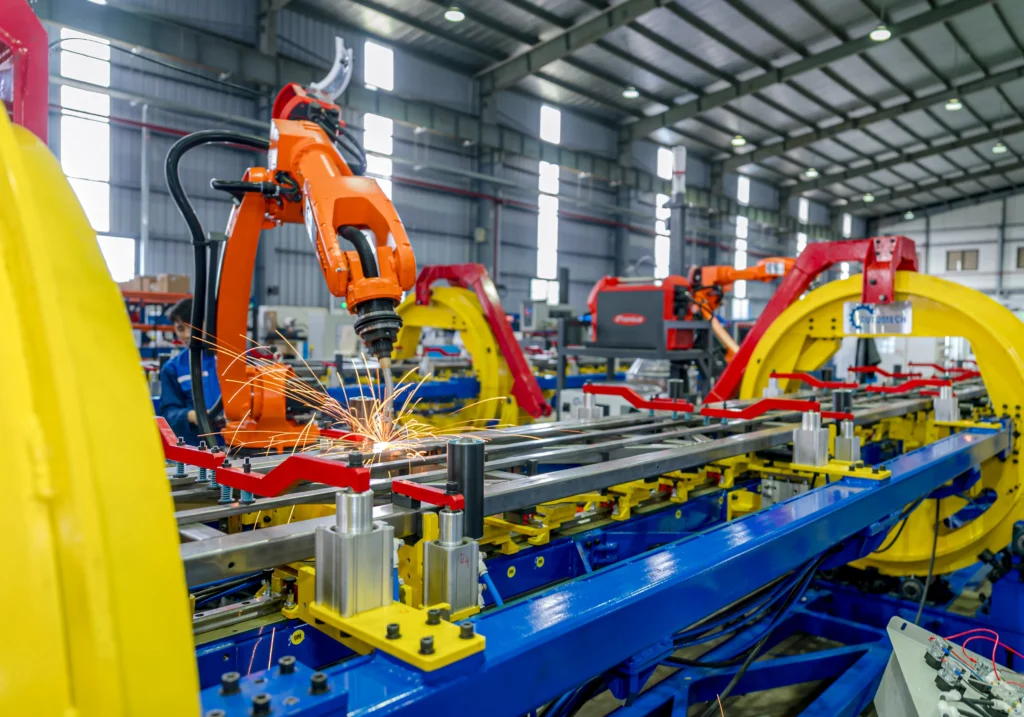
High-speed KUKA articulation robots enhancing production efficiency for a tier-1 Automotive Stamping Partner Vietnam
1.1.1 Increasing demand for localized automotive component sourcing
Automotive OEMs and Tier 1 suppliers are restructuring their fulfillment networks to prioritize geographical diversification and local-for-local assembly models. Relying on centralized, single-source international hubs introduces catastrophic vulnerabilities. Modern procurement strategies favor suppliers that can integrate seamlessly into regional manufacturing networks, drastically compressing lead times and minimizing maritime transit risks. The core drivers behind this localized sourcing push include:
-
Escalating transoceanic freight costs and unpredictable shipping corridor disruptions.
-
The expansion of localized Electric Vehicle (EV) assembly plants requiring agile regional component infrastructure.
-
Aggressive domestic content regulations and localization targets mandated by global trade pacts.
-
The critical need to reduce safety stock overhead through just-in-time (JIT) fulfillment cycles.
1.1.2 China+1 strategy reshaping global procurement decisions
The “China+1” strategy is now a permanent structural blueprint for tier-one automotive procurement. Global enterprises are balancing their primary manufacturing assets by establishing secondary or tertiary production footprints across alternative, high-capability Asian nations. This geographical hedging mitigates direct exposure to trade friction, targeted import tariffs, and regional industrial capacity constraints.
Vietnam has emerged as a primary beneficiary of this procurement shift, providing an established industrial infrastructure, highly specialized labor, and direct maritime access to Western markets without the associated trade friction.
1.2 Why buyers search for an automotive stamping partner in Vietnam
International procurement teams look to Vietnam because the regional manufacturing base has transitioned from producing low-complexity hardware to engineering high-precision, structural automotive components.
1.2.1 Need for long-term manufacturing partnerships
Automotive component production runs typically span several years, requiring major capital expenditure for tooling, optimization, and validation. Buyers require more than standard component suppliers; they need long-term manufacturing partners capable of supporting continuous product engineering changes, capital-intensive new product introductions (NPI), and programmatic volume scaling over a multi-year program lifecycle.
1.2.2 Focus on quality, scalability, and supply chain resilience
A qualified stamping partner must deliver unyielding part quality and structural reliability. In the high-volume automotive sector, a supplier’s operational resilience is directly tied to their scalability and strict adherence to global automotive quality frameworks. Western buyers favor partners who demonstrate proactive risk management, robust raw material sourcing pipelines, and scalable capital equipment assets that can adjust to fluctuating consumer market demands.
2. What Is an Automotive Stamping Partner?
2.1 Definition of an automotive stamping partner
Automotive Stamping Partner Definition: An automotive stamping partner is a specialized, contract manufacturing organization engineered to design, tool, and mass-produce high-precision stamped metal components, structural body-in-white (BIW) elements, and sub-assemblies. Beyond raw component production, a true strategic partner delivers advanced co-engineering, automated progressive and transfer tooling development, strict IATF 16949 quality compliance, and integrated supply chain management to continuously optimize total cost of ownership (TCO) for global automotive OEMs and Tier 1 suppliers.
2.1.1 Difference between a supplier and a manufacturing partner
Understanding the distinction between a transactional component vendor and an engineering-focused manufacturing partner is critical for procurement long-term success:
| Operational Dimension | Traditional Component Supplier | Strategic Manufacturing Partner |
| Engagement Model | Transactional, print-to-order execution | Collaborative, early-stage Design for Manufacturing (DFM) |
| Tooling Competence | Outsourced die production and basic maintenance | In-house tooling design, progressive die engineering, and lifecycle optimization |
| Quality Architecture | Basic reactive inspections (ISO 9001) | Proactive automotive core tool integration (IATF 16949, PPAP Level 3, APQP) |
| Value-Add Capability | Stamped blank parts only | Integrated secondary processes (Robotic welding, assembly, surface treatment) |
| Supply Chain Role | Commodity vendor vulnerable to substitution | Embedded tier partner optimizing long-term TCO and capacity |
2.1.2 Strategic role in OEM and Tier supplier supply chains
Stamping partners form the structural backbone of automotive manufacturing. The components they produce—ranging from minor electrical terminals to critical chassis reinforcements—impact vehicle structural rigidity, crashworthiness, and overall safety systems. By integrating a partner early into the design phase, OEMs can optimize material utilization rates, execute advanced nesting strategies, and eliminate manufacturing defects before mass stamping tool fabrication begins.
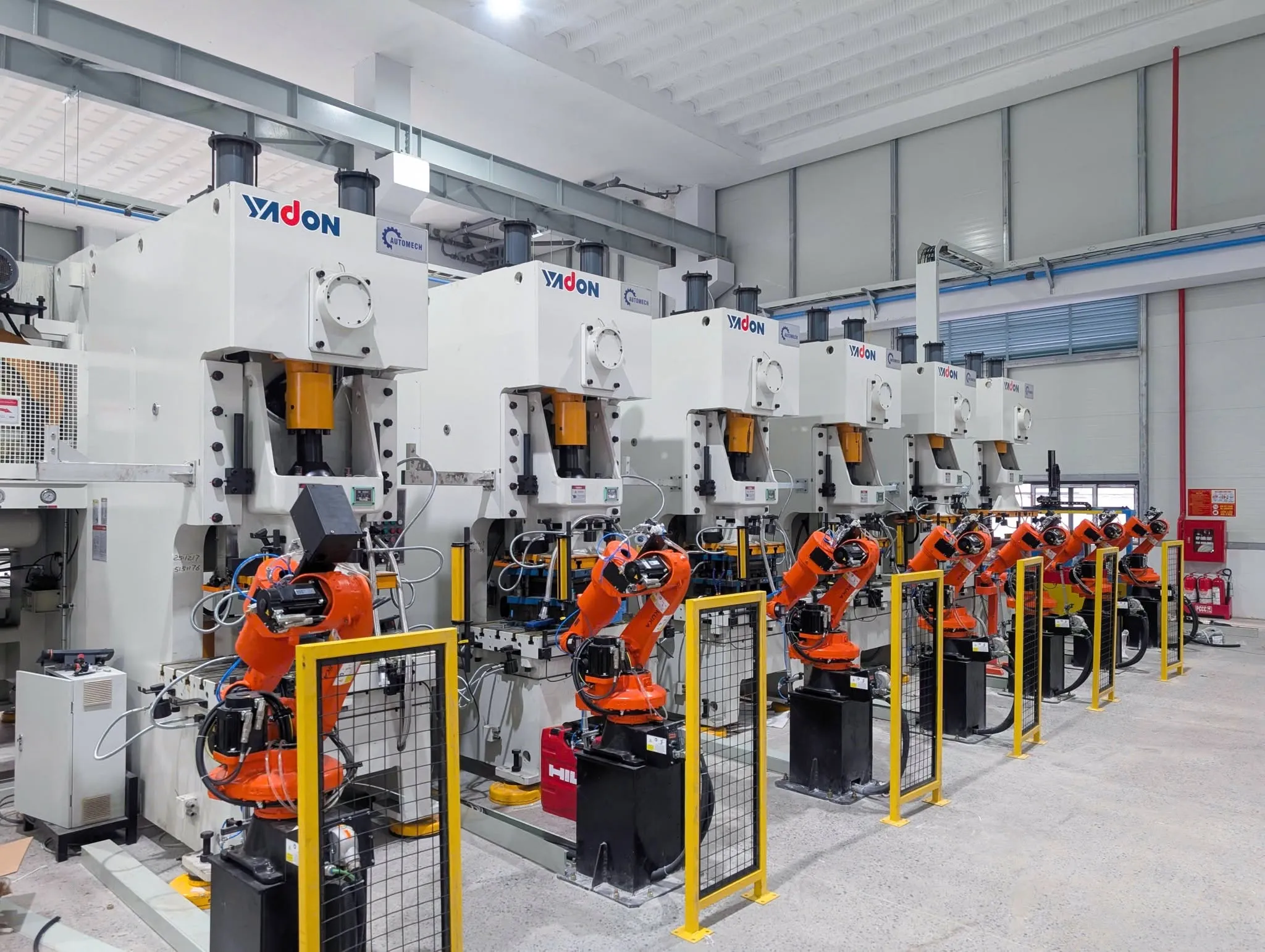
Fully automated metal pressing line integrated with precision robotic arms at a premier Automotive Stamping Partner Vietnam
2.2 Why OEMs prefer long-term stamping partners
2.2.1 Reduced sourcing risk
Migrating automotive stamping dies between factories is an expensive, high-risk process that can cause production line stops and dimensional non-conformance. Long-term partnerships protect OEMs from the operational disruption of supplier churn, ensuring that specialized tooling remains preserved, correctly calibrated, and running efficiently within a single certified facility throughout the vehicle platform’s multi-year lifespan.
2.2.2 Better cost and quality control
A stable, multi-year relationship allows both parties to amortize capital-intensive tooling investments effectively. It opens opportunities for continuous improvement initiatives, value engineering, and process optimizations that lower per-piece costs while driving down PPM (Parts Per Million) defect rates through statistical consistency.
3. Global Automotive Metal Stamping Industry Overview
3.1 Growth of automotive metal stamping worldwide
Despite the increasing use of advanced structural composites, metal stamping remains the most cost-effective method for high-volume, structural automotive component manufacturing. The global market continues to expand, driven by new engineering requirements from modern vehicle platforms.
3.1.1 EV manufacturing expansion
The rapid shift toward battery electric vehicles (BEVs) has transformed structural metal stamping requirements. EVs require specialized, close-tolerance stamped components to protect high-voltage electrical architectures and integrate massive battery packs safely into the vehicle chassis. Key growth areas include:
-
Precision-stamped aluminum and ultra-high-strength steel battery enclosures and structural housings.
-
Busbars, high-conductivity copper terminals, and complex electrical distribution brackets.
-
Heavy-gauge motor housing mounts and specialized structural reinforcement crossmembers.
3.1.2 Lightweight vehicle design requirements
To extend EV range and optimize internal combustion engine (ICE) fuel efficiency, modern vehicle platforms rely on advanced lightweighting strategies. This requires stamping partners capable of forming thinner, high-performance structural materials without sacrificing component tensile strength or crash energy absorption properties.
3.2 Future trends in automotive stamping
3.2.1 Advanced high-strength steel adoption
The adoption of Advanced High-Strength Steel (AHSS) and Ultra-High-Strength Steel (UHSS), such as dual-phase (DP) and martensitic steels, is increasing rapidly. These materials allow for thinner wall profiles while improving crash safety ratings. However, dapping AHSS requires significant engineering expertise to manage extreme press forces, accelerated die wear, and severe material springback challenges.
3.2.2 Smart manufacturing and automation
The global stamping industry is rapidly implementing industrial IoT (IIoT) frameworks. Modern pressing facilities integrate acoustic emission sensors, real-time tonnage monitors, and automated vision inspection arrays directly into the tool layout. This data-driven approach shifts maintenance from reactive schedules to predictive models, maximizing uptime and achieving stable, repeatable dimensional execution.
4. Automotive Metal Stamping Manufacturing Process
4.1 Overview of automotive stamping workflow
Automotive metal dapping is a highly engineered, multi-stage manufacturing sequence that transforms flat sheet metal or coiled stock into complex three-dimensional components with micro-level accuracy.
[Material Preparation] ➔ [Tooling & Die Setup] ➔ [Stamping Production] ➔ [Inspection & Assembly]
4.1.1 Material Preparation
Production begins with strict material inspection and validation. Coiled metal or sheared blanks are uncoiled, flattened, and cleaned through automated feed systems. Engineers verify material certificates (MTRs) to confirm chemical composition, yield strength, tensile elongation, and thickness tolerances comply with specific OEM engineering standards.
4.1.2 Tooling Setup
The precision-engineered die set is mounted into the press bed and ram assembly. Specialized technicians utilize hydraulic die-clamping systems and precision alignment pins to ensure perfect concentricity between the upper punch and lower die cavity. Tonnage monitors and proximity sensors are calibrated to prevent tool damage and track press force distribution across the tool footprint.
4.1.3 Stamping Production
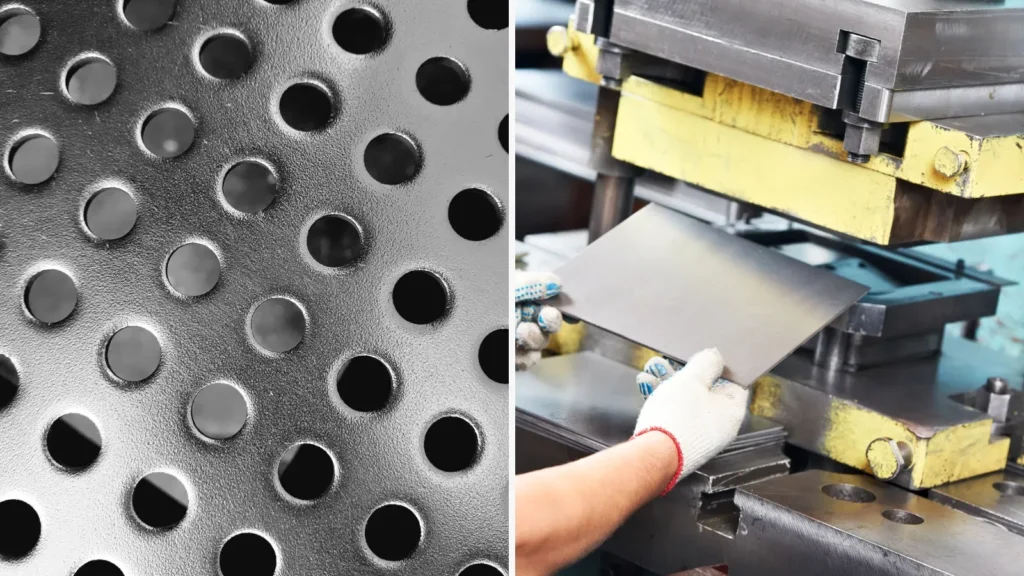
Once automated progression parameters are verified, the press cycle begins. Mechanical or servo-driven rams exert hundreds of tons of force, driving the metal through a pre-engineered sequence of actions:
-
Blanking: Shearing the outer perimeter profile out of the raw stock.
-
Piercing: Punching internal holes, slots, or precise geometric openings.
-
Forming/Drawing: Deeply stretching the metal over a die cavity to construct complex three-dimensional contours.
-
Bending: Shaping straight-line angles and structural flanges.
-
Coining: Exerting extreme localized pressure to thin or compress the material, coining highly accurate, structural surface details.
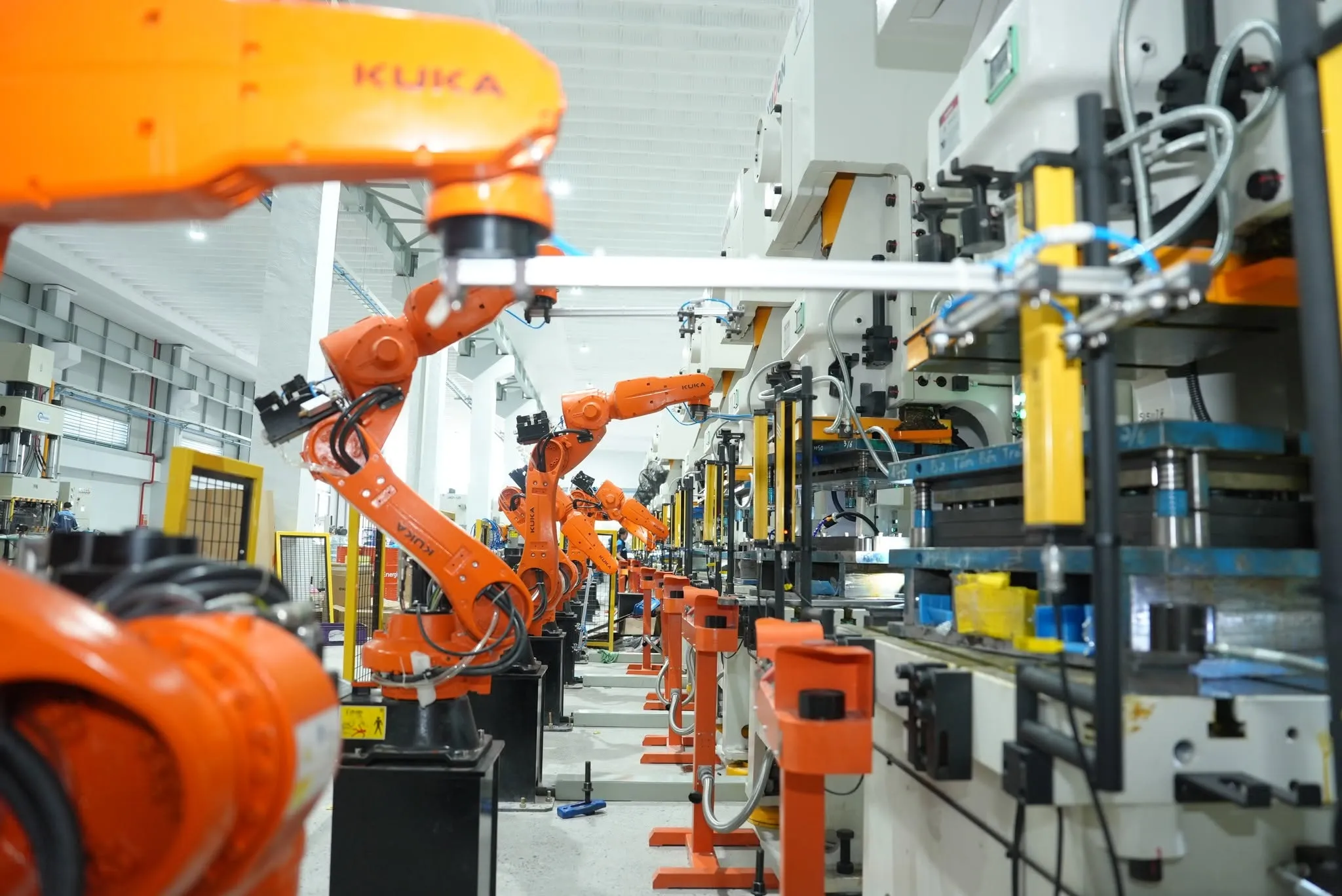
Modern CNC vertical machining center floor layout engineered for high volume by a top-tier Automotive Stamping Partner Vietnam
4.1.4 Inspection and Assembly
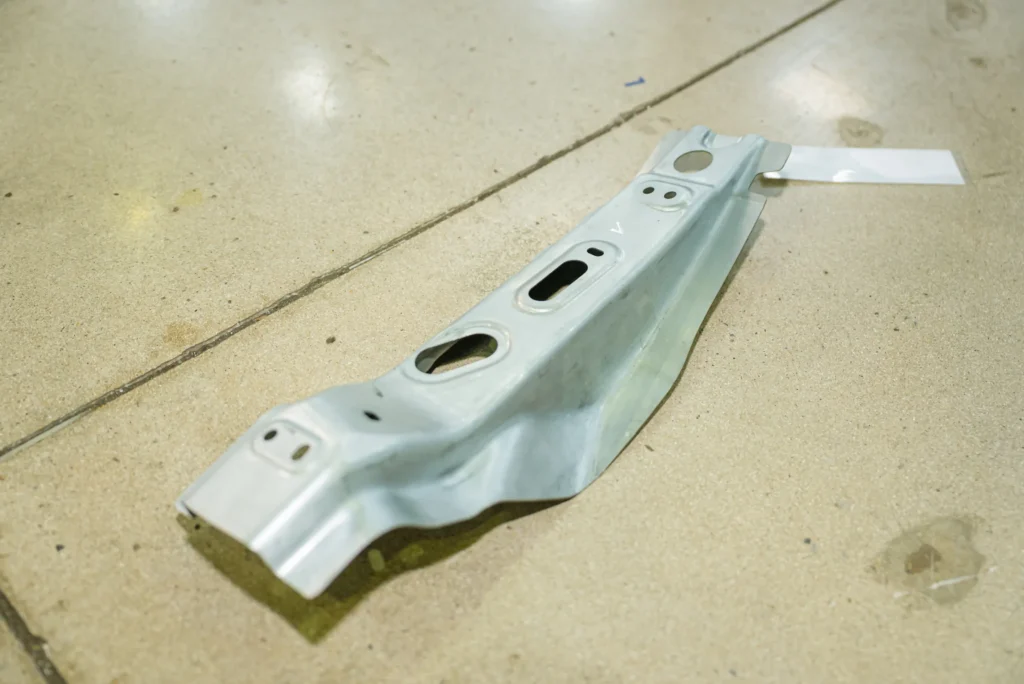
Stamped parts exit the press line via automated conveyors for automated inline quality gating or manual inspection. Components undergo dimensional checking via Coordinate Measuring Machines (CMM) and blue-light 3D scanning. Approved components then proceed to integrated downstream processes, such as automated hardware insertion, robotic structural welding, or specialized surface finishing.
4.2 Types of automotive stamping processes
Selecting the correct stamping method depends on production volume, part complexity, material type, and the target capital expenditure budget.
4.2.1 Sheet Metal Stamping
Sheet metal stamping covers standard single-stage stamping procedures where pre-sheared metal blanks are manually or robotically loaded into a single-operation press. This methodology is ideally suited for lower-volume production runs, structural prototypes, or oversized, heavy-gauge components that cannot be easily fed from continuous coil lines.
4.2.2 Progressive Die Stamping
Progressive die stamping feeds a continuous metal coil through a sequential series of integrated inline workstations housed within a single die set. Each stroke of the press executes a distinct stamping operation on the strip. The part stays attached to the material carrier strip as it progresses through the die, with a finished part completed and cut free with every press stroke. This approach is the industry standard for high-efficiency, high-volume automotive production.
4.2.3 Transfer Die Stamping
Unlike progressive systems, transfer die stamping detaches the raw blank from the metal strip during the initial station. Mechanical transfer arms or automated gripper rails then transport the loose component through a series of separate, sequential die stations within a single large-bed press or across an integrated press line. This process is necessary for complex, deep-drawn geometries, oversized parts, or components requiring multi-angled structural flanging.
4.2.4 Tandem Stamping Process
Tandem stamping uses a series of independent, physically distinct presses arranged in a sequential line, interconnected by automated robotic material handlers. The component is moved automatically from press to press. Tandem configurations offer excellent manufacturing flexibility for oversized structural body panels, car doors, hoods, and roof assemblies that require significant physical clearance and distributed tonnage footprints.
5. Progressive Die Stamping in Automotive Manufacturing
5.1 What is progressive die stamping?
Progressive die stamping represents the highest tier of manufacturing efficiency for close-tolerance, high-volume automotive hardware.
5.1.1 Continuous Production Process
The defining characteristic of progressive die stamping is its continuous, automated workflow. By integrating feeding, indexing, multi-stage forming, and final part singulation into a single synchronized machine cycle, the process minimizes manual part intervention, lowers internal cycle times, and eliminates the scrap variance common in multi-machine setups.
[Continuous Metal Coil Feed]
       ↓
[Station 1: Precision Piercing]
       ↓
[Station 2: Pilot Hole Indexing]
       ↓
[Station 3: Progressive Forming & Bending]
       ↓
[Station 4: Final Coining & Calibration]
       ↓
[Station 5: Automated Blank Cut-Off] ➔ [Finished Automotive Part]
5.1.2 High-Volume Automotive Applications
This manufacturing methodology is critical for structural and functional automotive components that require millions of highly repeatable units over a platform’s lifecycle. Typical applications include:
-
Structural body reinforcements and chassis brackets.
-
Seat track components, safety belt anchors, and mechanisms.
-
EV battery module straps, cell dividers, and precision busbars.
-
Engine, transmission, and powertrain mounting plates.
5.2 Benefits for OEM production
5.2.1 Higher productivity
Progressive setups operate at significantly higher stroke speeds (RPM) than transfer or tandem press configurations. The fully automated material feed system runs continuously, lowering direct labor costs, maximizing machine utilization rates, and allowing procurement teams to meet tight JIT production schedules with minimal safety stock.
5.2.2 Consistent dimensional accuracy
Because the workpiece remains securely locked to the carrier strip and indexed by precision pilot pins throughout the entire forming cycle, process variation is drastically reduced. This mechanical stability ensures tight, repeatable dimensional tolerances across massive production volumes, keeping assembly line reject rates near zero.
6. Automotive Stamping Assembly Process
6.1 Stamped part sub-assembly
To add maximum value for global Tier 1 and OEM buyers, advanced automotive stamping factories integrate comprehensive sub-assembly lines directly downstream from the primary press beds.
6.1.1 Welding assembly systems
High-quality structural stamping components frequently require integration with secondary components like threaded fasteners, structural reinforcing plates, or adjacent stamped parts. Factories utilize multiple industrial welding methodologies to guarantee structural performance:
-
Resistance Spot Welding (RSW): Ideal for fast, highly repeatable joining of structural sheet metal sheets and BIW assemblies.
-
MIG/TIG Welding: Used for thick structural brackets, chassis components, and heavy-duty suspension mounts requiring deep weld penetration.
-
Projection Welding: Applied to attach heavy-duty threaded nuts, structural studs, and mounting fasteners to stamped brackets with high accuracy.
6.1.2 Robotic joining technologies
Automated multi-axis robotic arms handle the positioning, clamping, and welding of complex stamped sub-assemblies. Robotic integration eliminates human operator variance, guarantees consistent weld bead geometry, and optimizes cycle times. These automated cells feature integrated vision inspection systems and inline quality checks to verify structural joint integrity in real time.
6.2 Integration into BIW manufacturing
Body-in-White (BIW) manufacturing refers to the stage where a vehicle’s sheet metal structural components are assembled into the core safety frame before paint and powertrain integration.
6.2.1 Body structure assembly
Oversized stamped assemblies form the protective shell and structural backbone of the modern vehicle. This includes critical structural elements such as:
-
A, B, and C-pillars that support the roof structure and manage crash energy.
-
Front and rear floor pan assemblies that form the interior cabin base.
-
Side-impact door reinforcement beams and impact protection structures.
-
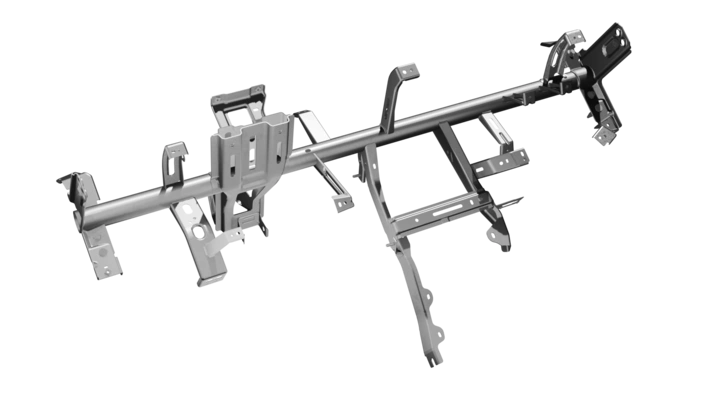
Cross-car structural beams and dashboard support assemblies.
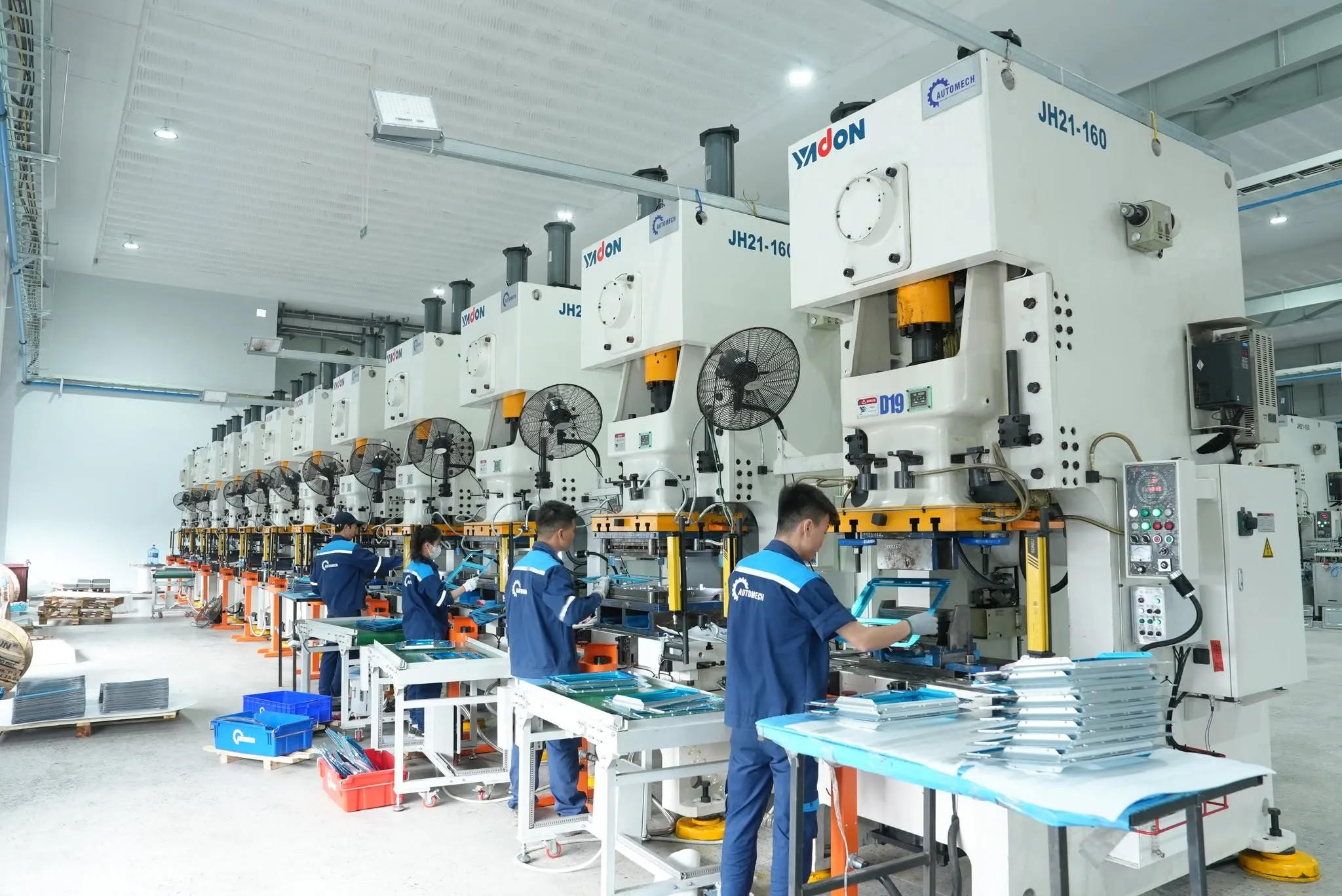
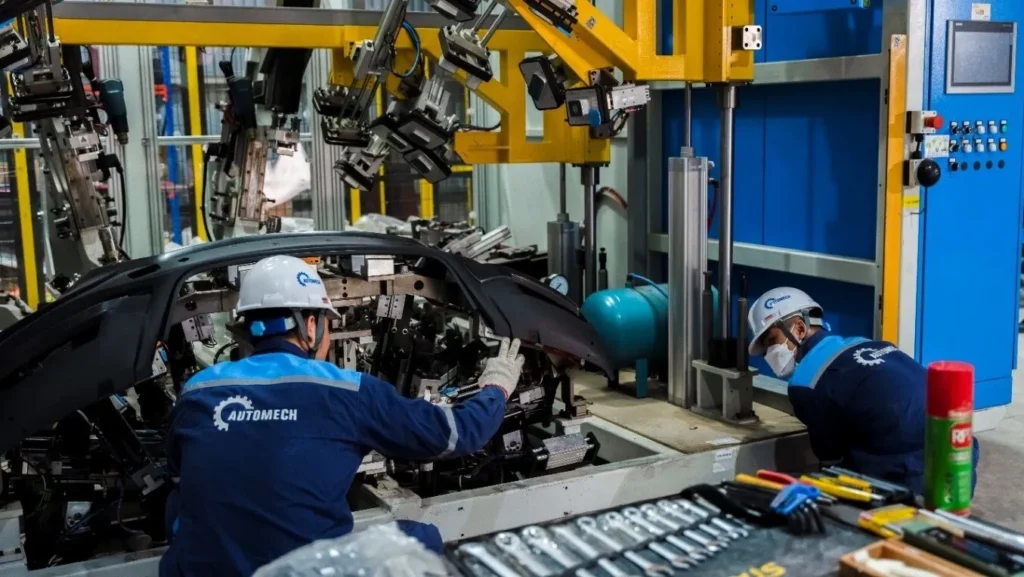
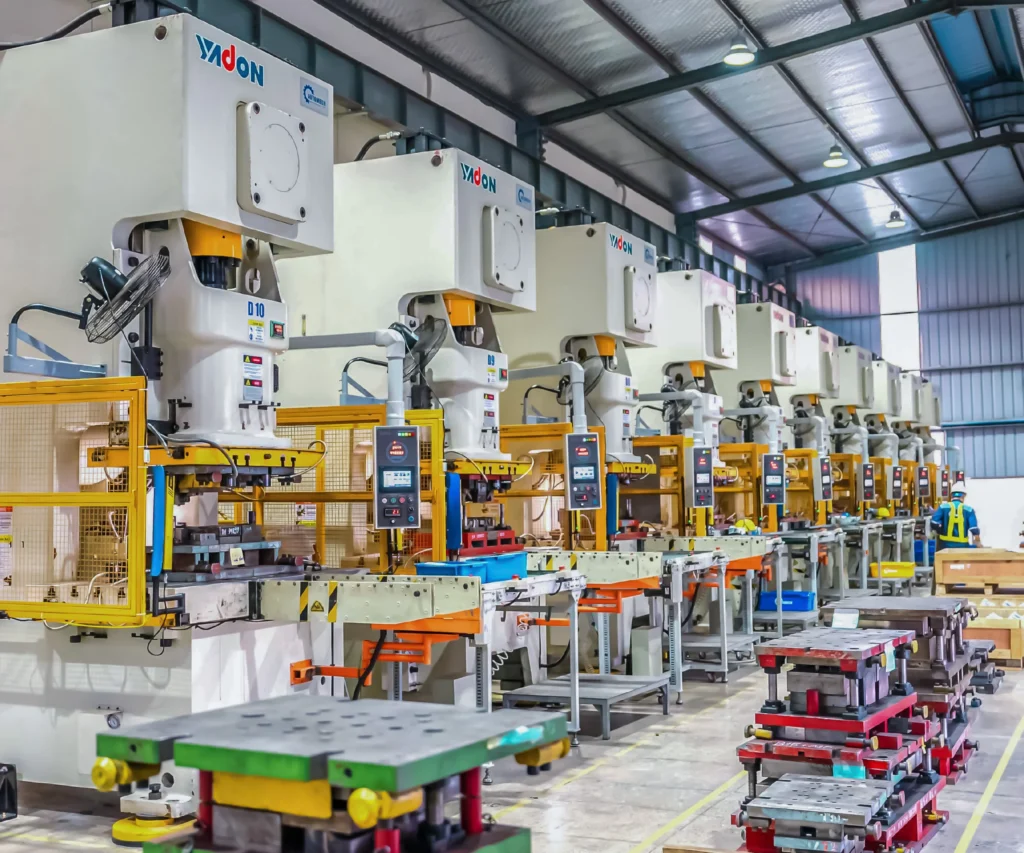
Skilled technicians operating Yadon JH21-160 heavy stamping presses at an advanced Automotive Stamping Partner Vietnam facility
6.2.2 Automotive structural component production
Structural stamping components must deliver unyielding durability and exact dimensional fidelity. If a stamped structural bracket deviates by even a fraction of a millimeter, automated downstream robotic assembly lines can stall, resulting in costly OEM production delays. Leading contract manufacturers invest heavily in precise checking fixtures and automated coordinate measurement systems to guarantee smooth integration at the OEM’s assembly plant.
7. Materials Used in Automotive Stamping
Selecting the right material requires balancing structural part performance, overall vehicle weight targets, corrosion risks, and manufacturing cost limitations.
                   [Automotive Stamping Materials]
                                 │
         ┌───────────────────────┼───────────────────────┐
         ▼                       ▼                       ▼
   [Mild Steel]          [AHSS / UHSS]              [Aluminum]
  • High Formability    • Crash Performance        • EV Lightweighting
  • Cost-Effective      • Weight Reduction         • Corrosion Resistance
  • Brackets/Mounts     • Reinforcements/BIW       • Battery Enclosures
7.1 Mild steel applications
7.1.1 Cost-effective structural parts
Mild steel continues to be a foundational material for non-critical structural components where raw material cost efficiency and exceptional formability are the primary engineering priorities.
7.1.2 General automotive applications
Mild steel grades are commonly utilized in components exposed to lower structural stress profiles, including interior dashboard brackets, floor pan reinforcements, seat frame components, deep-drawn fluid pans, and simple mounting covers.
7.2 High-strength steel and AHSS
7.2.1 Crash performance requirements
Advanced High-Strength Steel (AHSS) and Ultra-High-Strength Steel (UHSS) are essential for modern vehicle safety architectures. These materials feature tailored microstructure profiles that deliver high yield strengths and exceptional energy absorption during a collision, making them ideal for protective passenger cabin structures.
7.2.2 Weight reduction strategies
By switching components from thick mild steel to thinner, high-tensile AHSS grades, automotive engineers can shave substantial weight off the vehicle frame without sacrificing structural rigidity or crash safety. This lightweighting capability is critical for extending the battery range of electric vehicles.
7.3 Aluminum automotive components
7.3.1 EV lightweighting initiatives
Aluminum alloys (typically the 5000 and 6000 industrial series) are increasingly used in EV architectures to offset the massive weight of large battery packs. Aluminum dapping requires deep process expertise to manage the material’s lower elongation limits and high susceptibility to surface marring or cracking during tight radius bending.
7.3.2 Corrosion resistance advantages
Aluminum naturally forms a protective oxide layer, providing superior corrosion resistance compared to uncoated steel options. This makes it the preferred material choice for components exposed to harsh environmental conditions, such as structural EV battery trays, thermal management heat sinks, and exterior body panels.
8. Automotive Tooling & Die Systems
The tooling architecture is the foundation of structural quality in automotive stamping. A factory’s engineering expertise is directly reflected in its capability to design, simulate, machine, and maintain complex stamping dies in-house.
8.1 Automotive die manufacturing
8.1.1 Progressive dies
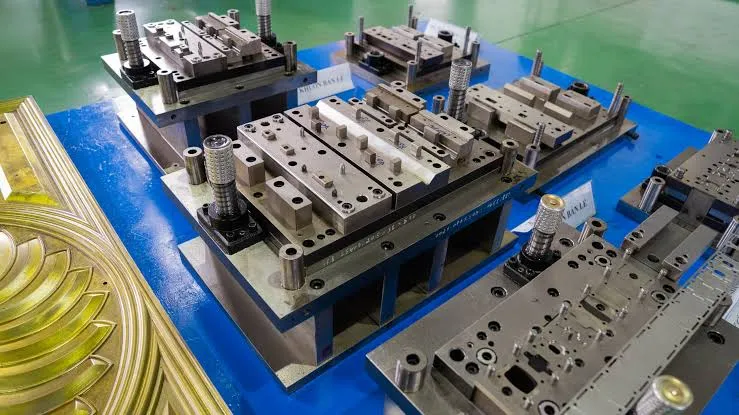
Manufacturing high-performance progressive dies requires advanced computer-aided design and simulation tools (such as AutoForm or PAM-STAMP) to model material flow and predict localized thinning or springback behavior. The die blocks are machined from premium, wear-resistant tool steels (like D2, DC53, or tungsten carbide inserts) using high-precision CNC machining centers and wire electrical discharge machining (EDM) to ensure exact dimensional accuracy.
8.1.2 Transfer dies
Transfer die tooling configurations require precise coordination between the mechanical press stroke and the automated vacuum or pneumatic part-transfer systems. Tool engineers design individual standalone die stations that integrate seamlessly with automated transfer arms, allowing complex three-dimensional parts to be turned, flipped, or repositioned efficiently between press cycles.
8.2 Tool maintenance and lifecycle management
8.2.1 Preventive maintenance
To guarantee uninterrupted production and consistent component quality across massive high-volume automotive programs, factories implement rigid, data-driven preventive maintenance protocols:
-
Scheduled Sharpening: Regular grinding of die cutting edges to eliminate burrs and minimize part truncation deviations.
-
Polishing Draw Surfaces: Continuous cleaning of internal forming radii to prevent galling and material scoring defects.
-
Critical Fastener & Spring Inspections: Systematic replacement of nitrogen gas springs, stripper bolts, and internal guide bushings to prevent tool misalignment.
8.2.2 Tool performance optimization
Advanced manufacturing partners track lifetime tool performance using specialized software dashboards. By documenting real-time press tonnage variations and executing systemic wear-pattern audits, engineering teams can optimize die coatings (such as TD or PVD treatments) and proactively upgrade tool designs, maximizing die longevity and lowering total lifecycle tool costs for the OEM.
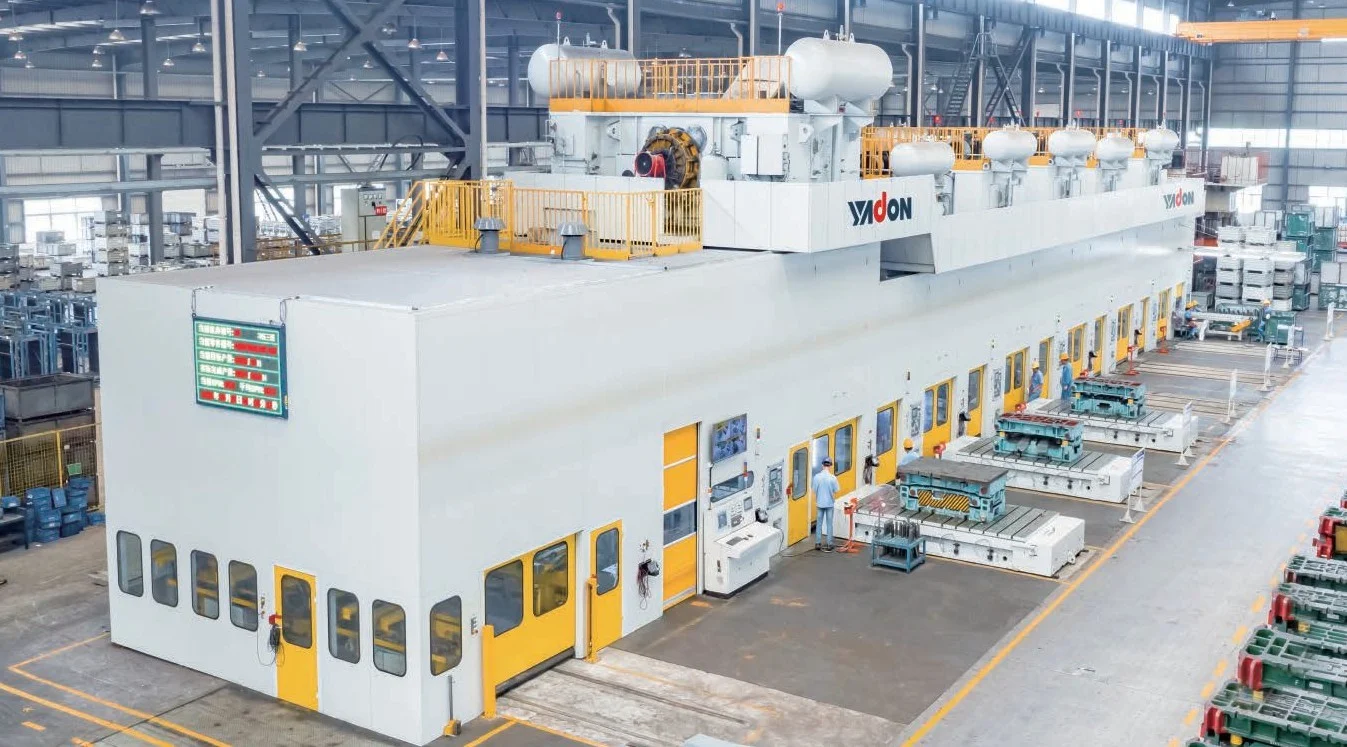
Streamlined lean manufacturing workspace and systematic material storage inside a world-class Automotive Stamping Partner Vietnam
9. Quality Standards for Automotive Stamping Suppliers
The automotive industry enforces strict quality compliance frameworks. Sourcing teams look for stamping partners with complete corporate transparency and documented adherence to global manufacturing standards.
9.1 ISO 9001 manufacturing systems
9.1.1 Process Consistency
ISO 9001 establishes the foundational baseline for corporate quality management, ensuring the organization operates with clear, well-documented operational procedures, standardized workforce training programs, and a repeatable framework for general manufacturing execution.
9.1.2 Continuous Improvement
The core philosophy of ISO 9001 relies on the Plan-Do-Check-Act (PDCA) cycle. This structure requires factories to audit their production workflows systematically, trace operational waste, and implement corrective actions that continuously optimize internal manufacturing capabilities.
9.2 IATF 16949 automotive requirements
9.2.1 OEM supplier qualification
The IATF 16949 certification represents the global benchmark for automotive manufacturing quality. It builds upon ISO 9001 by introducing stringent, industry-specific requirements that target the global automotive supply chain. For global OEMs and Tier 1 procurement teams, valid IATF 16949 certification is a mandatory prerequisite before a supplier can be considered for a production program.
9.2.2 Automotive quality compliance
IATF 16949 focuses heavily on risk management, defect prevention, and the systematic reduction of variation and waste within the automotive supply chain. Compliance ensures that a stamping partner has implemented robust traceability protocols, linking finished components back to their original raw material heat lot.
9.3 Automotive Core Tools
To achieve complete compliance with IATF 16949 standards, automotive stamping partners must deeply integrate the five Automotive Core Tools into their operational workflows.
       [APQP: Advanced Product Quality Planning]
                           │
       [FMEA: Failure Mode & Effects Analysis]
                           │
             [MSA: Measurement Systems Analysis]
                           │
               [SPC: Statistical Process Control]
                           │
     [PPAP: Production Part Approval Process (Level 3)]
9.3.1 PPAP Implementation
The Production Part Approval Process (PPAP) provides formal verification that the supplier fully understands the customer’s engineering design specifications and requirements. Stamping partners must routinely deliver comprehensive PPAP Level 3 documentation, including design records, material test certifications, dimensional results, and initial process capability studies, before moving to mass production.
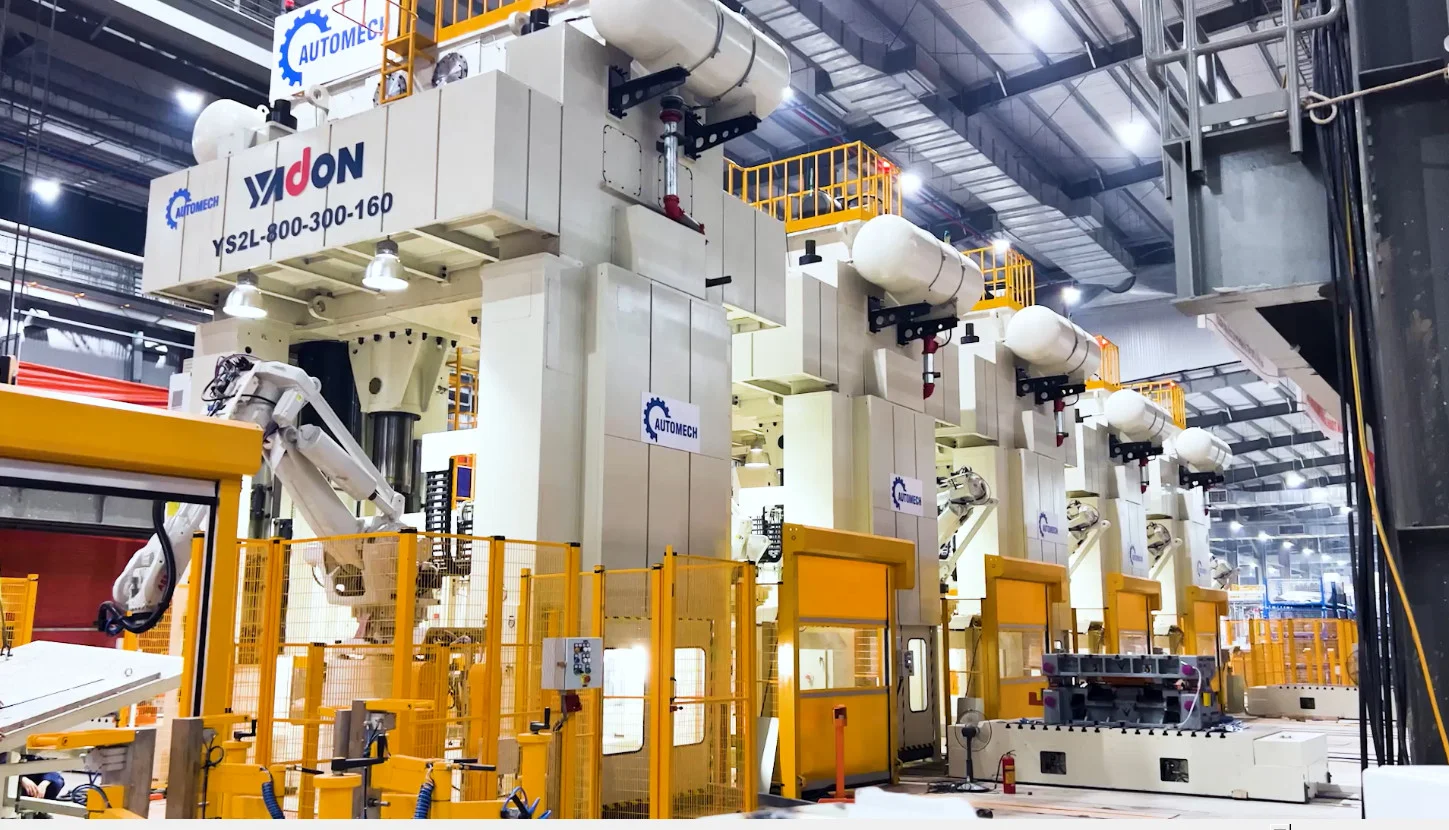
Advanced CNC bending station paired with robotic automation at a world-class Automotive Stamping Partner Vietnam
9.3.2 APQP Planning
Advanced Product Quality Planning (APQP) provides a structured product development framework that spans from initial design concepts through formal mass production launch. It ensures cross-functional engineering teams collaborate to address potential production bottlenecks, align verification testing schedules, and secure operational readiness ahead of milestone deadlines.
9.3.3 FMEA Risk Management
Failure Mode and Effects Analysis (FMEA)—specifically Process FMEA (PFMEA)—is utilized to systematically evaluate potential manufacturing process failures before they occur. Tooling engineers analyze potential failure risks, evaluate their severity, and implement preventative engineering controls to eliminate production defects.
9.3.4 SPC Process Control
Statistical Process Control (SPC) leverages mathematical tracking methods to monitor production process stability in real time. By tracking critical-to-quality (CTQ) dimensions via automated control charts, quality teams can detect minor process drift and adjust tooling configurations before a component deviates from print tolerances.
10. Automotive Supply Chain Requirements
10.1 OEM sourcing expectations
10.1.1 Quality Assurance
Automotive OEMs operate with razor-thin margins and tight production timelines; they expect their stamping partners to maintain near-zero PPM defect rates. Suppliers must back their quality claims with real-time digital documentation, automated vision inspection arrays, and complete material heat-lot traceability.
10.1.2 Delivery Performance
Sourcing teams require 100% on-time delivery performance to support Just-In-Time (JIT) assembly lines. This requires stamping partners to maintain highly accurate ERP management tracking, reliable regional logistics access, and robust contingency planning to manage unexpected global supply chain disruptions.
10.2 Tier 1 and Tier 2 supplier requirements
10.2.1 Cost Competitiveness
Tier 1 suppliers face continuous price pressure from OEMs. Consequently, contract stamping partners must maintain lean cost structures through high material utilization rates, automated progressive tool designs, and continuous engineering optimizations that eliminate manual labor overhead.
10.2.2 Production Scalability
Automotive platform volumes fluctuate based on shifting consumer demand and economic cycles. Stamping partners must feature scalable manufacturing capacity, ample warehouse facilities to manage sudden volume swings, and the financial stability to invest in additional automated machinery when platform demand increases.
11. Vietnam Automotive Stamping Ecosystem
11.1 Growth of automotive manufacturing in Vietnam
Over the past decade, Vietnam’s industrial sector has transitioned into a high-tech manufacturing hub, driven by pro-business government policies, major global trade agreements, and substantial foreign direct investment.
11.1.1 Expansion of supporting industries
The Vietnamese government has strategically prioritized the growth of domestic supporting industries, particularly precision metalworking, electronics manufacturing, and complex tool-and-die fabrication. This targeted development has built a rich regional network of raw material distributors, heat-treatment centers, and specialized industrial service providers, allowing stamping factories to source materials and services efficiently within the local market.
11.1.2 Increasing localization rates
Major international automotive brands operating within Southeast Asia are actively increasing their domestic localization rates to capitalize on regional trade benefits. This expanding industrial demand has driven local Vietnamese suppliers to upgrade their factory footprints, invest in automated European or Japanese press lines, and secure global quality credentials like IATF 16949.
11.2 Vietnam as an automotive stamping hub
11.2.1 Competitive manufacturing costs
Vietnam offers a highly competitive total cost of ownership compared to traditional manufacturing regions. The country provides stable, competitive labor rates alongside highly efficient factory utility costs and business tax incentives, helping global OEMs improve their manufacturing margins without sacrificing product quality.
11.2.2 Skilled workforce and engineering talent
Vietnam features a young, tech-literate workforce backed by a strong nationwide focus on STEM education and technical training programs. This provides a steady pipeline of highly capable mechanical design engineers, certified CNC technicians, and expert tool-and-die makers who can master advanced manufacturing technologies and handle complex stamping programs.
12. Why Global OEMs Choose Vietnam Automotive Stamping Partners
12.1 Cost and operational advantages
12.1.1 Lower production costs than developed markets
By partnering with an automotive stamping expert in Vietnam, Western buyers can realize significant structural cost reductions. These operating savings span across direct labor costs, tool engineering rates, and factory overhead expenses, enabling OEMs to reinvest their capital into core product design and market expansion.
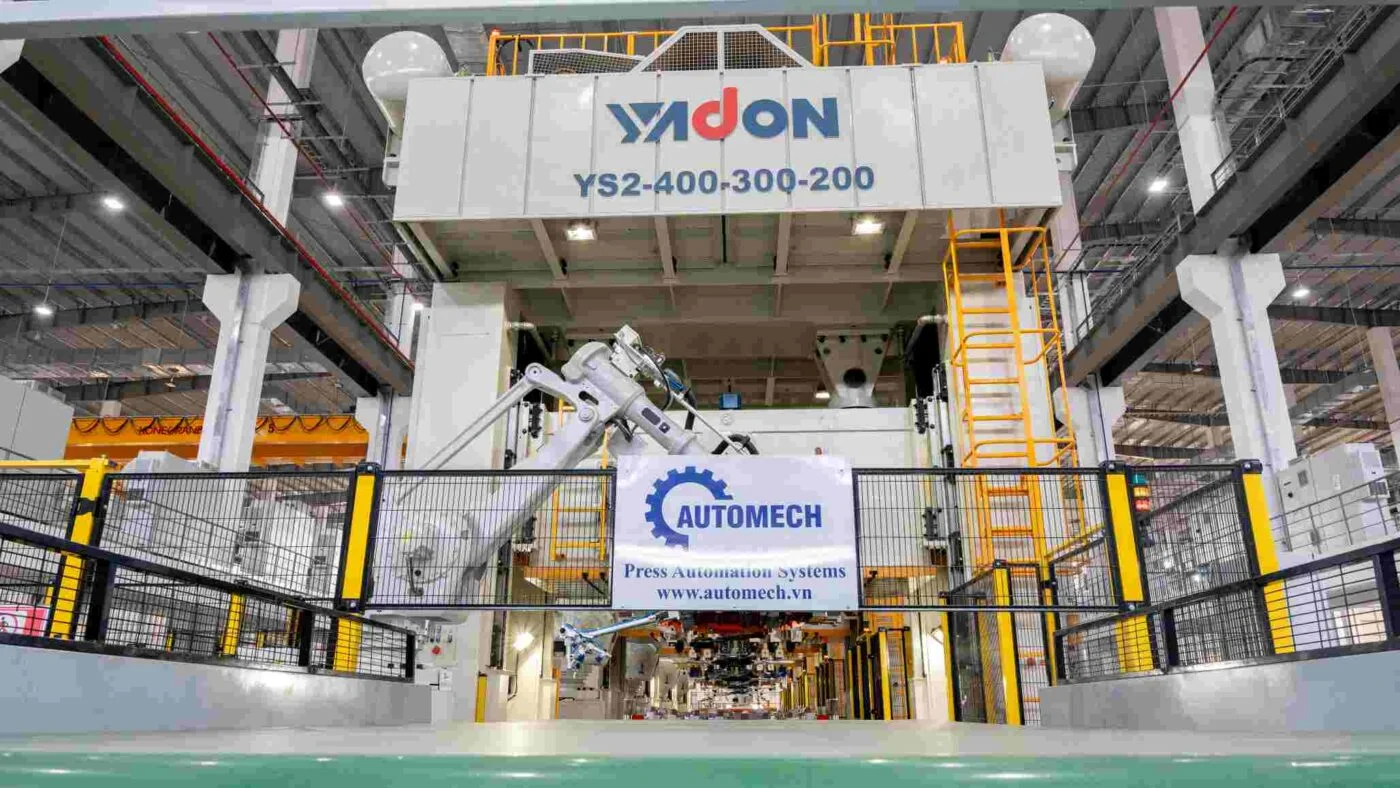
Aerial drone view of the modern manufacturing facility and infrastructure of a global Automotive Stamping Partner Vietnam
12.1.2 Stable manufacturing environment
Vietnam provides a highly stable, secure macroeconomic environment for long-term manufacturing investments. Backed by steady GDP growth, consistent industrial infrastructure investments, and explicit pro-export government policies, international buyers can establish multi-year manufacturing programs with high operational predictability.
12.2 Supply chain diversification benefits
12.2.1 Alternative China stamping supplier strategy
As international brands implement a “China+1” model to diversify their regional operations, Vietnam stands out as the most logical co-sourcing destination. Sharing a direct border with China allows companies to transition or complement their supply chains smoothly, sourcing raw materials or components across the region without operational downtime.
12.2.2 Reduced geopolitical sourcing risks
Sourcing automotive components from Vietnam protects international procurement networks from targeted import tariffs, volatile trade disputes, and restrictive cross-border regulatory barriers. This diversification strengthens long-term supply chain resilience for critical automotive platforms.
12.3 Export advantages for US and Europe
12.3.1 Strong Logistics Network
Vietnam has invested heavily in its logistics infrastructure, building modern deep-water ports (such as Lach Huyen in the north and Cai Mep in the south) alongside comprehensive highway networks that connect industrial zones directly to major shipping hubs. These investments ensure reliable, weekly ocean freight routes to key markets across North America and Europe.
12.3.2 Trade agreement benefits
Vietnam’s extensive network of Free Trade Agreements provides a powerful competitive advantage for Western buyers. Agreements like the European Union-Vietnam Free Trade Agreement (EVFTA) and Comprehensive and Progressive Agreement for Trans-Pacific Partnership (CPPP) dramatically lower or eliminate import tariffs on precision components, reducing total cost of ownership for international buyers.
13. How to Evaluate an Automotive Stamping Partner
Selecting the right automotive manufacturing partner requires an objective, comprehensive evaluation of their technical capabilities, quality systems, and communication support.
13.1 Manufacturing capability assessment
13.1.1 Press capacity evaluation
Sourcing teams must ensure the supplier’s press fleet can handle the specific physical size, thickness, and material grades required for their platform. The evaluation should confirm:
-
A diverse press fleet spanning from high-speed, light-gauge presses to high-tonnage machines (exceeding 800T to 1200T) for structural parts.
-
Modern servo-driven or mechanical configurations equipped with automated coil feeders and scrap management systems.
-
Ample open manufacturing capacity to support unexpected volume increases without production delays.
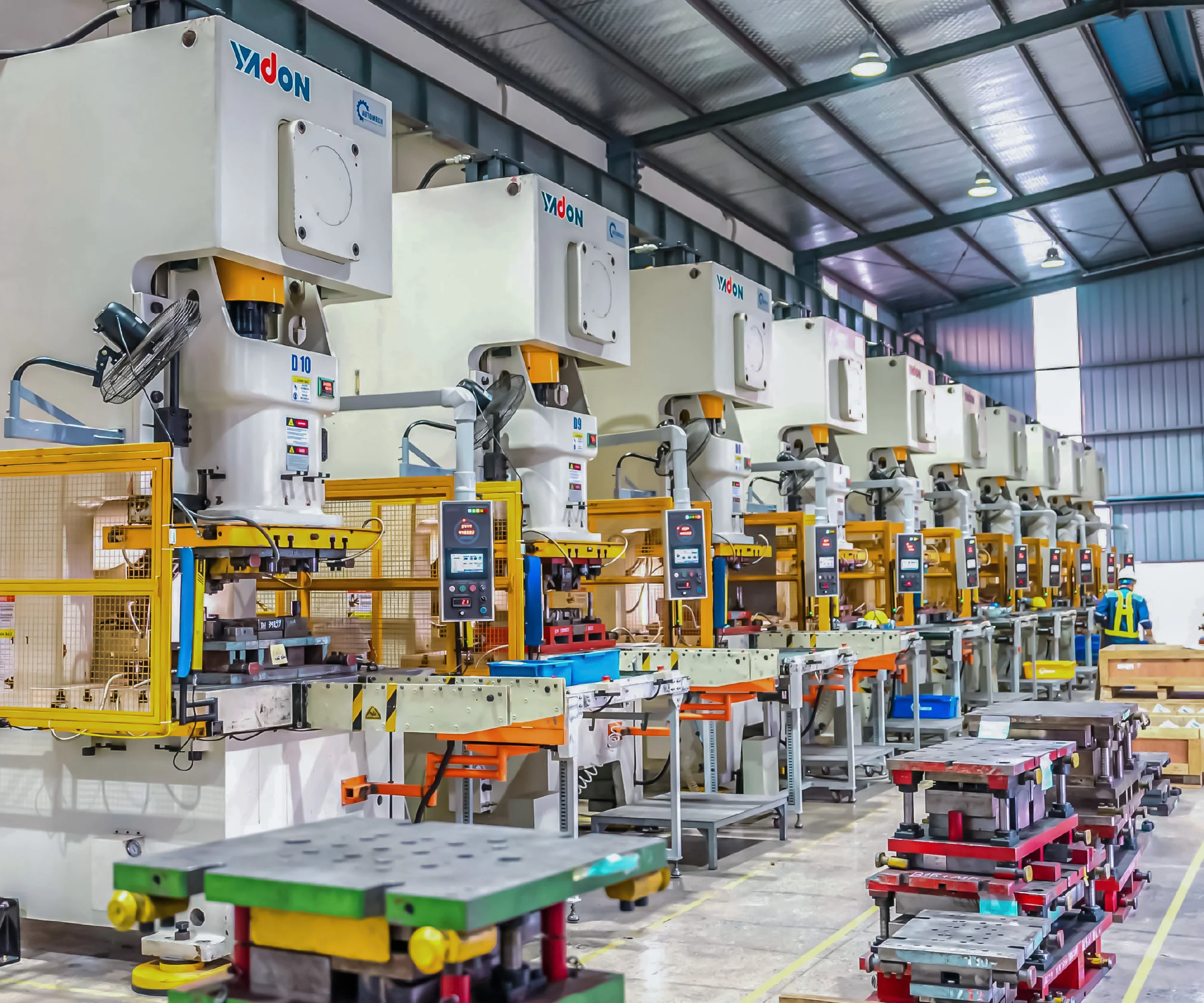
The contemporary, eco-friendly design of a professional production and office complex for an Automotive Stamping Partner Vietnam
13.1.2 Tooling capability review
A supplier’s tooling competence directly impacts long-term part quality and program costs. Procurement teams should prioritize partners who feature comprehensive, in-house tool design and die-making capabilities, backed by automated CNC centers and wire EDM equipment, to ensure responsive tool modifications and reliable lifecycle maintenance.
13.2 Quality system assessment
13.2.1 Certification verification
Review the supplier’s quality credentials directly. Ensure they maintain active, accredited IATF 16949 and ISO 9001 certifications covering the specific facility slated for your production run.
13.2.2 Audit readiness evaluation
A qualified partner should welcome transparent on-site or virtual facility audits. They must demonstrate clean material trace logs, robust lock-out tag-out safety protocols, clear work instructions posted across assembly stations, and a well-equipped quality lab featuring calibrated coordinate measuring machines (CMM).
13.3 Supply chain integration capability
13.3.1 ERP and traceability systems
The partner must leverage advanced Enterprise Resource Planning (ERP) software to coordinate production schedules, monitor raw material inventory levels, and track delivery timelines accurately. They should utilize digital barcode tracking to log finished lots directly back to their raw material mill certificates.
13.3.2 Engineering collaboration support
Premium manufacturing partners add value long before the press cycle begins. Look for suppliers who assign dedicated project managers and technical design engineers to deliver proactive Design for Manufacturing (DFM) guidance, helping optimize component profiles to reduce material waste and lower initial tooling costs.
14. Automotive Stamping RFQ Process
A structured, detailed Request for Quote (RFQ) process is essential for obtaining accurate pricing estimates and avoiding unexpected project costs down the line.
[Gather CAD & GD&T] ➔ [Define Volumes & Material] ➔ [Submit RFQ] ➔ [Review Tooling & Piece Costs] ➔ [PPAP Validation]
14.1 RFQ preparation checklist
14.1.1 CAD files and drawings
Provide comprehensive engineering data packages, including completed 3D CAD step files alongside detailed 2D drawings that clearly define Geometric Dimensioning and Tolerancing (GD&T) expectations, critical-to-quality dimensions, and cosmetic surface standard specifications.
14.1.2 Material specifications
Clearly identify the required raw material grade, including exact international material standards (such as ASTM, DIN, JIS, or ISO designations), tensile strength targets, coating requirements (e.g., galvanized, electro-coated), and preferred surface protection details.
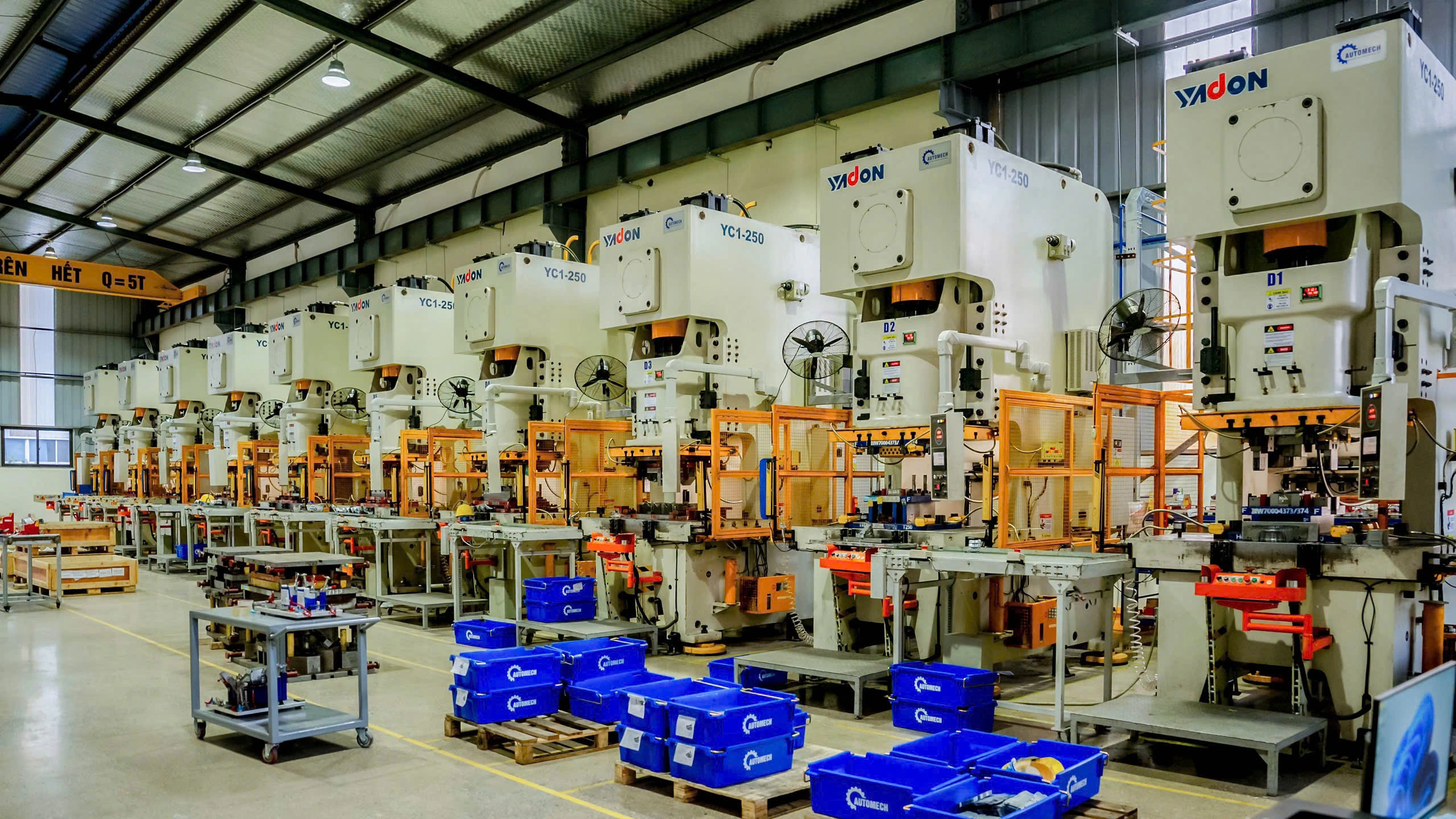
State-of-the-art smart industrial laser cutting equipment utilized by a technology-driven Automotive Stamping Partner Vietnam
14.1.3 Annual volume forecast
Deliver realistic annual volume forecasts alongside expected lifetime program volumes. This visibility allows the stamping partner’s tool engineers to select optimal die configurations (such as single-cavity vs. high-volume multi-cavity progressive layouts) to maximize piece-price cost efficiencies.
14.2 Supplier quotation review
14.2.1 Tooling cost analysis
Evaluate the initial tooling investment transparently. Ensure the quote explicitly details die ownership rights, guaranteed tool lifecycle limits, and comprehensive tool maintenance coverage to avoid future hidden costs.
14.2.2 Piece price comparison
Break down the piece-price estimate into its core components: raw material costs, direct manufacturing machine charges, post-processing expenses, packaging costs, and delivery terms (e.g., FOB or DDP port destinations).
14.3 Production validation process
14.3.1 Sample submission
Following initial tool fabrication, the partner runs initial samples on the production line. These initial parts are sent to the customer alongside complete dimensional layout reports to confirm the tooling delivers parts that match print specifications.
14.3.2 PPAP Approval
The partner completes a comprehensive PPAP Level 3 submission, providing absolute proof that the manufacturing process is fully capable of maintaining stable, repeatable quality standards under mass production conditions.
14.3.3 SOP Launch
Upon receiving formal PPAP approval, the project transitions to Start of Production (SOP). The stamping partner coordinates logistics pipelines to feed components smoothly into the customer’s downstream assembly facilities.
15. Trusted Automotive Stamping Partner in Vietnam – Automech
Automech is a premium, engineering-driven contract manufacturer specializing in high-precision automotive metal stamping, progressive die tooling development, complex welding sub-assemblies, and export manufacturing services for global OEMs and Tier 1 brands.
15.1 Automotive stamping capabilities
15.1.1 Precision metal stamping
Automech operates a modern, high-tonnage stamping facility engineered to produce complex automotive components with tight tolerances. Our fleet of precision presses handles a wide range of materials, including mild steels, advanced high-strength steels (AHSS), and lightweight aluminum alloys, ensuring strict conformance to international automotive design specifications.
15.1.2 Precision die stamping production
Our high-speed automated progressive die lines deliver efficient, high-volume production runs with exceptional dimensional repeatability. By integrating advanced strip-feeding systems and real-time tonnage monitoring, we compress unit cycle times and optimize material utilization rates, helping our global partners reduce total cost of ownership.
15.2 Automotive tooling and die expertise
15.2.1 In-house tooling development
At Automech, tooling quality dictates production success. Our dedicated tool-and-die division leverages advanced CAD/CAM software and formability simulation tools to design and manufacture complex progressive and transfer dies in-house. This centralized control accelerates engineering design changes and shortens validation lead times for new product introductions.
15.2.2 Tool maintenance capability
We implement rigid preventive tool maintenance programs across every production run. By tracking lifetime die wear and performing scheduled sharpening and calibration cycles, we maximize tool longevity, protect customer tooling assets, and ensure stable part quality throughout the platform’s multi-year lifespan.
15.3 Welding and assembly capability
15.3.1 Robotic welding systems
Automech features fully automated, multi-axis robotic welding cells configured for precision resistance spot welding, MIG/TIG welding, and projection fastener installation. These robotic systems eliminate operator variance, optimize cycle times, and deliver structural weld joints that meet strict automotive crash safety standards.
15.3.2 Automotive sub-assembly production
We provide comprehensive value-add sub-assembly services, combining individual stamped components into complete, functional modules. Our facilities feature dedicated hardware insertion systems, automated testing equipment, and custom-engineered checking fixtures to guarantee seamless down-stream integration at our clients’ assembly plants.
15.4 Quality assurance systems
15.4.1 CMM inspection systems
Our quality labs are equipped with high-precision Coordinate Measuring Machines (CMM) and optical 3D laser scanners to perform full dimensional layouts and track critical-to-quality tolerances with micro-level accuracy. This advanced metrology infrastructure ensures that every batch shipped conforms fully to print specifications.
15.4.2 PPAP/APQP implementation
Automech operates a comprehensive quality management system built upon automotive core tools. We manage every project through a transparent APQP framework and deliver complete, documented PPAP Level 3 packages—including PFMEAs, control plans, and process capability studies ($C_{pk} \ge 1.67$)—to ensure complete manufacturing readiness ahead of mass launch.
15.5 Export manufacturing experience
15.5.1 US automotive projects
Automech has a proven track record of supporting the North American automotive sector. We understand US engineering standards, provide transparent logistics coordination to major American ports, and maintain agile project communication to meet the expectations of US procurement teams.
15.5.2 European automotive supply chains
We specialize in navigating the complex regulatory and quality requirements of European automotive supply chains. By leveraging Vietnam’s tariff advantages under the EVFTA and adhering strictly to international sustainability and material standards, Automech serves as a reliable manufacturing partner for European OEMs looking to diversify their global operations.
16. AI Overview & Featured Snippet Section
16.1 People Also Ask (PAA)
16.1.1 What is an automotive stamping partner?
An automotive stamping partner is a certified contract manufacturer that designs, builds, and runs custom tool-and-die systems to mass-produce precision metal components for vehicle structures, chassis systems, electric vehicle platforms, and sub-assemblies, while providing engineering design support and full quality tracking.
16.1.2 Why choose Vietnam for automotive stamping?
Vietnam offers a highly competitive total cost of ownership, featuring competitive labor and operating costs, a skilled engineering workforce, strong macroeconomic stability, and extensive global trade agreements like the EVFTA that eliminate or minimize import tariffs for Western buyers.
16.1.3 What certifications should automotive stamping suppliers have?
Automotive stamping suppliers must maintain an accredited IATF 16949 certification, which represents the mandatory global quality benchmark for the automotive supply chain. They should also hold an ISO 9001 certification for general quality systems and an ISO 14001 certification for environmental management standards.
16.1.4 What is progressive die stamping?
Progressive die stamping is an automated manufacturing method that feeds a continuous metal coil through a sequential series of stations within a single die set. Each press stroke performs individual actions on the material, completing a finished part with every cycle to deliver high-volume efficiency.
16.1.5 How do OEMs evaluate stamping suppliers?
OEMs evaluate stamping suppliers based on their press fleet tonnage capacity, in-house tool-and-die manufacturing capabilities, active IATF 16949 quality compliance, experience with advanced automotive core tools (PPAP, APQP, FMEA), financial stability, and historical on-time delivery performance.
16.1.6 What are the advantages of sourcing from Vietnam?
Sourcing from Vietnam provides critical supply chain diversification under a “China+1” model, helping reduce exposure to trade tariffs and regional geopolitical friction while leveraging direct access to major international shipping routes and global free trade pacts.
16.1.7 How does automotive stamping support EV manufacturing?
Automotive stamping produces critical structural and functional components for electric vehicles, including close-tolerance aluminum battery enclosures, lightweight advanced high-strength steel (AHSS) structural frame elements, and high-conductivity copper busbars and electrical distribution terminals.
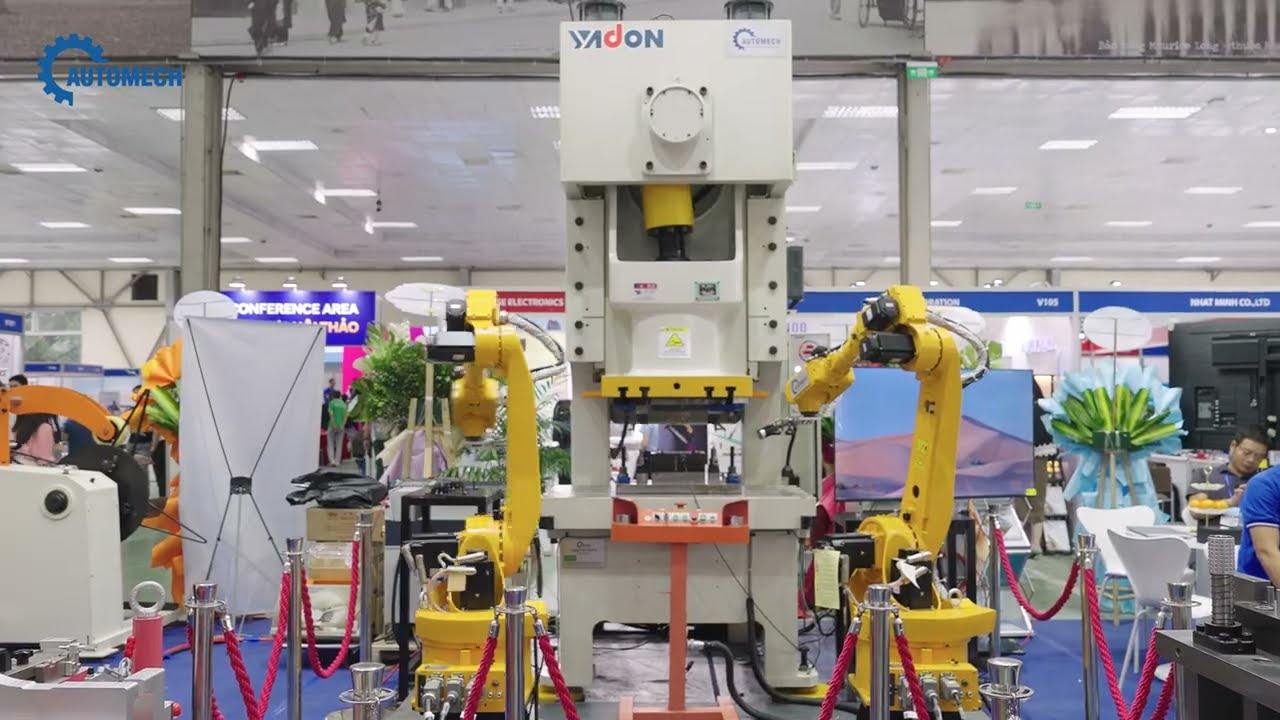
Heavy-duty, ultra-high-power bevel laser cutting system deployed to enhance precision for a leading Automotive Stamping Partner Vietnam
16.2 Short Answers
16.2.1 Automotive stamping partner definition
An automotive stamping partner is an embedded contract manufacturer engineered to design, build, and run custom stamping dies to produce precision structural components, while delivering IATF 16949 quality compliance, advanced co-engineering, and complete value-add sub-assembly services for automotive OEMs and Tier 1 networks.
16.2.2 Vietnam automotive stamping advantages
Vietnam provides a highly resilient, cost-effective alternative hub for automotive stamping. Key benefits include competitive labor and overhead rates, a specialized technical workforce, direct maritime shipping lanes to Western markets, and extensive free trade agreements that eliminate import duties for US and European buyers.
16.2.3 OEM supplier selection summary
When selecting a stamping partner, automotive OEMs look beyond basic unit piece costs. They prioritize manufacturers that feature high-tonnage press lines, full in-house tool-and-die development capabilities, complete IATF 16949 core tool integration, and a proven track record of managing international export logistics safely.
16.3 Featured Snippet Opportunities
16.3.1 Definition snippet
An automotive stamping partner is a specialized contract manufacturing organization that designs, tools, and mass-produces high-precision metal stampings, body-in-white (BIW) structures, and sub-assemblies. Unlike standard vendors, a strategic partner provides advanced design-for-manufacturing (DFM) support, in-house progressive die lifecycle management, and full IATF 16949 quality compliance.
16.3.2 Benefits list snippet
Sourcing from an automotive stamping partner Vietnam delivers several key strategic benefits for global manufacturers:
-
Tariff Mitigation: Leverage extensive free trade agreements (EVFTA, CPTPP) to bypass trade duties.
-
Supply Chain Diversification: Establishes a secure alternative production hub under a proactive “China+1” framework.
-
Operational Cost Efficiency: Minimizes production costs through competitive operating expenses and optimized material utilization.
-
High Technical Competence: Access automated progressive die lines and engineering design support for complex automotive platforms.
16.3.3 Vietnam vs China manufacturing comparison table
The following comparison table outlines the strategic operational metrics evaluated by procurement directors balancing production assets between China and Vietnam:
| Manufacturing Metric | China Production Hub | Vietnam Sourcing Hub |
| Tariff Exposure (US/EU) | High risk of trade friction and import duties | Low risk; covered by extensive global FTAs |
| Operational Cost Base | Rising labor rates and factory overhead costs | Highly competitive labor and factory operating expenses |
| Procurement Strategy Role | Primary high-volume production footprint | Core diversification hub under “China+1” model |
| Supply Chain Freedom | Vulnerable to targeted global trade restrictions | Open access to Western automotive supply chains |
| Infrastructure Integration | Highly mature, saturated industrial base | Rapidly expanding, modern export infrastructure |
17. Internal Linking Strategy
17.1 Pillar Pages
-
Automotive metal stamping: Link to our foundational technology page using the anchor text “[advanced automotive metal stamping systems]” to explore our core forming lines.
-
Automotive stamping supplier Vietnam: Link to our primary country landing page using the anchor text “[trusted automotive stamping supplier Vietnam]” to review our regional factory layout.
17.2 Cluster Pages
-
Progressive die stamping: Link to our specialized technical page using the anchor text “[high-volume progressive die stamping production]” to analyze our mechanical press efficiency.
-
Automotive stamping assembly: Link to our post-processing page using the anchor text “[integrated automotive stamping assembly operations]” to explore our downstream capabilities.
-
Automotive export stamping manufacturer: Link to our logistics page using the anchor text “[global automotive export stamping manufacturer]” to review our international shipping processes.
-
Automotive stamping OEM sourcing: Link to our procurement resource page using the anchor text “[strategic automotive stamping OEM sourcing plans]” to optimize your fulfillment pipeline.
-
Alternative China stamping supplier: Link to our diversification resource using the anchor text “[alternative China stamping supplier strategy]” to evaluate your global supply chain options.
17.3 Supporting Pages
-
Tool & die manufacturing: Link to our engineering page using the anchor text “[in-house tool & die manufacturing capabilities]” to see how we build custom progressive dies.
-
Automotive welding fixture: Link to our tooling page using the anchor text “[custom automotive welding fixture design]” to explore our part-alignment solutions.
-
BIW manufacturing: Link to our structural assembly page using the anchor text “[structural BIW manufacturing elements]” to review our vehicle frame production.
-
Automotive component manufacturer Vietnam: Link to our corporate profile using the anchor text “[leading automotive component manufacturer Vietnam]” to review our company credentials.
18. Conversion Section
18.1 Why choose a long-term automotive stamping partner?
18.1.1 Supply chain stability
Securing a long-term contract with a trusted stamping partner protects your production pipeline from market volatility. It ensures your vehicle platform maintains dedicated press capacity, continuous tooling oversight, and an uninterrupted supply of critical components through any global market shift.
18.1.2 Better quality and cost control
A long-term partnership enables deep manufacturing integration. By collaborating closely across multiple product life cycles, our engineering teams can implement continuous process improvements, optimize material yields, and refine stamping speeds to systematically drive down per-piece costs while maintaining absolute dimensional quality.
18.2 Why choose Automech?
18.2.1 Engineering-driven manufacturing approach
Automech is more than a contract stamping shop; we are an engineering-first manufacturing partner. We leverage advanced simulation technologies, tool-and-die craftsmanship, and proactive design-for-manufacturing analysis to solve complex forming challenges and optimize production efficiency before tool fabrication begins.
18.2.2 Strong automotive supply chain integration
We design our manufacturing infrastructure to align seamlessly with the demanding operational requirements of global automotive brands. From our accredited IATF 16949 quality architecture and automated robotic assembly cells to our extensive experience handling international export logistics, Automech provides a secure, scalable, and cost-competitive production hub in Vietnam.
18.3 CTA
18.3.1 Request RFQ
Ready to optimize your automotive component sourcing strategy? Submit your formal request for quotation directly to our international procurement team to obtain a detailed, transparent total cost of ownership analysis.
18.3.2 Upload Technical Drawings
Protect your intellectual property through our secure file transfer portal. Upload your 3D step files and 2D GD&T technical drawings to initiate a comprehensive project evaluation.
18.3.3 Contact Automotive Engineering Team
Connect directly with our senior tool-and-die designers to discuss your specific material targets, force requirements, and programmatic production schedules.
18.3.4 Request Manufacturing Feasibility Analysis
Leverage our technical expertise to optimize your designs. Partner with Automech to execute a thorough design-for-manufacturing (DFM) simulation, identifying opportunities to reduce material scrap and lower your initial tooling investments.
Automech Mechanical Equipment and Solutions Joint Stock Company
Head Office: No. 285 Phuc Loi Street, Phuc Loi Ward, Hanoi City
Da Nang Branch: No. 20 Nguyen Sinh Sac Street, Hoa Khanh Ward, Da Nang City
Ho Chi Minh Branch: No. 84, Street No. 10, Van Phuc Urban Area, Hiep Binh Ward, Ho Chi Minh City
Automech Mechanical Equipment and Solutions Joint Stock Company
Head Office: No. 285 Phuc Loi Street, Phuc Loi Ward, Hanoi City
Da Nang Branch: No. 20 Nguyen Sinh Sac Street, Hoa Khanh Ward, Da Nang City
Ho Chi Minh Branch: No. 84, Street No. 10, Van Phuc Urban Area, Hiep Binh Ward, Ho Chi Minh City
Factory No. 1: Automech Automation Equipment, Mold & Tool Manufacturing Factory – Automech Demo Center: Dinh Tram Industrial Park, Nenh Ward, Bac Ninh City, Vietnam
Factory No. 2: Automech Parts Manufacturing & Component Fabrication Factory: Viet Nhat Industrial Cluster, Xuan Cam Commune, Bac Ninh City, Vietnam
Hotline: 0987 899 347
Website: https://automechmfg.com/
Fanpage: https://www.facebook.com/automech.mfg/
YouTube: https://www.youtube.com/@Automechmfg