As global mobility shifts toward electric powertrains and lightweight body structures, the b pillar car assembly has evolved from a simple vertical post into a sophisticated multi-material safety system. Occupying the central lateral span of the Body-in-White (BIW), this critical component shields passengers and under-floor battery packs during severe side impact events. Procurement and engineering teams evaluating international suppliers require a balance of high-tonnage stamping capability, robotic joinery precision, and competitive landed costs. Automech delivers certified OEM manufacturing solutions for automotive b pillars directly from Vietnam—combining progressive tooling design, automated welding, and total IATF 16949 quality control.

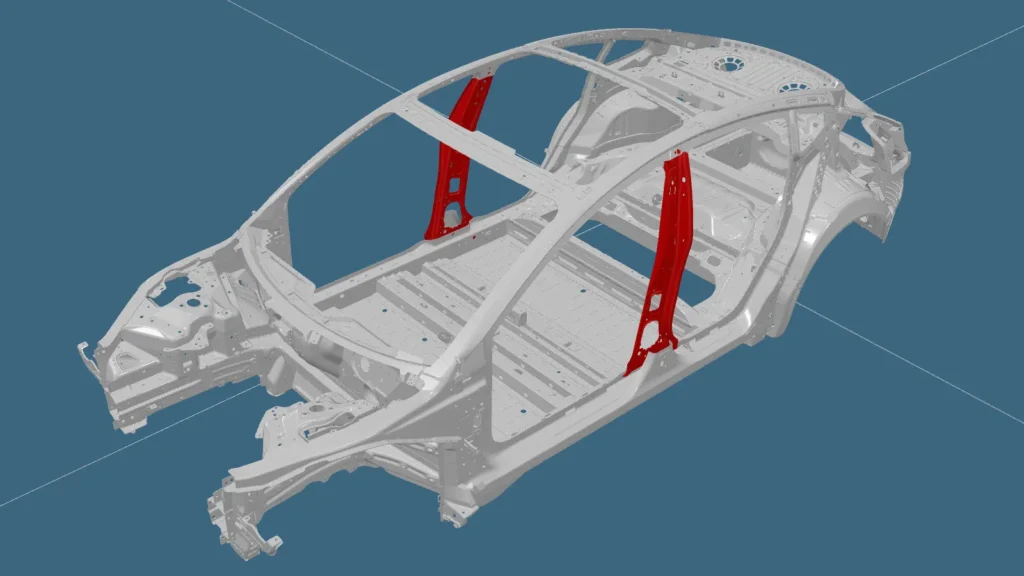
Full side body reinforcement structure including A, B, and C pillars highlighted in red
1. B Pillar Car: Structure, Manufacturing Process & Choosing a Reliable Automotive B Pillar Supplier
1.1 What Is a B Pillar in a Car?
1.1.1 Definition of the B Pillar
The b pillar car component represents the central vertical structural post integrated into unibody passenger vehicles. Situated between the front windshield pillar and the rear quarter pillar, it acts as a primary compression beam linking the lower sill structure to the upper roof longitudinal rail.
1.1.2 Where the B Pillar Is Located in a Vehicle
Positioned directly alongside the front seatbacks, the b pillar creates the physical division between the front cabin door opening and the rear passenger entrance. It forms the structural framing required to seal and latch adjacent side doors.
1.1.3 Relationship Between A Pillar, B Pillar, C Pillar and Vehicle Body Structure
- A Pillar: Anchors the windshield and front door hinges, absorbing frontal impact energy.
- B Pillar: Controls lateral cabin intrusion, anchors seatbelts, and supports roof load transfers.
- C Pillar: Supports the rear window frame and quarter panels. Together, these pillars form the protective safety cage surrounding vehicle occupants.
1.1.4 Evolution of B Pillar Design in Modern Vehicles
Legacy vehicles utilized multi-piece cold-stamped mild steel assemblies. Modern automotive architectures leverage ultra-high-strength tailored blanks, hot-stamped boron steels, and variable-thickness profiles to drastically enhance crash performance while paring down total body mass.

Stacked precision stamped sheet metal components protected with foam sheets
1.2 Functions of the B Pillar
1.2.1 Side Impact Protection
In lateral barrier collisions, the b pillar restricts dynamic intrusion into occupant seating spaces, dissipating lateral kinetic energy into the floor structure and roof cross-members.
1.2.2 Roof Crush Resistance
During rollover scenarios, the b pillar sustains severe compressive loading to satisfy static roof strength standards, keeping the upper roof frame from collapsing into the cabin space.
1.2.3 Door Hinge and Latch Support
It serves as the mounting foundation for the front door striker plate and rear door structural hinges, ensuring flush door alignment and reliable latch engagement.
1.2.4 Seat Belt Anchorage Integration
The upper internal section of the b pillar anchors the shoulder belt height adjuster, engineered to absorb extreme tensile forces during sudden vehicle deceleration.
1.2.5 Contribution to Overall BIW Structural Rigidity
By tying the upper roof ring to the lower floor pan, the b pillar elevates chassis bending and torsional stiffness, improving vehicle handling dynamics and ride comfort.
1.2.6 NVH (Noise, Vibration and Harshness) Performance
A rigid b pillar structure eliminates body flex over rough road surfaces, preventing door seal micro-gaps, panel rattles, and high-speed wind noise infiltration.

Batch of stamped steel reinforcement components neatly stacked on wooden pallets
2. B Pillar Design and Engineering
2.1 Anatomy of an Automotive B Pillar
2.1.1 Inner Panel
The interior structural core, formed from high-strength or press-hardened steel to provide maximum deformation resistance against lateral crash forces.
2.1.2 Outer Panel
The exterior-facing panel engineered for aerodynamic styling, door weatherstrip retention, and environmental corrosion protection.
2.1.3 Reinforcement Components
Internal stiffener plates and patch brackets welded at high-stress zones, such as latch attachment points and lower rocker joint junctions.
2.1.4 Joining Interfaces within BIW
Precision mating flanges and locator holes designed for automated resistance spot welding and robotic joinery within the main body assembly line.
2.2 B Pillar Reinforcement
2.2.1 Reinforcement Design Principles
Strategic material placement using multi-gauge steel blanks to bolster load-bearing capacity at high-stress areas without adding dead weight across the whole assembly.
2.2.2 Load Path Optimization
Computer-modeled geometry directs incoming lateral impact forces away from pelvic and thoracic occupant zones toward heavy cross-members in the floor pan.
2.2.3 Crash Energy Management
Tailoring structural yield zones—combining an ultra-strong upper section to resist cabin intrusion with a ductile lower base that deforms predictably to absorb kinetic energy.

Close-up structural diagram of automotive B-pillar reinforcement showing key load-bearing sections
2.3 Structural Performance Requirements
2.3.1 Side Crash Performance
Compliance with FMVSS 214 and Euro NCAP lateral impact standards by maintaining intrusion speeds and depths within safe occupant limits.
2.3.2 Roof Strength Requirements
Meeting FMVSS 216 regulations, requiring the b pillar and roof structure to withstand static crushing loads up to 4 times the vehicle’s unladen weight.
2.3.3 Occupant Safety Standards
Preserving passenger cabin envelope dimensions to ensure side door latches remain functional for emergency post-collision rescue access.
2.3.4 Lightweight Design Considerations
Optimizing sheet metal thickness and high-tensile material selection to curb BIW mass, supporting EV range extension and reduced fuel emissions.
3. Materials Used in Automotive B Pillars
3.1 High-Strength Materials
3.1.1 High Strength Steel (HSS)
Micro-alloyed HSLA grades (300–500 MPa yield strength) ideal for mounting brackets, internal stiffeners, and outer cosmetic panels.
3.1.2 Advanced High Strength Steel (AHSS)
Dual Phase (DP) and Complex Phase (CP) steels (600–1000 MPa tensile strength) offering excellent work-hardening capacity for cold-stamped structural inner parts.
3.1.3 Ultra High Strength Steel (UHSS)
Fully martensitic steels (>1000 MPa tensile strength) specified for heavy-duty reinforcement inserts to counteract dynamic bending forces.

Side outer frame and B-pillar assembly highlighted in red on car body structure
3.2 Material Selection Criteria
3.2.1 Strength-to-Weight Ratio
Selecting advanced steel alloys that maximize load-bearing capacity per millimeter of thickness to minimize overall component mass.
3.2.2 Formability
Verifying that raw sheet metal can undergo deep drawing, stretch forming, and sharp flanging operations without material necking or tearing.
3.2.3 Weldability
Ensuring seamless joint creation during automated spot welding and laser welding without generating brittle metallurgical zones.
3.2.4 Corrosion Resistance
Specifying pre-galvanized (GI/GA) or aluminum-silicon (AlSi) coated steel coils to guarantee multi-year environmental rust protection.
3.2.5 Cost vs Performance
Balancing raw material procurement expenses against die wear, press tonnage requirements, and target crash performance ratings.
3.3 Material Trends for EV Platforms
3.3.1 Lightweight Structures
Replacing thick multi-piece steel assemblies with hot-stamped tailored blanks to offset heavy EV battery packs.
3.3.2 Battery Protection Requirements
Fortifying the lower b pillar base connection to prevent side barrier impacts from piercing the floor-mounted high-voltage battery casing.
3.3.3 Sustainability Considerations
Adopting low-emission steelmaking processes and high recycled-content steel coils to fulfill global automotive ESG commitments.

Vehicle Body-in-White (BIW) structure with specific structural joint reinforcement location
4. B Pillar Manufacturing Process
4.1 Engineering Design
4.1.1 CAD & CAE Development
3D CAD surface modeling and finite element crash simulation to validate structural load transfer before cutting tool steel.
4.1.2 DFM Analysis
Design for Manufacturability audits to evaluate draw angles, radii, springback compensation, and robotic welding gun accessibility.
4.1.3 Tooling Design
Engineering multi-station progressive stamping dies, transfer dies, and holding fixtures tailored to high-strength steel behavior.
4.2 Metal Stamping Process
4.2.1 Coil Preparation
Uncoiling, precision leveling, and washing sheet metal rolls to ensure uniform thickness feed into stamping presses.
4.2.2 Blanking
Shearing flat steel coils into optimized blank shapes designed to reduce raw material scrap during drawing operations.

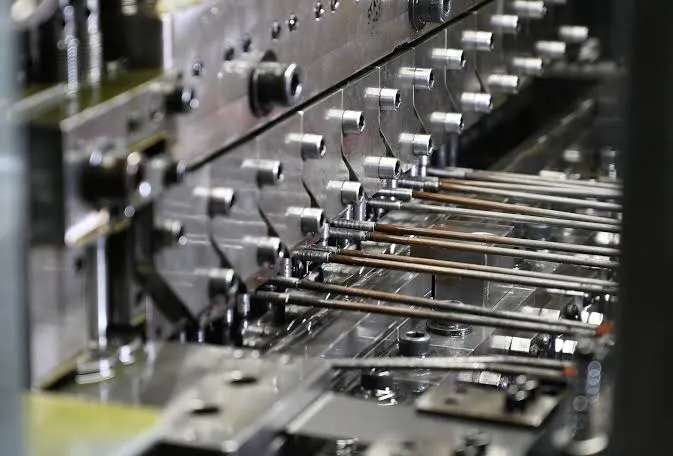
High-precision metal stamping dies and progressive tooling on display at the factory floor
4.2.3 Progressive Die Stamping
Sequential high-speed stamping operations where raw metal strips move through a single multi-station die set.
4.2.4 Transfer Die Stamping
Mechanized transfer arms move individual pre-cut blanks through a series of dedicated high-tonnage press stations.
4.2.5 Forming and Trimming
Deep drawing the 3D pillar contour followed by mechanical die or 5-axis laser trimming to remove excess scrap margins.
4.3 Hot Stamping vs Cold Stamping
4.3.1 Hot Stamping Process
Boron steel blanks are heated to ~900°C in an furnace, formed in a water-cooled die, and rapidly quenched to achieve tensile strengths exceeding 1500 MPa.
4.3.2 Cold Stamping Process
Metal blanks are stamped at ambient room temperature on mechanical or servo press lines, ideal for ductile steel grades up to ~1000 MPa.

High-precision metal stamping dies and welding jigs for automotive body component fabrication
4.3.3 Comparison Table: Hot Stamping vs Cold Stamping
| Parameter | Hot stamping (press hardening) | Cold stamping |
| Compatible materials | Boron steel (22MnB5) | Mild steel, HSS, AHSS, DP Steels |
| Tensile strength | Ultra-High (≥1500 MPa) | Moderate to high (300 – 1000 MPa) |
| Springback characteristics | Near zero springback | High (Requires active die compensation) |
| Capital & equipment cost | Furnace & cooling tooling required | Standard high-tonnage stamping setup |
| Primary structural role | Intrusion safety barriers | Outer covers & structural brackets |
4.3.4 When Each Process Is Preferred
Hot stamping is selected for high-intrusion risk safety zones requiring maximum yield strength, whereas cold stamping is chosen for cost-effective, high-throughput structural and skin panels.
4.4 Welding Assembly
4.4.1 Robotic Spot Welding
Automated 6-axis articulated robots execute Resistance Spot Welding (RSW) to fuse inner, outer, and patch plates into a rigid sub-assembly.
4.4.2 Laser Welding
High-precision laser seam welding creates continuous structural joints, increasing assembly torsional stiffness while keeping flange widths slim.

Engineer monitoring an automated robotic welding station with custom pneumatic fixtures
4.4.3 MIG/TIG Welding (Where Applicable)
Gas Metal Arc Welding deployed for heavy mounting brackets or specialized structural joints requiring deep weld penetration.
4.4.4 Welding Fixtures and Assembly Jigs
Pneumatic clamping fixtures hold stamped details in exact geometric position during automated robot joinery cycles.
4.5 BIW Integration
4.5.1 Assembly into Vehicle Body
Positioning and welding the completed b pillar sub-assembly into the primary body framing cell alongside roof rails and side sills.
4.5.2 Structural Alignment
Utilizing optical laser positioning sensors to verify datum alignment before closing final body welding guns.
4.5.3 Final BIW Validation
In-line coordinate measuring and non-destructive weld testing to confirm structural dimensions prior to E-coat paint dipping.
5. Manufacturing Quality Requirements
5.1 Dimensional Accuracy
5.1.1 GD&T Requirements
Enforcing strict Geometric Dimensioning & Tolerancing to control hole locations, profile tolerances, and datum alignment.
5.1.2 Dimensional Tolerance Standards
Maintaining critical mating features within ±0.5 mm to ensure uniform door seal compression and panel flushness.
5.1.3 Geometric Consistency
Eliminating part-to-part variation across high-volume production runs through automated process monitoring.

Quality control team inspecting small stamped metal auto parts at assembly workstations
5.2 Inspection Systems
5.2.1 CMM Inspection
Bridge-type Coordinate Measuring Machines in climate-controlled metrology labs verify 3D part profiles against native CAD models.
5.2.2 Checking Fixtures
Precision physical checking fixtures used directly on the shop floor for rapid, operator-driven dimensional verification.
5.2.3 Assembly Fixtures
Dedicated holding fixtures that lock components in exact spatial coordinates prior to robotic spot welding.
5.2.4 Inline Vision Inspection
Automated optical camera systems inspect weld nut presence, hole counts, and structural sealant bead continuity in real time.

Pneumatic clamping fixture system designed for precision automotive body welding
5.3 Automotive Quality Management
5.3.1 ISO 9001
The foundational international standard for quality management systems across industrial manufacturing facilities.
5.3.2 IATF 16949
The mandatory global automotive quality standard specifying defect prevention, continuous improvement, and supply chain control.
5.3.3 PPAP
Production Part Approval Process supplying OEMs with full Level 3 documentation and sample proof of manufacturing capability.
5.3.4 APQP
Advanced Product Quality Planning structured timeline guiding product development from initial design through SOP.
5.3.5 PFMEA
Process Failure Mode and Effects Analysis identifying potential manufacturing risks and establishing preventive containment actions.
5.3.6 Control Plan
Documentation specifying operational parameters, inspection frequencies, and reaction protocols for every production stage.
5.3.7 SPC
Statistical Process Control monitoring critical product dimensions (Cp / Cpk ≥ 1.67) to guarantee long-term process capability.
5.3.8 MSA
Measurement System Analysis (Gage R&R) verifying that inspection gauges and CMM equipment deliver accurate, repeatable data.
5.3.9 Full Traceability System
Laser-etched QR matrix coding tracking every b pillar car part back to raw steel coils, press operators, and weld parameter logs.

Precision stamped metal mounting bracket with anti-corrosion coating for automotive chassis
6. Applications of Automotive B Pillars
6.1 Passenger Vehicles
6.1.1 Sedan
Designed to balance side-impact energy absorption with slim pillar profiles that preserve driver lateral visibility.
6.1.2 Hatchback
Engineered to maintain cabin torsional stiffness despite compact body lengths and large rear tailgate openings.
6.1.3 SUV
Features reinforced cross-sections to support higher vehicle curb weights and satisfy elevated roof crush test requirements.
6.1.4 Pickup Truck
Utilizes heavy-gauge structural steel to withstand off-road frame twisting and heavy bed payload stresses.
6.2 Electric Vehicles
6.2.1 Battery Protection
Reinforced base attachments safeguard floor-mounted battery enclosures against lateral barrier collision forces.
6.2.2 Lightweight BIW Structures
Leverages hot-stamped boron steel to trim BIW mass, helping offset heavy battery pack loads.
6.2.3 Structural Crash Performance
Custom load paths redirect lateral crash forces around battery tray housings to prevent thermal runaway risks.

Stacks of blanked sheet metal plates ready for press forming processes
6.3 Commercial Vehicles
6.3.1 Light Commercial Vehicles
Engineered for high durability and resistance to frequent door slam cycles in urban delivery fleets.
6.3.2 Heavy-Duty Vehicles
Heavy-duty structural pillars designed for commercial cabs operating under severe long-haul and off-highway conditions.
7. How OEMs Evaluate a B Pillar Supplier
7.1 Manufacturing Capability
7.1.1 Stamping Capacity
High-tonnage press availability (630T to 2000T) capable of drawing and blanking thick-gauge high-strength steels.
7.1.2 Robotic Welding Systems
Automated multi-axis welding cells equipped with real-time current and force feedback monitoring controls.
7.1.3 Tooling Development
In-house tool shop capabilities for quick die maintenance, engineering change order (ECO) execution, and tool repairs.
7.1.4 Production Automation
Integrated material transfer automation reducing cycle times and eliminating manual handling errors.

Multi-station robotic stamping automation system for sheet metal auto parts manufacturing.
7.2 Engineering Capability
7.2.1 DFM Support
Providing early engineering feedback to optimize part geometries, material utilization, and tooling lifespan.
7.2.2 Prototype Development
Rapid prototyping via soft-tooling or laser cutting to supply physical test samples for OEM crash evaluation.
7.2.3 Process Validation
Demonstrating stable process capabilities (Cpk) through structured pilot production runs.
7.2.4 Continuous Improvement
Active Kaizen programs targeting scrap reduction, operational efficiency, and overall yield optimization.
7.3 Quality Capability
7.3.1 Automotive Certifications
Mandatory active IATF 16949 certification verified by accredited third-party auditing bodies.
7.3.2 Quality Inspection Equipment
In-house metrology lab equipped with bridge-type CMM machines, tensile test rigs, and optical vision scanners.
7.3.3 Process Traceability
End-to-end material tracking linking raw steel coil batches directly to completed finished assemblies.
7.3.4 Supplier Audit Readiness
Open-door policies for OEM quality audits covering process controls, safety, and environmental compliance.

Skilled welder performing manual MIG/MAG welding on automotive tubular structural joints
8. RFQ Process for B Pillar Manufacturing
8.1 Information Required for RFQ
8.1.1 CAD Drawings
Detailed 2D engineering prints and 3D CAD models (STEP, IGES, CATIA) with complete GD&T specifications.
8.1.2 Material Specifications
Exact material standard designations (e.g., DP600, 22MnB5), nominal thickness, and required anti-corrosion coatings.
8.1.3 Annual Volume
Estimated Annual Volume (EAV), project lifecycle duration, and expected delivery batch sizes.
8.1.4 Quality Requirements
OEM testing criteria, required PPAP submission level, and key dimensional inspection datums.
8.1.5 Packaging Requirements
Specifications for export packaging, custom steel dunnage, VCI anti-corrosion wrapping, and sea freight containers.
8.2 Manufacturing Feasibility Review
8.2.1 DFM Evaluation
Evaluating part geometries for draw depth limits, thinning risks, springback, and welding torch access.
8.2.2 Cost Optimization
Delivering transparent cost breakdowns covering raw material yields, machine press rates, and tooling amortization options.
8.2.3 Tooling Assessment
Determining optimal die layouts (progressive vs. transfer) and estimated tool construction schedules.

Spacious assembly and quality inspection workshop for stamped sheet metal parts
8.2.4 Production Timeline
Mapping out program milestones from CAD sign-off and die build to prototype testing and SOP launch.
9. Why Global OEMs Source Automotive Structural Components from Vietnam
9.1 Advantages of Vietnam Manufacturing
9.1.1 Competitive Production Cost
Favorable labor rates and competitive factory conversion costs lower total manufacturing expenses.
9.1.2 Skilled Automotive Workforce
A growing pool of mechanical engineers and automation technicians skilled in CNC tooling and robotic welding.
9.1.3 Modern Manufacturing Infrastructure
Expanding industrial zones equipped with modern press shops, automated welding lines, and metrology labs.
9.1.4 China+1 Supply Chain Strategy
Sourcing from Vietnam provides critical supply chain diversification, shielding global OEMs against single-region trade risks.

Operator configuring an automated robotic welding cell for structural component assembly
9.2 Vietnam vs China for Automotive Structural Manufacturing
9.2.1 Manufacturing Cost
Vietnam offers competitive operational overhead and conversion costs compared to rising labor expenses in China.
9.2.2 Supply Chain Stability
Stable trade environment and favorable tariff frameworks simplify export logistics for global Tier 1 buyers.
9.2.3 Export Capability
Direct access to deep-water seaports facilitates reliable ocean container shipments to North America and Europe.
9.2.4 Quality Systems
Vietnamese suppliers operate under international IATF 16949 standards, matching global OEM expectations.
9.2.5 OEM Collaboration
Proactive technical communication and transparent project co-management throughout product launch lifecycles.

Modern exterior facade of Automech Parts manufacturing and component fabrication facility
10. Trusted B Pillar Manufacturing Supplier in Vietnam – Automech
10.1 Automotive Body Structure Manufacturing Capability
10.1.1 BIW Manufacturing
Specialized manufacturing setup for Body-in-White components including b pillars, cross car beams, and chassis reinforcements.
10.1.2 B Pillar Stamping
High-precision press lines capable of drawing and forming mild, high-strength, and ultra-high-strength steel sheet parts.
10.1.3 Robotic Welding Assembly
Automated multi-axis robotic spot welding cells delivering consistent structural joints and geometric accuracy.
10.1.4 Automotive Structural Component Manufacturing
End-to-end production of safety-critical structural assemblies engineered to pass stringent OEM crash criteria.
10.2 Engineering & Tooling Expertise
10.2.1 Tool and Die Design
In-house tooling engineering team specializing in progressive stamping dies, transfer dies, and forming tools.
10.2.2 Welding Fixture Design
Designing high-precision pneumatic welding fixtures to maintain tight tolerances during automated assembly.
10.2.3 Assembly Fixture Manufacturing
Fabrication of checking gauges and assembly holding fixtures tailored to OEM quality standards.
10.2.4 DFM Engineering Support
Early supplier involvement (ESI) providing technical reviews to optimize part designs for mass production efficiency.

Automated robotic welding cell equipped with Plymovent industrial fume extraction system
10.3 Quality Assurance
10.3.1 CMM Inspection
Climate-controlled metrology lab with 3D CMM equipment for complete GD&T verification and CAD comparison.
10.3.2 PPAP & APQP
Full compliance with automotive core tools, supplying Level 3 PPAP documentation packages for OEM approval.
10.3.3 Full Production Traceability
Laser-etched QR coding linking finished parts back to raw material heat lots and press run logs.
10.3.4 OEM Quality Standards
Operating under an IATF 16949 certified quality management system guaranteeing zero-defect targets.
10.4 Global Export Experience
10.4.1 US Market
Proven track record supplying precision metal stampings and welded sub-assemblies to North American automotive buyers.
10.4.2 European Market
Experienced in executing automotive programs compliant with European OEM specifications and DIN guidelines.
10.4.3 OEM & Tier 1 Project Experience
Successful project co-management and volume supply for global automotive manufacturers and Tier 1 system integrators.

Technician operating a precision body welding jig fixture at the assembly line
10.5 Request a B Pillar Manufacturing RFQ
10.5.1 Upload Technical Drawings
Send your 2D engineering prints and 3D CAD models directly to our technical team for immediate review.
10.5.2 Request DFM Review
Get comprehensive DFM feedback on part geometry, material yield optimization, and tool feasibility.
10.5.3 Request Manufacturing Feasibility Analysis
Receive a detailed commercial proposal covering unit pricing, tooling costs, and production schedules.
10.5.4 Contact Automotive Engineering Team
Speak with our English-speaking technical sales engineers in Vietnam to discuss your ongoing vehicle program needs.
11. Frequently Asked Questions (FAQ)
11.1 What is a B pillar in a car?
A b pillar car assembly is the middle vertical column on a vehicle chassis connecting the roof rail to the rocker panel to support passenger protection.
11.2 Why is the B pillar important for vehicle safety?
It acts as the principal barrier preventing side collision intrusion and preserves roof collapse margins during rollover events.

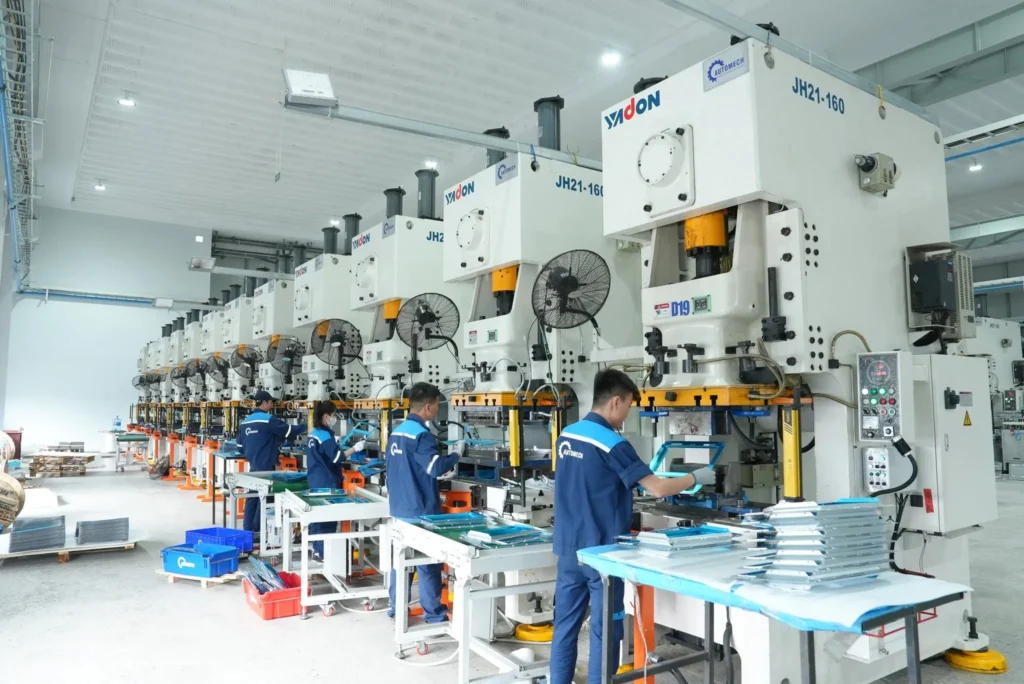
High-speed Yadon stamping press line integrated with KUKA robotic transfer arms
11.3 What materials are commonly used for B pillars?
High-Strength Steel (HSS), Advanced High-Strength Steel (AHSS), Ultra High-Strength Steel (UHSS), and hot-stamped Boron Steel.
11.4 What is the difference between hot stamped and cold stamped B pillars?
Hot stamped pillars feature tensile strengths exceeding 1500 MPa with zero springback, whereas cold stamped pillars suit ductile alloys up to ~1000 MPa.
11.5 How is a B pillar manufactured?
By executing high-tonnage sheet metal stamping (drawing, trimming, piercing) followed by automated robotic spot welding of inner and outer plates.
11.6 How do OEMs choose a B pillar supplier?
By auditing active IATF 16949 certifications, high-tonnage stamping press capabilities, robotic welding automation, and CMM metrology testing.
11.7 Why source B pillar manufacturing from Vietnam?
Vietnam provides competitive manufacturing conversion costs, a highly skilled mechanical workforce, and resilient China+1 export advantages.

Panoramic aerial view of Automech Parts manufacturing factory facility
12. Frequently Asked Questions (FAQ)
12.1 What is a B pillar in a car?
12.1.1 Definition of a B pillar
A b pillar car structure is the primary central vertical column linking the lower floor sill to the longitudinal roof rail on a unibody automobile frame.
12.1.2 Where the B pillar is located
It is situated directly between the front side door frame and the rear passenger door entrance.
12.1.3 Why every passenger vehicle has a B pillar
Every passenger car requires a b pillar to maintain unibody structural stiffness, secure door latch mechanisms, and shield occupants from dynamic lateral impacts.
12.2 What are the main functions of a B pillar?
12.2.1 Side-impact protection
Absorbs and redirects lateral collision kinetic energy away from occupant thoracic seating zones toward floor cross-members.
12.2.2 Roof crush resistance
Sustains vertical dynamic loads during rollover events to meet stringent FMVSS 216 safety standards.
12.2.3 Seat belt anchorage
Houses the upper height-adjustable D-ring anchor for front seat belt restraint systems, withstanding extreme tensile forces.
12.2.4 Structural rigidity and NVH performance
Increases unibody chassis torsional stiffness, minimizing road vibrations, seal creaks, and wind noise transmission.

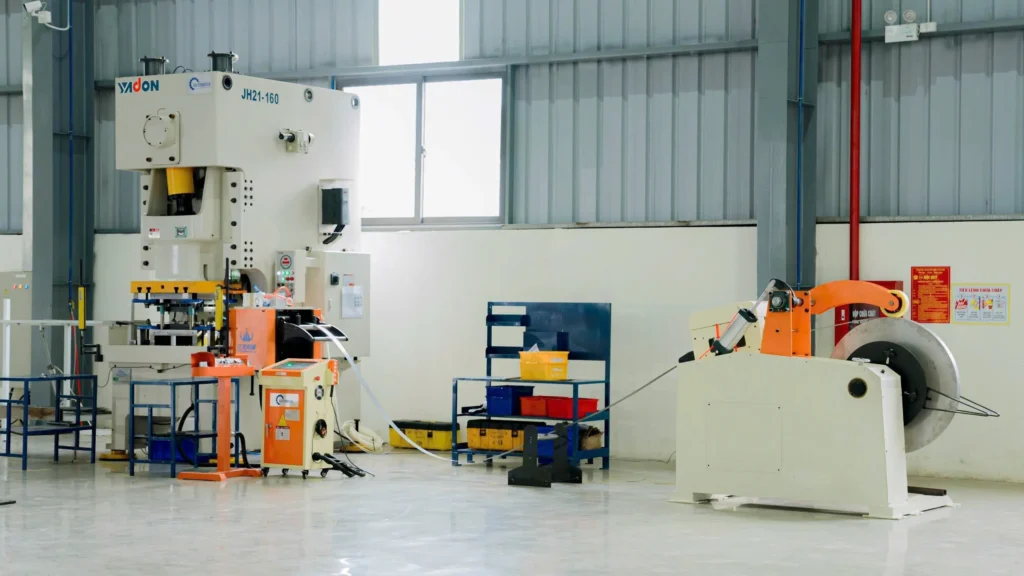
Heavy-duty Yadon 200T stamping press line equipped with automatic coil feeding system
12.3 What materials are commonly used to manufacture automotive B pillars?
12.3.1 High Strength Steel (HSS)
Micro-alloyed HSLA steels (300–500 MPa) specified for outer cosmetic skins and secondary mounting brackets.
12.3.2 Advanced High Strength Steel (AHSS)
Dual Phase steels (600–1000 MPa) providing high work-hardening capabilities for cold-stamped structural inner profiles.
12.3.3 Ultra High Strength Steel (UHSS)
Fully martensitic steels (>1000 MPa) used for heavy-duty reinforcement inserts resisting dynamic bending forces.
12.3.4 Why hot-stamped steel is widely used
Hot-stamped boron steel reaches tensile strengths above 1500 MPa with zero springback, delivering maximum intrusion protection at minimal component mass.
12.4 How is a B pillar manufactured?
12.4.1 Tooling and die design
Engineering progressive or transfer dies with advanced FEA springback prediction software models.
12.4.2 Metal stamping process
Uncoiling, flat blanking, deep drawing, trimming, and piercing sheet metal coils on high-tonnage mechanical or hydraulic presses.
12.4.3 Robotic welding assembly
Fusing inner reinforcements, outer covers, and patch plates using automated resistance spot welding cells.
12.4.4 BIW integration and quality inspection
Welding the completed sub-assembly into the main vehicle framing line followed by 3D CMM inspection and laser scanning.

Engineers setting up and calibrating precision body welding jigs at Automech factory
12.5 What is the difference between hot stamped and cold stamped B pillars?
12.5.1 Manufacturing process
Hot stamping forms heated boron steel (~900°C) inside a water-cooled die, while cold stamping forms steel sheet blanks at room temperature.
12.5.2 Mechanical properties
Hot stamped components deliver ultimate tensile strengths 1500 MPa, whereas cold stamped parts suit ductile steels up to ~1000 MPa.
12.5.3 Typical automotive applications
Hot stamping is specified for primary safety intrusion barriers; cold stamping is selected for outer cosmetic panels and mounting brackets.
12.6 How do OEMs choose a reliable B pillar supplier?
12.6.1 Manufacturing capability
Auditing high-tonnage stamping press availability (630T–2000T) and robotic welding line automation.
12.6.2 Quality management systems
Requiring active IATF 16949 certification, full PPAP Level 3 documentation, and CMM metrology testing facilities.
12.6.3 Engineering support
Prioritizing suppliers with in-house DFM analysis, die simulation, and fixture engineering capabilities.
12.6.4 Export and OEM project experience
Evaluating past performance in supplying international Tier 1 buyers with custom export packaging and logistics management.
12.7 Why source automotive B pillars from Vietnam?
12.7.1 Competitive manufacturing costs
Optimized labor rates and lower factory overhead reduce overall component conversion expenses.

Close-up of manual MIG/MAG welding process on structural steel pipe joints
12.7.2 Skilled automotive workforce
Access to a highly trained engineering talent pool specializing in mechanical automation and tooling development.
12.7.3 Strong export capabilities
Deep-water port access enables efficient ocean container shipping to major North American and European trade hubs.
12.7.4 China+1 sourcing advantages
Provides global OEMs with supply chain resilience and tariff optimization away from single-region trade risks.
Automech Mechanical Equipment and Solutions Joint Stock Company
Head Office: No. 285 Phuc Loi Street, Phuc Loi Ward, Hanoi City
Da Nang Branch: No. 20 Nguyen Sinh Sac Street, Hoa Khanh Ward, Da Nang City
Ho Chi Minh Branch: No. 84, Street No. 10, Van Phuc Urban Area, Hiep Binh Ward, Ho Chi Minh City
Factory No. 1: Automech Automation Equipment, Mold & Tool Manufacturing Factory – Automech Demo Center: Dinh Tram Industrial Park, Nenh Ward, Bac Ninh City, Vietnam
Factory No. 2: Automech Parts Manufacturing & Component Fabrication Factory: Viet Nhat Industrial Cluster, Xuan Cam Commune, Bac Ninh City, Vietnam
Hotline: 0902 997 331
Website: https://automechmfg.com/
Fanpage: https://www.facebook.com/automech.mfg/
YouTube: https://www.youtube.com/@Automechmfg