Looking for a reliable CNC machining contract manufacturer Vietnam to scale your OEM production and diversify your global supply chain? As production costs rise in mature markets and the “China+1” strategy becomes essential for risk management, securing a trusted manufacturing partner is critical. Automech delivers high-precision, export-ready CNC milling and turning services engineered specifically for the demanding automotive and industrial sectors. Backed by rigorous ISO 9001 and IATF 16949 quality systems, we provide a seamless, cost-effective transition from advanced DFM and prototyping to high-volume mass production without compromising on engineering excellence.
1. Introduction: CNC Contract Manufacturing in Vietnam for Global OEMs
Finding a reliable CNC machining contract manufacturer Vietnam has become a strategic priority for global OEMs seeking to optimize their supply chains. As global supply dynamics shift, procurement managers and engineers require scalable, high-precision manufacturing partners capable of delivering complex components on time and within budget. Vietnam has emerged as a premier hub for outsourced OEM production, combining advanced CNC technology with a highly skilled workforce and competitive operational costs.
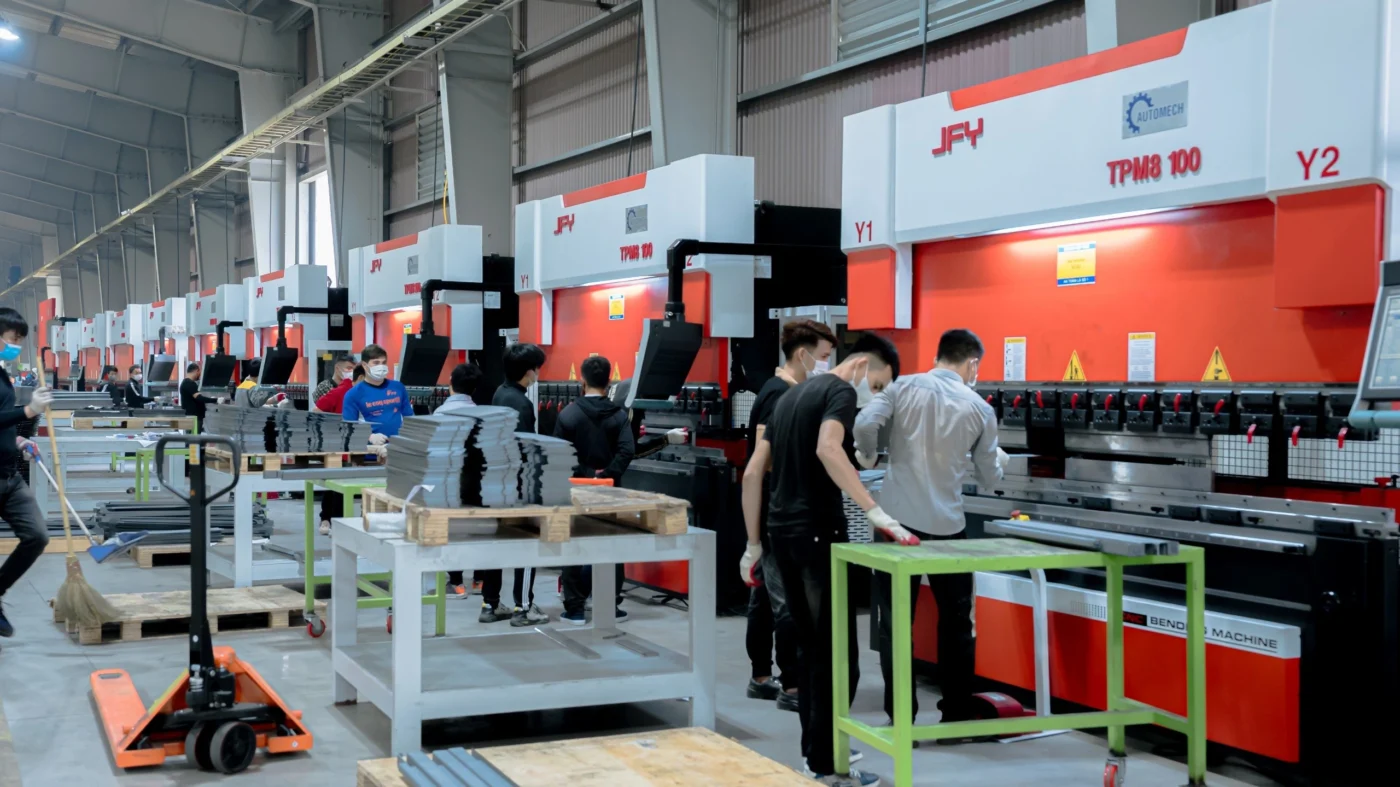
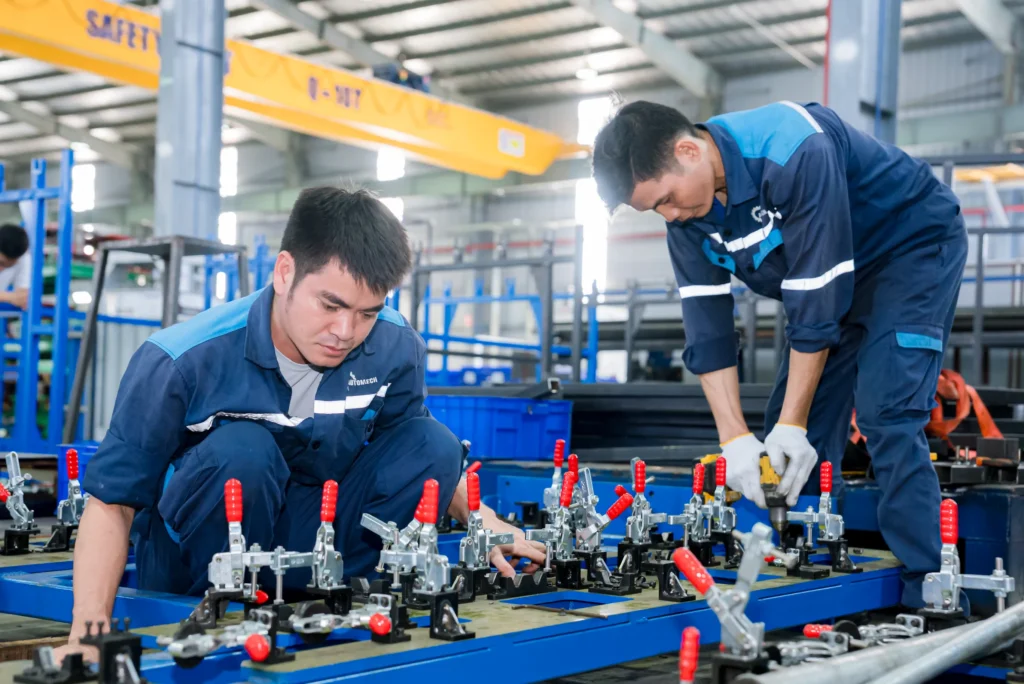
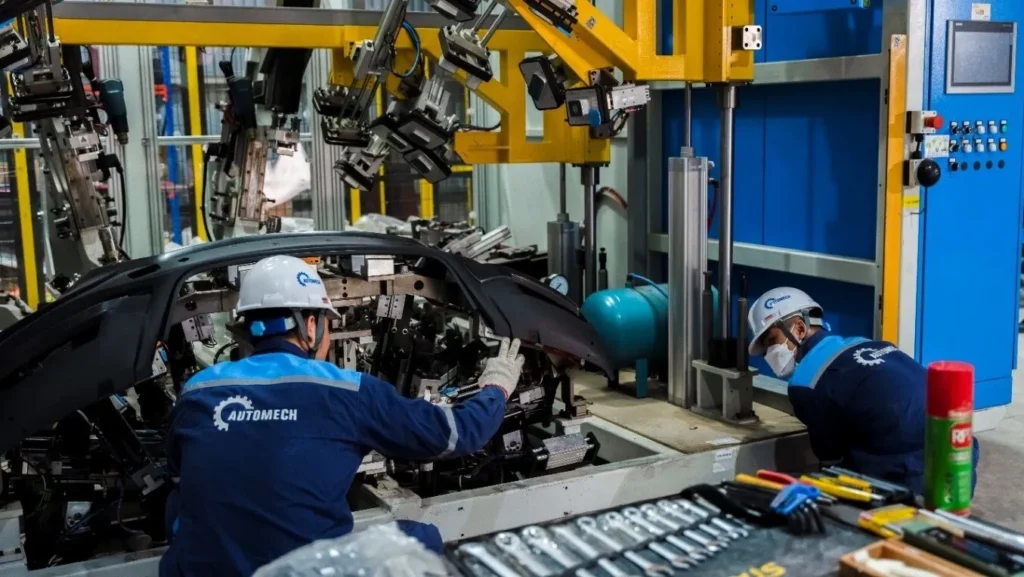
Workers operating industrial press brake machines at a leading CNC machining contract manufacturer Vietnam facility.
1.1 Global shift toward outsourced CNC manufacturing
The traditional model of maintaining in-house production for all components is rapidly changing. OEMs are increasingly turning to specialized contract manufacturers to handle precision machining, allowing them to focus on core competencies like R&D, assembly, and market expansion.
1.1.1 Rising cost pressure in US/EU manufacturing
Manufacturers in the United States and the European Union face mounting cost pressures driven by escalating labor rates, high energy costs, and stringent regulatory compliance. Maintaining an in-house fleet of multi-axis CNC machines requires massive capital expenditure and ongoing maintenance. Outsourcing to dedicated facilities drastically reduces overhead and unit costs without sacrificing part quality or dimensional accuracy.
1.1.2 China+1 sourcing strategy and supply chain diversification
Geopolitical tensions, tariff fluctuations, and unforeseen supply chain disruptions have accelerated the “China+1” strategy. Global OEMs are actively diversifying their supplier base by adding Southeast Asian manufacturing partners to their vendor lists. Vietnam stands out as the most viable destination, offering political stability, favorable trade agreements, and a rapidly maturing industrial infrastructure.
1.2 Why buyers search “CNC machining contract manufacturer Vietnam”
Procurement teams querying this specific entity are not looking for a simple machine shop; they are searching for an enterprise-level partner capable of long-term integration into their global supply chains.
1.2.1 Need for scalable OEM manufacturing partners
Industrial buyers require suppliers who can seamlessly scale from initial low-volume prototypes to high-volume mass production. A true contract manufacturer aligns its capacity, tooling, and workforce with the OEM’s forecasted demand, ensuring uninterrupted supply lines.
1.2.2 Demand for reliable, export-ready CNC suppliers in Asia
Sourcing internationally comes with logistical complexities. Buyers demand export-ready suppliers who understand international shipping standards, custom packaging requirements, and necessary export documentation. Vietnam’s robust network of deep-water ports and its proximity to major global shipping routes make it an ideal hub for export manufacturing.
2. What is a CNC Machining Contract Manufacturer?
2.1 Definition of CNC contract manufacturing
What is a CNC machining contract manufacturer?
A CNC machining contract manufacturer is a strategic B2B partner that manages the entire production lifecycle of custom machined components for OEMs. Unlike a standard machine shop, a contract manufacturer provides end-to-end services, including Design for Manufacturability (DFM), prototyping, material sourcing, high-volume mass production, quality assurance, and global export logistics.

A lineup of diverse, high-precision CNC milling and machining centers representing the advanced machinery infrastructure of a trusted CNC machining contract manufacturer Vietnam
2.1.1 Outsourced CNC production for OEM and industrial buyers
For OEMs, these manufacturers act as a direct extension of their own production lines. By leveraging the contract manufacturer’s specialized equipment and technical expertise, industrial buyers can procure complex, high-tolerance parts without the capital burden of owning the machinery.
2.1.2 Manufacturing partnership from prototype to mass production
The relationship is inherently collaborative. A contract manufacturer works closely with the buyer’s engineering team to validate designs during the prototyping phase, optimize the machining process for efficiency, and establish rigid quality control frameworks before locking in mass production runs.
2.2 Role in global manufacturing supply chains
2.2.1 Supporting OEM production capacity
During demand spikes or new product introductions, contract manufacturers provide elastic capacity. They absorb the overflow of machining requirements, ensuring that the OEM meets its market delivery targets without bottlenecking internal assembly lines.
2.2.2 Reducing internal machining investment and production risk
Investing in 5-axis CNC mills and automated turning centers is capital-intensive. By utilizing a contract manufacturer, OEMs shift the depreciation, maintenance, and labor risks to the supplier, converting fixed capital costs into variable, predictable operational expenses.
3. CNC Contract Manufacturer vs CNC Machining Supplier
3.1 Key differences between contract manufacturer and supplier
Understanding the distinction between these two entities is critical for proper vendor selection.
| Feature | CNC Contract Manufacturer | Standard CNC Supplier (Job Shop) |
| Relationship | Long-term, strategic OEM partnership | Transactional, order-by-order basis |
| Services | DFM, prototyping, mass production, logistics | Machining to print only |
| Volume Capacity | Medium to high-volume production | Prototypes to low-volume batches |
| Quality Systems | ISO 9001, IATF 16949, SPC, Traceability | Basic dimensional inspection |
| Supply Chain | Manages material sourcing and sub-tier suppliers | Relies on customer-supplied materials (often) |
3.1.1 Contract manufacturer as long-term production partner
A contract manufacturer invests in understanding the OEM’s end-product. They implement continuous improvement (Kaizen) practices to drive down costs over the lifecycle of the product, managing inventory buffers and scheduling blanket orders.
3.1.2 CNC supplier as part or service provider
A standard CNC supplier typically operates on a “build-to-print” model. They receive a CAD file, machine the part, and ship it. They rarely provide engineering feedback or scale up for complex, multi-year supply agreements.
3.2 When OEMs need a contract manufacturer
3.2.1 Medium-to-high volume production
When an OEM requires thousands or tens of thousands of parts per month, standard job shops lack the automation and workflow to maintain consistency. Contract manufacturers utilize pallet pools, robotics, and automated bar feeders to sustain high-volume output efficiently.
3.2.2 Complex components requiring engineering support
Parts with strict GD&T (Geometric Dimensioning and Tolerancing) requirements, tight tolerances, or complex geometries demand front-end engineering. Contract manufacturers provide DFM feedback to optimize toolpaths and reduce cycle times.
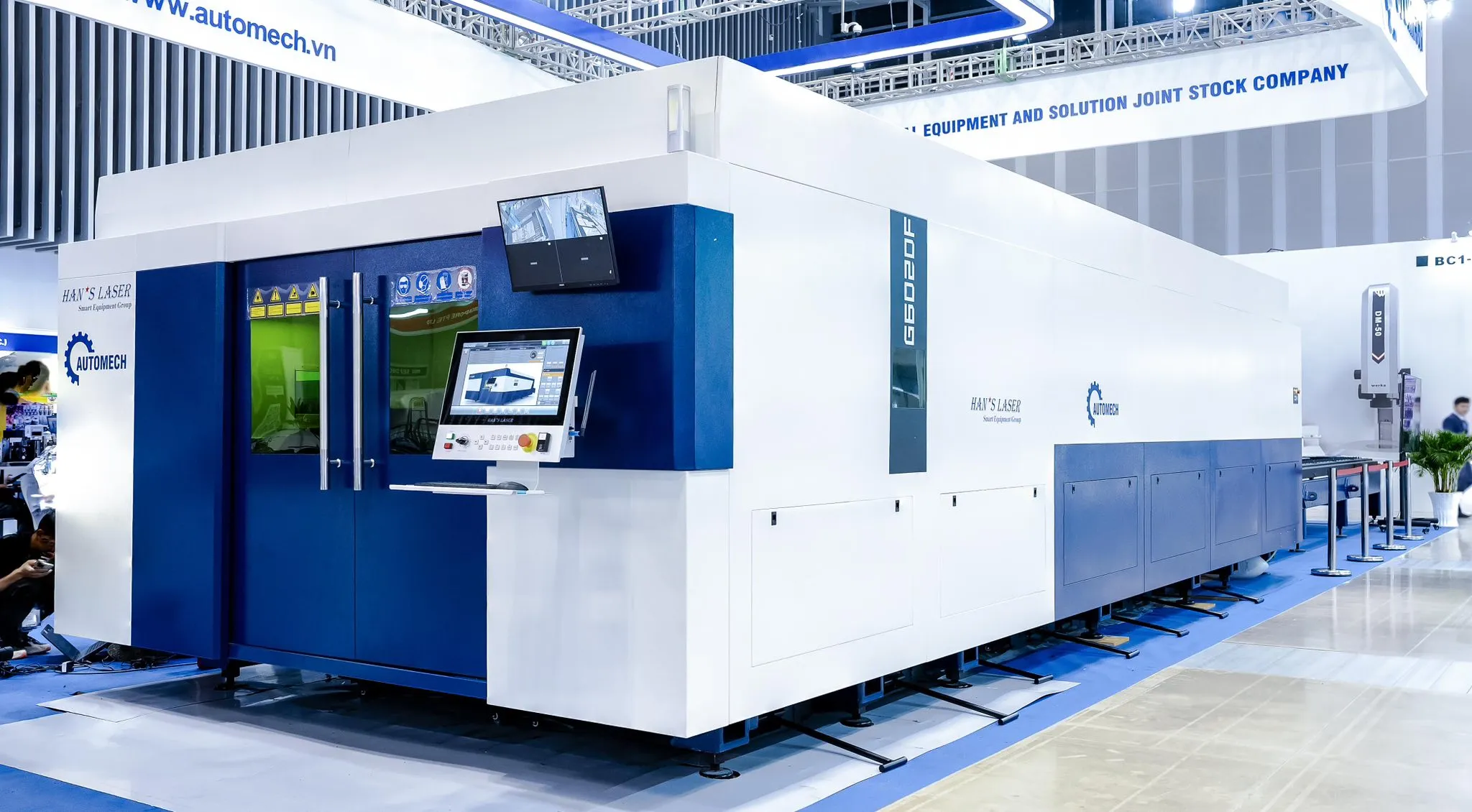
A large, high-tech fiber laser cutting system displayed at an industrial exhibition, highlighting the sheet metal processing capabilities available through a premier CNC machining contract manufacturer Vietnam.
3.3 When a standard CNC supplier may be enough
3.3.1 Prototype or low-volume orders
If an engineering team simply needs a handful of test parts to validate a concept, a local job shop can provide quick turnaround times without the overhead of establishing a long-term supply agreement.
3.3.2 Simple machined components
For basic brackets, fixtures, or non-critical structural components with loose tolerances, a standard supplier may offer the fastest and most cost-effective solution.
4. Why OEMs Outsource CNC Machining to Vietnam
4.1 Cost advantages of CNC machining Vietnam
4.1.1 Competitive labor and operating costs
Vietnam offers highly competitive labor rates for skilled machinists and manufacturing engineers compared to mature markets and even traditional Asian manufacturing hubs. Furthermore, industrial zone incentives and competitive energy costs heavily favor large-scale production.
4.1.2 Lower total manufacturing cost compared with mature markets
By aggregating labor savings, reduced overhead, and efficient machining processes, OEMs routinely achieve a 20% to 40% reduction in total manufacturing costs when shifting production to Vietnam, drastically improving their gross margins.
4.2 Vietnam as an alternative China CNC machining supplier
4.2.1 Reduced dependency on China-based production
Over-reliance on a single geographic region introduces critical risk. By establishing a CNC machining contract manufacturer in Vietnam, OEMs successfully hedge against localized disruptions, tariff hikes, and trade embargoes.
4.2.2 Improved supply chain resilience
Vietnam’s integration into global trade networks provides a redundant, highly resilient supply chain node. Procurement teams can dynamically balance production loads between China, Vietnam, and domestic suppliers to ensure uninterrupted delivery.
4.3 Export manufacturing benefits
4.3.1 Growing Vietnam export manufacturing ecosystem
Vietnam is rapidly developing a deep ecosystem of supporting industries, including raw material distribution, surface treatment (anodizing, plating, heat treatment), and specialized tooling suppliers. This localized supply chain reduces lead times and logistics costs.
4.3.2 Stronger access to US/EU supply chains
Through free trade agreements such as the EVFTA (EU-Vietnam Free Trade Agreement) and CPTPP, manufactured goods exported from Vietnam enjoy favorable tariff structures when entering major consumer markets in North America and Europe.
5. CNC Machining Contract Manufacturing Capabilities
5.1 CNC milling capabilities
5.1.1 3-axis and 4-axis CNC milling
The foundation of precision manufacturing relies on robust 3-axis and 4-axis milling centers. These machines handle standard block, plate, and housing configurations, offering high material removal rates and excellent surface finishes for prismatic parts.
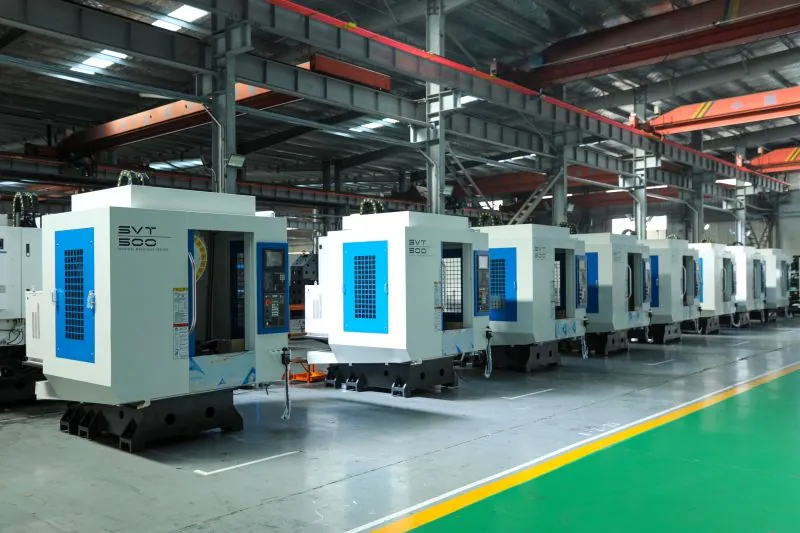
A clean, well-lit factory floor featuring a row of white and blue vertical machining centers ready for high-volume production projects handled by an expert CNC machining contract manufacturer Vietnam.
5.1.2 5-axis machining for complex precision parts
For aerospace, medical, and advanced automotive components, 5-axis simultaneous machining is required. This capability allows the cutting tool to approach the workpiece from any angle, enabling the creation of complex organic geometries and undercuts in a single setup, which dramatically improves positional accuracy.
5.2 CNC turning capabilities
5.2.1 Shaft, bushing, housing, and cylindrical components
Advanced CNC lathes and turning centers are utilized for producing precise cylindrical components. From simple bushings and spacers to complex drive shafts and motor housings, turning capabilities are essential for mechanical assemblies.
5.2.2 High repeatability for production batches
Equipped with automated bar feeders and parts catchers, modern CNC turning centers operate in a “lights-out” manufacturing environment. This automation guarantees high repeatability and strict dimensional stability across large production batches.
5.3 Multi-axis machining capabilities
5.3.1 Complex geometries and tight tolerance requirements
Mill-turn centers and multi-tasking machines combine the capabilities of milling and turning into a single platform. This is vital for complex parts that require both rotational and prismatic features with extremely tight true-position tolerances.
5.3.2 Reduced setup time and improved part consistency
By completing a part in a single operation (“done-in-one”), multi-axis machines eliminate the stack-up errors associated with moving a workpiece between different machines. This reduces setup time, minimizes handling damage, and drastically improves overall part consistency.
6. Materials and Tolerance Capabilities
6.1 Common materials for CNC contract manufacturing
6.1.1 Aluminum alloys
Aluminum (such as 6061-T6 and 7075-T6) is highly favored for its exceptional strength-to-weight ratio and machinability. It is standard in automotive lightweighting, aerospace structures, and consumer electronics housings.
6.1.2 Carbon steel and stainless steel
For industrial equipment and high-wear applications, carbon steels (like 1045) and alloy steels (like 4140) provide necessary durability. Stainless steels (304, 316, 17-4PH) are machined for applications requiring high corrosion resistance, such as medical devices and fluid handling systems.
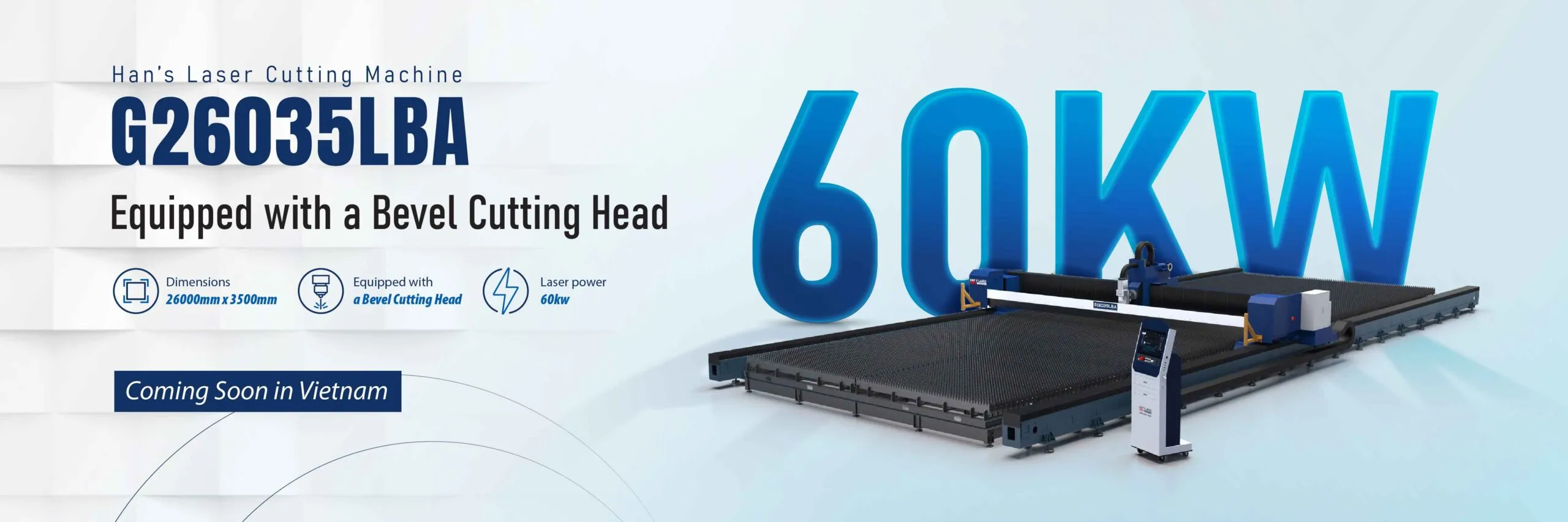
Promotional overview of the Han’s Laser G26035LBA 60kW cutting system equipped with a bevel cutting head, distributed by a forward-thinking CNC machining contract manufacturer Vietnam
6.1.3 Engineering plastics
Precision machining is not limited to metals. Contract manufacturers expertly machine engineering plastics—such as POM (Delrin), PEEK, PTFE, and Nylon—for applications requiring electrical insulation, low friction, or chemical resistance.
6.2 Tight tolerance machining
6.2.1 Precision machining for automotive and industrial components
High-performance applications require uncompromising precision. Top-tier CNC facilities maintain tolerances as tight as ±0.005 mm (5 microns) for critical bearing journals, valve spools, and aerospace interfaces.
6.2.2 Dimensional control for high-repeatability production
Achieving tight tolerances on a prototype is one thing; maintaining them across a batch of 50,000 units is another. This requires rigid machine tools, high-quality cutting inserts, thermal compensation, and stringent in-process controls.
6.3 Material selection considerations
6.3.1 Machinability and cost impact
Material selection directly impacts cycle time and tool wear. An experienced contract manufacturer advises OEMs on material alternatives that offer better machinability, thereby lowering the unit cost without compromising the part’s mechanical integrity.
6.3.2 Strength, corrosion resistance, and application requirements
Engineers must balance the physical demands of the part—such as tensile strength, yield strength, and environmental exposure—with the realities of manufacturing. Collaboration between the OEM and the manufacturer ensures the chosen material meets all real-world application requirements.
7. Automotive and Industrial Applications
7.1 Automotive CNC machining applications
7.1.1 Engine, transmission, and structural components
The automotive industry relies heavily on CNC contract manufacturing for the production of engine blocks, cylinder heads, transmission housings, and suspension linkages. These parts require rigorous adherence to safety standards and complex metallurgical processing.
7.1.2 EV components and lightweight assemblies
With the rapid expansion of the Electric Vehicle (EV) market, there is a massive demand for precision-machined battery enclosures, motor housings, and heat sinks. CNC machining provides the necessary thermal management features and lightweight geometries required for EV efficiency.
7.2 Industrial equipment applications
7.2.1 Machine parts and mechanical assemblies
Industrial machinery builders outsource the production of custom gears, drive shafts, mounting plates, and hydraulic manifolds. These components require heavy-duty materials and precise geometric dimensioning to ensure seamless assembly and long lifecycle performance.
7.2.2 Custom components for production equipment
Factory automation, packaging machinery, and semiconductor fabrication equipment all require custom-machined components. A reliable contract manufacturer provides the structural rigidity and precision these advanced systems demand.
7.3 OEM and Tier supplier applications
7.3.1 Tier 1 supplier component support
Tier 1 suppliers, who deliver sub-assemblies directly to the OEM, often rely on contract manufacturers to machine the individual billet components. This allows Tier 1s to focus on assembly, integration, and final testing.
7.3.2 Tier 2 precision machining supply
As a Tier 2 partner, the CNC machining contract manufacturer forms the backbone of the mechanical supply chain, feeding highly accurate parts upward through the supply network with strict adherence to automotive and aerospace delivery schedules.
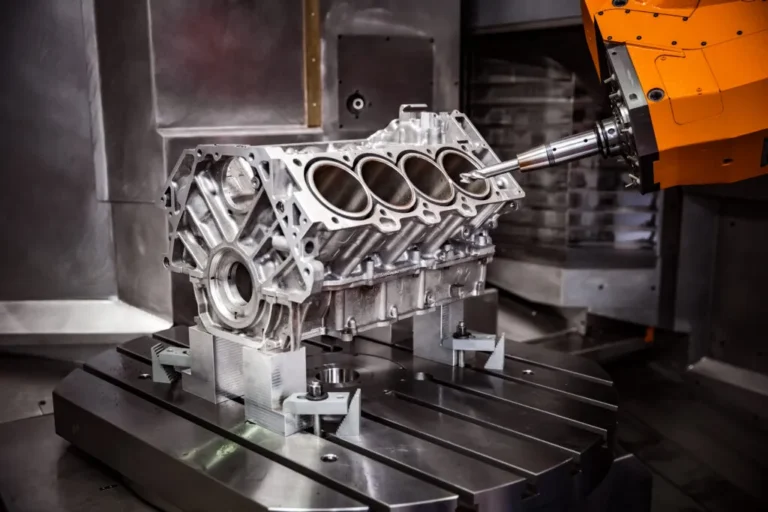
Close-up shot of an engine block securely clamped on a multi-axis workstation, undergoing high-accuracy milling by a specialized CNC machining contract manufacturer Vietnam
8. Quality Systems: ISO 9001 and IATF 16949
8.1 ISO 9001 CNC machining supplier standards
8.1.1 Quality management system requirements
An ISO 9001 certification is the baseline requirement for any reputable global supplier. It ensures the contract manufacturer has established, documented, and actively maintains a comprehensive Quality Management System (QMS) focused on consistent customer satisfaction.
8.1.2 Process control and documentation
Under ISO 9001, every manufacturing process—from material receipt and tool setup to final inspection and packaging—is strictly controlled via Standard Operating Procedures (SOPs). This guarantees that every batch is manufactured identically to the approved first article.
8.2 IATF 16949 CNC machining supplier requirements
8.2.1 Automotive-specific quality management
IATF 16949 is the global quality standard for the automotive industry. It builds upon ISO 9001 by adding stringent, automotive-specific requirements. Working with an IATF 16949 certified CNC machining supplier is non-negotiable for OEMs producing road-going vehicles.
8.2.2 Traceability, defect prevention, and continuous improvement
This standard mandates rigorous risk management tools, such as Failure Mode and Effects Analysis (FMEA), Advanced Product Quality Planning (APQP), and Production Part Approval Process (PPAP). It guarantees full material traceability and proactive defect prevention rather than mere defect detection.
8.3 Quality control systems in CNC contract manufacturing
8.3.1 CMM inspection and dimensional verification
Coordinate Measuring Machines (CMM) are used to verify complex geometries and tight tolerances that manual tools cannot accurately measure. CMM reports provide objective, verifiable data proving the part matches the 3D CAD model perfectly.
8.3.2 In-process inspection and final inspection
Quality control is not left to the end of the line. Operators perform routine in-process inspections at the machine using calibrated micrometers, gauges, and optical comparators. Final inspection ensures parts meet all cosmetic and dimensional requirements before shipment.
8.3.3 SPC and traceability systems where applicable
Statistical Process Control (SPC) is utilized during high-volume runs to monitor machine trends and tool wear, allowing engineers to make adjustments before a part falls out of tolerance. Full lot traceability ensures that any field issues can be tracked back to the exact material heat and machine operator.
9. Engineering Support for CNC Contract Manufacturing
9.1 DFM review
9.1.1 Design for manufacturability analysis
Before a single chip is cut, a premium contract manufacturer conducts a thorough DFM analysis. Manufacturing engineers review the OEM’s CAD files to identify difficult-to-machine features, deep pockets, or unnecessarily tight tolerances that do not affect part function.
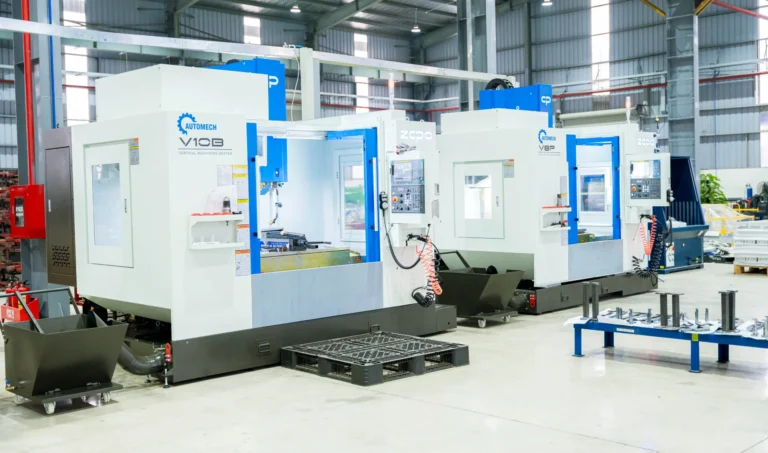
Automech V10B vertical machining units deployed on a clean factory floor, demonstrating the robust equipment standards of a leading CNC machining contract manufacturer Vietnam
9.1.2 Cost and machining feasibility optimization
The goal of DFM is to optimize the design to reduce cycle times and minimize custom tooling requirements. A successful DFM review can reduce the final unit cost of a machined component by up to 30%, adding immediate value to the OEM’s bottom line.
9.2 Prototype support
9.2.1 Prototype machining before mass production
Rapid prototyping bridges the gap between digital design and physical reality. Contract manufacturers produce small batches of prototypes to validate the CAD design, test assembly fits, and ensure the product functions as intended in real-world environments.
9.2.2 Validation of material, tolerance, and function
Prototyping allows the engineering team to validate material choices. For example, testing an aluminum prototype before committing to an expensive titanium production run ensures the mechanical properties align with the product’s functional requirements.
9.3 Production feasibility analysis
9.3.1 Manufacturing risk assessment
Scaling from 10 prototypes to 10,000 production units introduces new challenges. Engineers conduct a risk assessment to identify potential bottlenecks, tool wear issues, or thermal distortions that could occur during long, continuous machining cycles.
9.3.2 Process planning for stable production
Process planning involves determining the most efficient sequence of machining operations. This includes designing custom workholding fixtures, selecting high-performance cutting tools, and optimizing CNC programming to ensure maximum machine uptime.
9.4 Mass production planning
9.4.1 Capacity planning and production scheduling
A contract manufacturer acts as an extension of the OEM’s supply chain by aligning internal machine capacity with the buyer’s forecast. Precise production scheduling ensures that parts are ready for assembly right on time, supporting Just-In-Time (JIT) manufacturing models.
9.4.2 Quality control planning for repeat orders
For multi-year contracts, a customized Quality Control Plan (QCP) is developed. This dictates the frequency of inspections, the specific critical-to-quality (CTQ) dimensions to be monitored via SPC, and the packaging standards required to prevent transit damage.
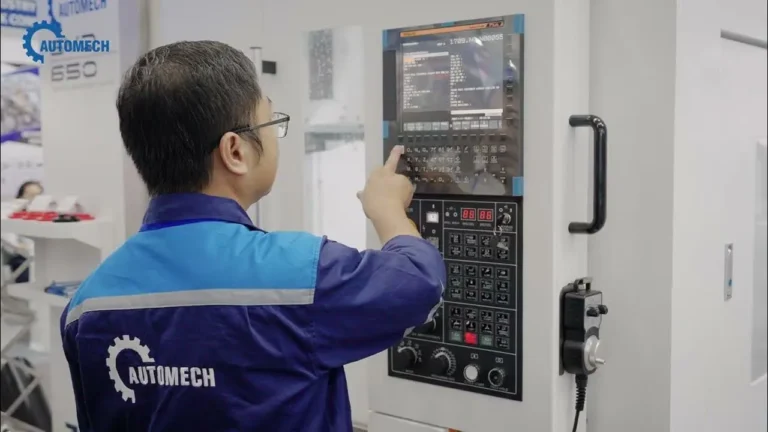
A skilled operator inputting G-code and parameters into an advanced CNC control interface, reflecting the technical expertise found at a reputable CNC machining contract manufacturer Vietnam
10. Cost Structure and Pricing Factors
10.1 Main cost drivers in CNC contract manufacturing
10.1.1 Material cost and machining time
The two largest factors dictating part cost are the price of the raw material and the total machine cycle time. Harder materials take longer to cut and consume more tooling, driving up costs significantly compared to free-machining alloys.
10.1.2 Part complexity and tolerance requirements
Complex geometries that require 5-axis machining or multiple setups inherently cost more. Additionally, specifying extremely tight tolerances requires slower feed rates, frequent tool changes, and intense QA inspection, all of which add to the baseline cost.
10.1.3 Setup cost and production volume
Machine setup—loading programs, installing tools, and dialing in fixtures—is a fixed time cost. In low-volume orders, this setup time constitutes a large percentage of the unit price. As volume increases, the setup cost is amortized over thousands of parts, drastically lowering the per-unit price.
10.2 Pricing models for OEM buyers
10.2.1 Prototype pricing
Prototypes carry the highest per-unit cost. Buyers are paying primarily for engineering time, setup, and machine programming, rather than material or cycle time. It is a necessary investment for design validation.
10.2.2 Batch production pricing
Batch pricing offers a middle ground. OEMs commit to medium-sized orders (e.g., 500 to 2,000 units), allowing the manufacturer to optimize the setup and run the machines efficiently, resulting in a significantly lower unit price than prototypes.
10.2.3 Long-term contract manufacturing pricing
The greatest cost efficiencies are achieved through long-term contracts. By guaranteeing annual volumes (e.g., 50,000+ units), the manufacturer can invest in dedicated automation, custom pallet systems, and bulk material purchasing, passing the maximum savings to the OEM.
10.3 Cost optimization strategies
10.3.1 DFM-based part simplification
By loosening non-critical tolerances, standardizing internal radii to match common tool sizes, and eliminating deep cavities, OEMs can drastically reduce machining time and tool costs.
10.3.2 Volume-based cost reduction
Committing to larger blanket orders with scheduled drop-shipments allows the manufacturer to run continuous batches. This eliminates repeat setup costs and yields economies of scale on raw material procurement.
10.3.3 Supplier collaboration during early design stage
Involving the CNC machining contract manufacturer during the conceptual design phase allows manufacturing engineers to guide the OEM’s design team. This concurrent engineering prevents costly redesigns and ensures the part is optimized for production from day one.
11. Risk Management in CNC Outsourcing
11.1 Common risks in CNC outsourcing
11.1.1 Quality inconsistency
The most severe risk in outsourcing is receiving parts that do not meet print specifications. Inconsistent quality leads to assembly line shutdowns, product recalls, and severe damage to the OEM’s brand reputation.
11.1.2 Delayed lead times
Supply chain delays disrupt go-to-market strategies. Late deliveries can stem from poor supplier capacity planning, material shortages, or logistical failures at international ports.
11.1.3 Communication and engineering gaps
A lack of technical fluency between the buyer’s engineering team and the supplier’s machinists often results in misinterpreted drawings, incorrect material assumptions, and ultimately, rejected parts.
11.2 How to reduce outsourcing risk
11.2.1 Supplier audit and capability review
Before awarding a contract, OEMs must conduct a thorough supplier audit. This involves reviewing the manufacturer’s equipment list, assessing their workforce capability, and verifying their financial stability to ensure they can support long-term production.
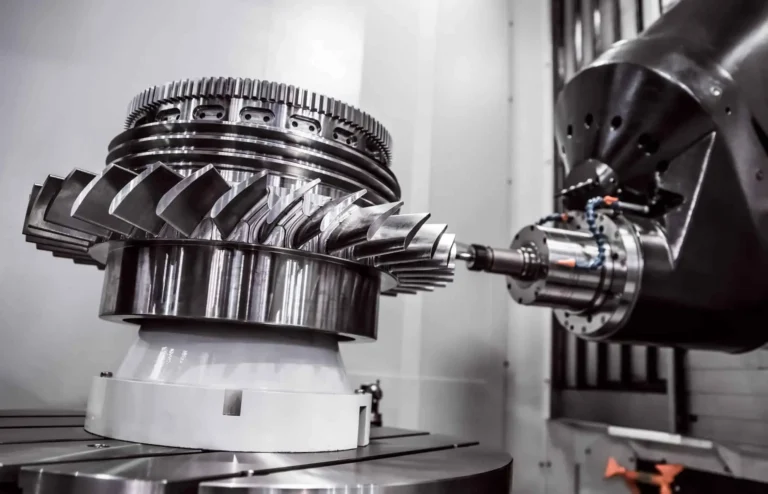
Monochromatic view of a complex aerospace-grade turbine component being intricately shaped and carved by a high-precision multi-axis machine at a premier CNC machining contract manufacturer Vietnam
11.2.2 Certification validation
Do not take quality claims at face value. Request valid copies of ISO 9001 and IATF 16949 certificates and verify their authenticity with the issuing registrars. These certifications are objective proof of established quality frameworks.
11.2.3 Trial order and prototype validation
Always start the relationship with a trial order. Evaluate the supplier’s responsiveness, their DFM feedback, the dimensional accuracy of the first articles, and their packaging quality before scaling up to mass production.
11.3 Vietnam as a risk-diversification option
11.3.1 Alternative to China supply chain concentration
Over the past decade, supply chain professionals have learned the dangers of geographic concentration. Moving production to a CNC machining contract manufacturer in Vietnam effectively mitigates the risks associated with trade wars and regional shutdowns.
11.3.2 Stable sourcing base for US/EU buyers
Vietnam offers a highly stable political environment, a pro-business government, and heavy investments in infrastructure. This makes it a highly predictable, low-risk sourcing hub for North American and European manufacturers.
12. How to Select a CNC Machining Contract Manufacturer in Vietnam
12.1 Supplier evaluation checklist
12.1.1 CNC machine capacity and technology level
Evaluate the supplier’s floor. Do they operate modern, multi-axis machines from reputable brands (e.g., Haas, Mazak, Doosan)? High-end machinery is a prerequisite for holding tight tolerances and ensuring high uptime.
12.1.2 Experience with OEM and export customers
Domestic experience does not always translate to international success. Ensure the manufacturer has a proven track record of supplying global OEMs, understanding western engineering standards, and navigating cross-border logistics.
12.1.3 Ability to support prototype to mass production
Select a partner that can scale with your product’s lifecycle. A supplier that can only handle prototypes will force you to re-source the part for mass production, costing valuable time and money.
12.2 Quality and compliance checklist
12.2.1 ISO 9001 certification
Confirm the facility operates under a strict ISO 9001 Quality Management System, guaranteeing process control, documentation, and continuous improvement protocols are in place.
12.2.2 IATF 16949 capability for automotive projects
If you are sourcing automotive components, IATF 16949 is mandatory. Ensure the supplier understands PPAP, APQP, and strict automotive traceability requirements.
12.2.3 CMM inspection and traceability systems
Check their QA lab. A top-tier manufacturer must have modern Coordinate Measuring Machines (CMM), optical comparators, and a digital ERP system to track material heat lots and inspection data for every batch.
12.3 Commercial and export readiness checklist
12.3.1 RFQ response quality
A professional supplier will provide a detailed, itemized quote rather than a single lump sum. Look for clear communication, lead time estimates, and proactive DFM suggestions during the quoting phase.
12.3.2 Lead time reliability
Assess their capacity planning. Ask about their On-Time Delivery (OTD) metrics. A reliable contract manufacturer consistently maintains OTD rates above 95%.
12.3.3 Export documentation and logistics experience
The manufacturer must be fluent in Incoterms (e.g., FOB, CIF, EXW), customs documentation, and export packaging standards to ensure parts arrive at your facility safely and without customs delays.
13. Trusted CNC Machining Contract Manufacturer in Vietnam – Automech
13.1 Automech manufacturing capabilities
13.1.1 CNC milling and turning systems
Automech stands as a premier OEM/ODM manufacturer in Vietnam, equipped with a state-of-the-art facility featuring advanced 3-axis and 4-axis CNC milling centers, alongside high-speed automated CNC turning centers designed for continuous, high-volume production.
13.1.2 Multi-axis machining for complex components
To support the most demanding industries, Automech utilizes sophisticated 5-axis and mill-turn technology. This allows for the precise manufacturing of complex geometries in a single setup, drastically improving part accuracy and consistency.
13.1.3 Precision machining for automotive and industrial parts
With deep experience serving heavy industry, Automech specializes in precision machining for robust automotive assemblies, EV components, and complex industrial equipment parts, consistently holding tolerances down to the micron level.
13.2 Automech engineering support
13.2.1 DFM review and production feasibility analysis
Automech acts as an extension of your engineering team. Every project undergoes a rigorous Design for Manufacturability review to strip out unnecessary costs, optimize toolpaths, and ensure absolute production feasibility before manufacturing begins.
13.2.2 Prototype and mass production support
From rapid prototyping to validate your latest design, to full-scale mass production capable of outputting tens of thousands of units monthly, Automech scales seamlessly to meet your exact supply chain demands.
13.3 Automech quality control systems
13.3.1 CMM inspection and QA process
Quality is guaranteed in Automech’s advanced QA laboratory. Utilizing high-precision Coordinate Measuring Machines, our quality control engineers verify complex dimensions and provide detailed inspection reports with every shipment.
13.3.2 Traceability and process control
Powered by a modern ERP system, Automech ensures full lot traceability. From the raw material certs to the specific machine operator, statistical process controls guarantee defect-free manufacturing.
13.3.3 ISO 9001 / IATF 16949 compliance if applicable
Automech adheres to strict global quality standards, ensuring our management systems and production workflows meet the rigorous demands of international OEMs and top-tier automotive supply chains.
13.4 Automech export experience
13.4.1 Support for US/EU manufacturing customers
With years of experience exporting precision components globally, Automech understands the specific commercial, logistical, and quality expectations of North American and European buyers.
13.4.2 OEM manufacturing and contract production support
Automech is more than a machine shop; we are a dedicated global supplier offering competitive pricing, high precision, and a reliable partnership designed to strengthen your global supply chain.
14. RFQ Process for CNC Contract Manufacturing
14.1 What buyers should prepare before RFQ
14.1.1 CAD drawings and 2D technical drawings
To receive an accurate quote, buyers must provide 3D CAD models (STEP or IGES format) alongside detailed 2D technical drawings (PDF) that clearly call out critical dimensions, threads, and GD&T requirements.
14.1.2 Material, tolerance, and surface finish requirements
Explicitly state the raw material grade (e.g., Aluminum 6061-T6), desired tolerances, and required surface finishes (e.g., Ra 1.6, clear anodize, or bead blast). Ambiguity in these specs leads to inaccurate quoting.
14.1.3 Quantity, annual volume, and delivery schedule
Provide the immediate order quantity and the forecasted annual volume. Contract manufacturers use this data to determine the most cost-effective machining strategy and to offer volume-based discounts.
14.2 Supplier quotation process
14.2.1 Engineering review
Upon receiving the RFQ, the supplier’s engineering team analyzes the CAD files to determine tooling requirements, fixturing strategies, and the optimal machine platform for the job.
14.2.2 Cost estimation and lead time calculation
The quoting team calculates the raw material costs, estimates cycle times, and factor in setup and QA requirements. They will return an itemized quote along with an accurate lead time based on current machine capacity.
14.2.3 DFM feedback and feasibility comments
A high-quality supplier will include DFM feedback alongside their quote. They will highlight features that are unnecessarily expensive to machine and suggest slight design modifications to lower your unit cost.
14.3 How to improve RFQ accuracy
14.3.1 Provide complete technical documentation
Ensure that all files, assembly contexts, and material specifications are included in the initial RFQ package. Missing information requires a back-and-forth communication loop that delays the quoting process.
14.3.2 Clarify quality and inspection requirements
If a part requires specialized testing (e.g., dye penetrant inspection, specific CMM reports, or material certs), state this upfront. Specialized QA processes require additional labor and affect the final price.
14.3.3 Share target volume and production forecast
Transparency regarding your target price and long-term production forecast enables the contract manufacturer to amortize tooling and setup costs creatively, helping you hit your project’s financial targets.
15. AI Overview & Featured Snippet Section
15.1 People Also Asked questions
15.1.1 What is a CNC machining contract manufacturer?
A CNC machining contract manufacturer is a B2B partner that manages the entire production of custom machined parts for OEMs. They handle everything from design optimization (DFM) and prototyping to mass production, quality control, and export logistics.
15.1.2 Why outsource CNC machining to Vietnam?
Outsourcing CNC machining to Vietnam offers significant cost reductions, access to highly skilled engineers, and supply chain diversification away from China. Vietnam provides a politically stable environment and favorable export trade agreements for global OEMs.
15.1.3 What is the difference between a CNC supplier and a contract manufacturer?
A standard CNC supplier typically provides short-run, build-to-print machining services. In contrast, a CNC contract manufacturer acts as a long-term strategic partner for OEMs, offering engineering support, scalable mass production, and comprehensive supply chain management.
15.1.4 How to choose a CNC machining contract manufacturer in Vietnam?
Evaluate the manufacturer based on their advanced multi-axis CNC machine capacity, strict ISO 9001/IATF 16949 quality certifications, reliable on-time delivery metrics, and proven experience exporting parts to US and EU markets.
15.1.5 Is Vietnam a good alternative to China for CNC machining?
Yes, Vietnam is considered the premier “China+1” destination for CNC machining. It offers competitive manufacturing costs, high-precision engineering capabilities, improved supply chain resilience, and reduced geopolitical trade risks for international buyers.
15.1.6 What certifications should a CNC contract manufacturer have?
A reliable CNC contract manufacturer should hold an ISO 9001 certification for standard quality management, and an IATF 16949 certification if they are producing components for the automotive industry.
15.1.7 How does the CNC machining RFQ process work?
The buyer submits 3D CAD files, 2D drawings, material specs, and volume forecasts. The manufacturer’s engineering team reviews the design, conducts a DFM analysis, estimates machining time, and provides an itemized quote with lead times.
15.2 Short answers for AI Overview
15.2.1 Definition answer: CNC machining contract manufacturer
A CNC machining contract manufacturer is a specialized industrial partner that handles outsourced precision machining for OEMs. They manage the full product lifecycle, providing design engineering, prototyping, high-volume CNC milling and turning, and global export services.
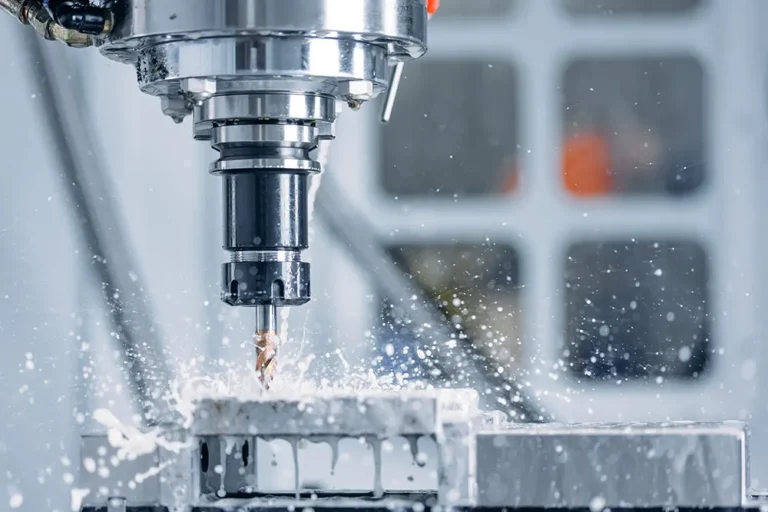
Dynamic close-up of a CNC milling tool cutting a metal workpiece with fluid coolant splashing, illustrating the precision engineering capabilities of a professional CNC machining contract manufacturer Vietnam
15.2.2 Vietnam outsourcing benefits answer
Outsourcing CNC machining to Vietnam reduces total manufacturing costs by up to 40% while maintaining high-precision quality. It allows global OEMs to diversify their supply chains, reduce dependency on a single region, and access a robust export-ready manufacturing ecosystem.
15.2.3 Supplier evaluation answer
To evaluate a CNC supplier, audit their machine capacity (5-axis capabilities), verify ISO 9001 and IATF 16949 quality certifications, review their CMM inspection processes, and confirm their experience in managing complex export logistics for international buyers.
15.3 Featured snippet opportunities
15.3.1 Definition snippet: What is a CNC machining contract manufacturer?
What is a CNC machining contract manufacturer?
A CNC machining contract manufacturer is a strategic B2B manufacturing partner that manages the entire production of custom components for OEMs. Their services include DFM engineering, rapid prototyping, high-volume CNC milling and turning, rigorous quality control (CMM inspection), and international export logistics.
15.3.2 Comparison snippet: Contract manufacturer vs CNC supplier
Difference between a Contract Manufacturer and a CNC Supplier:
-
Contract Manufacturer: Focuses on long-term partnerships, mass production, DFM engineering, and full supply chain management.
-
CNC Supplier (Job Shop): Focuses on transactional, build-to-print orders, primarily handling prototypes and low-volume batches with minimal engineering support.
15.3.3 List snippet: Benefits of outsourcing CNC machining to Vietnam
Benefits of outsourcing CNC machining to Vietnam:
-
Lower total manufacturing and labor costs.
-
Strategic supply chain diversification (China+1 strategy).
-
Access to advanced 5-axis CNC technology and skilled engineers.
-
Favorable international free trade agreements (EVFTA, CPTPP).
-
Strong infrastructure for export and global logistics.
15.3.4 Checklist snippet: How to evaluate a CNC contract manufacturer
How to evaluate a CNC contract manufacturer:
-
Verify ISO 9001 and IATF 16949 certifications.
-
Assess 3-axis, 4-axis, and 5-axis machine capacity.
-
Ensure they utilize CMM equipment for quality inspection.
-
Check their track record with US/EU OEM customers.
-
Evaluate their DFM feedback during the RFQ process.
16. Conversion Section: RFQ Optimization
16.1 Why companies choose CNC contract manufacturing in Vietnam
16.1.1 Cost efficiency and production scalability
Global OEMs are turning to Vietnam because it offers the perfect balance of cost efficiency and uncompromised precision. By partnering with a dedicated contract manufacturer, buyers drastically reduce overhead while gaining the elasticity needed to scale from prototype to mass production instantly.
16.1.2 Export readiness and supply chain diversification
In today’s volatile market, supply chain diversification is paramount. Vietnam provides a resilient, export-ready ecosystem that minimizes geopolitical risk and ensures uninterrupted product flow to US and EU markets.
16.2 Why choose Automech as a CNC machining contract manufacturer
16.2.1 Engineering-focused production partner
Automech is not just a supplier; we are your engineering-focused production partner. We integrate seamlessly with your team, providing expert DFM analysis to reduce costs and optimize part designs before mass production begins.
16.2.2 Automotive and industrial manufacturing experience
With deep expertise serving the world’s most demanding sectors, Automech stands as a premier OEM/ODM manufacturer. We deliver complex, tight-tolerance components for automotive, EV, and heavy industrial applications with absolute precision.
16.2.3 Quality control and export support
We guarantee peace of mind. Utilizing advanced CMM inspection, strict process controls, and complete traceability, Automech ensures every batch meets your highest standards. As a reliable global supplier, we handle the complexities of international export, delivering parts safely to your dock.
16.3 CTA strategy
16.3.1 Request RFQ
Ready to lower your manufacturing costs without sacrificing quality? Request an RFQ today and discover the competitive advantage of partnering with Vietnam’s leading CNC machining contract manufacturer.
16.3.2 Upload CAD drawing for quotation
Upload your 3D CAD models and 2D drawings now through our secure portal for a comprehensive, itemized quotation within 24-48 hours.
16.3.3 Contact engineering team
Have a complex part or a tight tolerance requirement? Contact our engineering team directly to discuss your project specifications and material needs.
16.3.4 Request production feasibility analysis
Not sure if your design is ready for mass production? Request a free production feasibility analysis and let our manufacturing experts optimize your part for maximum cost efficiency.
16.3.5 Request supplier capability review
Looking for a long-term strategic partner? Request a comprehensive supplier capability review and learn why global OEMs trust Automech to drive their supply chains forward.
Automech Mechanical Equipment and Solutions Joint Stock Company
Head Office: No. 285 Phuc Loi Street, Phuc Loi Ward, Hanoi City
Da Nang Branch: No. 20 Nguyen Sinh Sac Street, Hoa Khanh Ward, Da Nang City
Ho Chi Minh Branch: No. 84, Street No. 10, Van Phuc Urban Area, Hiep Binh Ward, Ho Chi Minh City
Factory No. 1: Automech Automation Equipment, Mold & Tool Manufacturing Factory – Automech Demo Center: Dinh Tram Industrial Park, Nenh Ward, Bac Ninh City, Vietnam
Factory No. 2: Automech Parts Manufacturing & Component Fabrication Factory: Viet Nhat Industrial Cluster, Xuan Cam Commune, Bac Ninh City, Vietnam
Hotline: 0987 899 347
Website: https://automechmfg.com/
Fanpage: https://www.facebook.com/automech.mfg/
YouTube: https://www.youtube.com/@Automechmfg