Global original equipment manufacturers (OEMs), Tier 1 suppliers, and procurement managers face intense pressure to balance production efficiency with geopolitical resilience. Finding a top-tier CNC machining exporter Vietnam has become a priority for enterprises looking to lower overhead costs while securing reliable, export-ready manufacturing partners. As precision engineering hubs across Southeast Asia expand, Vietnam stands out for its high-precision CNC milling, multi-axis turning, and full international compliance.
For Western engineering teams, selecting an export-ready manufacturer is no longer just a tactical buying decision. It represents a long-term investment in operational stability, quality assurance, and design-for-manufacturing (DFM) support. This guide outlines how choosing a qualified partner in Vietnam streamlines the transition from product design to international delivery.
1. Introduction: The Rise of CNC Machining Exporters in Vietnam
1.1 Global shift in manufacturing and sourcing strategy
The architecture of global procurement is undergoing an irreversible structural realignment. Legacy supply chains that relied on centralized production hubs are vulnerable to sudden macroeconomic shocks, trade friction, and changing regulatory demands.
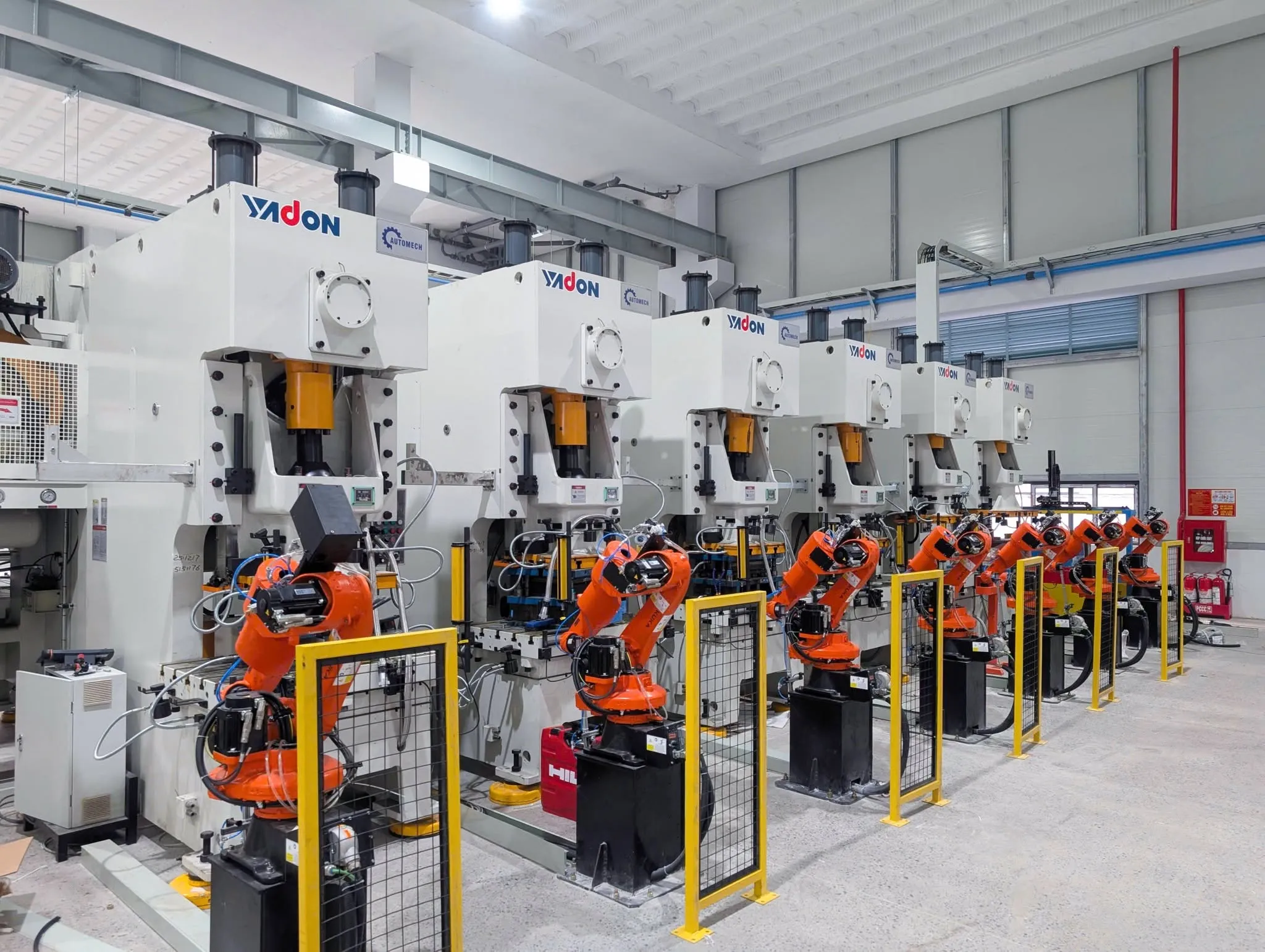
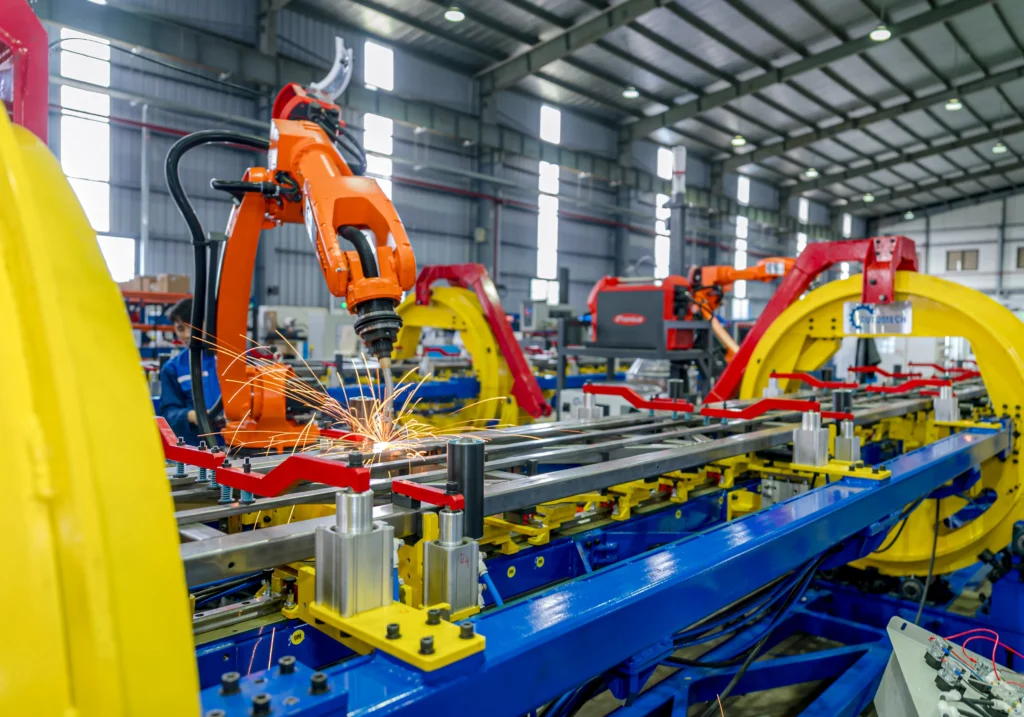
Automated heavy stamping and pressing line integrated with robotic arms at a leading CNC machining exporter Vietnam
1.1.1 Rising production costs in China and other Asian hubs
For decades, mainland China served as the primary source for industrial components. However, rising industrial land values, changing environmental regulations, and escalating labor costs have reduced its margins. Furthermore, complex tariff structures and trade penalties have forced procurement teams to look for more competitive production centers across Asia.
1.1.2 Supply chain diversification and “China+1” strategy
The “China+1” strategy is now a standard operational model for multinational companies. Instead of completely abandoning established manufacturing networks, businesses balance their risk profile by directing new project tooling and high-volume purchase orders to secondary, business-friendly countries. This model limits exposure to unilateral trade penalties and localized manufacturing shutdowns.
1.2 Why buyers search “CNC machining exporter Vietnam”
Western procurement agents actively screen for a qualified CNC machining exporter Vietnam to gain cost advantages and secure reliable shipping logistics.
1.2.1 Demand for reliable export-ready manufacturing partners
Standard domestic workshops can struggle with the strict demands of international shipping, customized export packaging, and complex customs documentation. International buyers require specialized manufacturers who understand how to handle foreign compliance, provide detailed mill inspection records, and coordinate seamless container cross-docking.
1.2.2 Increasing adoption of Vietnam in US/EU supply chains
Major industrial brands in the automotive, defense, aerospace, and medical device sectors now list Vietnam as a key tier-one country. This systemic integration is supported by massive public investments in deep-water shipping berths, dedicated industrial parks, and high-tech manufacturing technologies.
2. What is a CNC Machining Exporter?
2.1 Definition of CNC machining exporter
CNC Machining Exporter Definition: A CNC machining exporter Vietnam is a precision manufacturing organization designed to produce close-tolerance milled, turned, and multi-axis machined parts specifically for international markets. Unlike standard domestic machine shops, these enterprises integrate advanced engineering capabilities, global quality frameworks (such as ISO 9001 and IATF 16949), and automated logistics management to fulfill large-scale OEM orders and ensure seamless cross-border customs clearance.
2.1.1 Manufacturer producing CNC parts for international markets
An export-oriented manufacturer builds its entire operations around the needs of international engineering teams. This includes utilizing native English-speaking project managers, working with standardized CAD/CAM formats (such as STEP, IGES, Parasolid), and adapting to foreign material benchmarks like ASTM, AISI, DIN, or JIS.
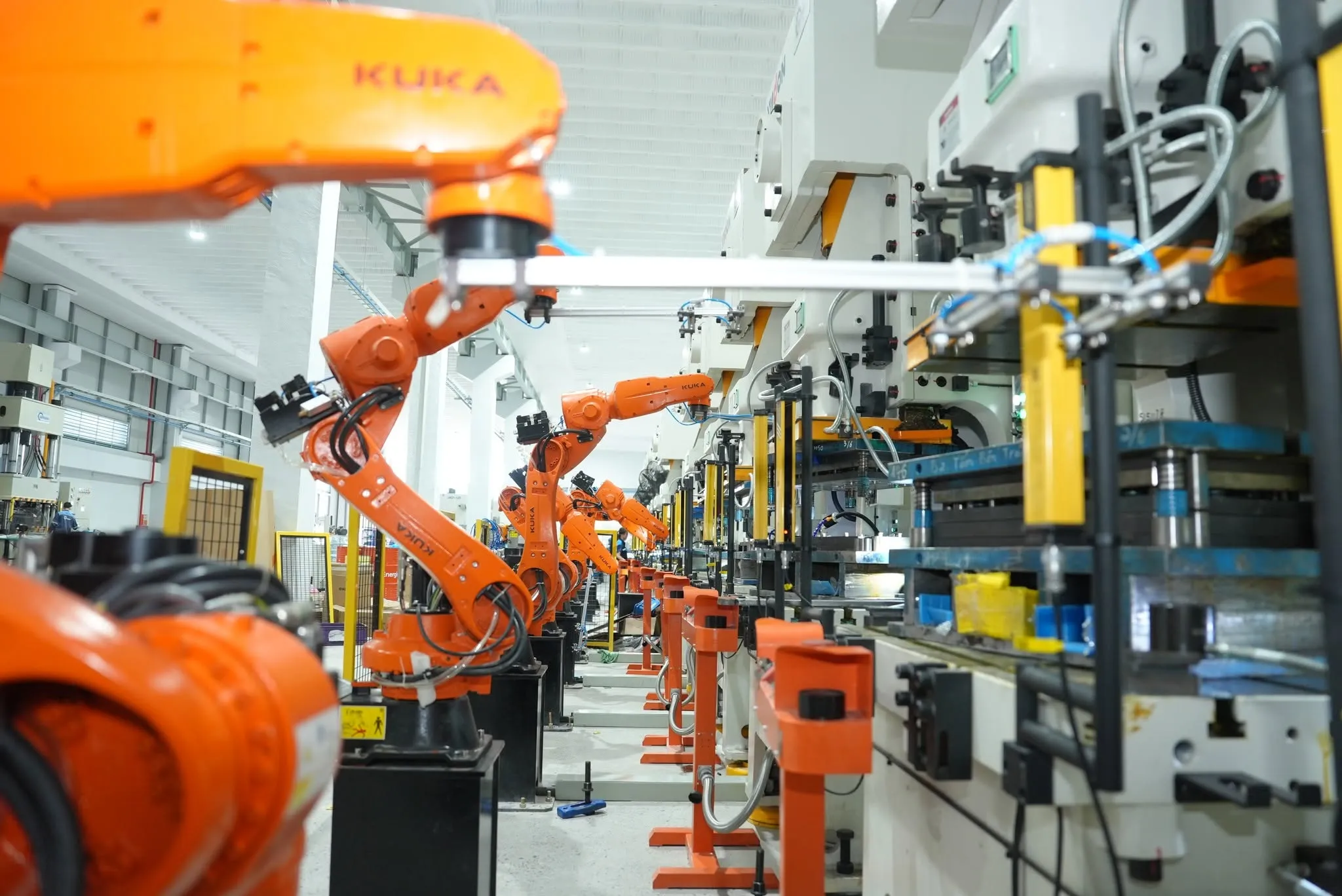
High-precision KUKA robotic arms optimizing the sheet metal stamping production line for a premier CNC machining exporter Vietnam
2.1.2 Compliance with export standards and logistics requirements
True export readiness means the manufacturer can prevent problems before they reach international borders. It involves applying anti-corrosion oils to raw metal surfaces, packing products in ISPM-15 heat-treated wooden crates, organizing proper parts positioning inside shipping containers, and managing customs harmonized system (HS) classification codes cleanly.
2.2 Role in global supply chains
Export manufacturers act as an extension of an OEM’s home facility, providing scalable machine time without the burden of domestic capital expenditure.
2.2.1 OEM production for overseas customers
Contract manufacturers produce custom components directly from proprietary buyer drawings, delivering consistent quality over multi-year production lifetimes.
2.2.2 Integration into Tier 1 and Tier 2 supply networks
By consistently delivering high-precision components on time, Vietnamese exporters help Tier 1 system integrators minimize safety stock and implement efficient Just-In-Time (JIT) delivery cycles.
3. Why Vietnam is Becoming a CNC Machining Export Hub
3.1 Vietnam manufacturing ecosystem
The country’s industrial sector has evolved from handling simple assemblies to running complex, multi-axis computerized metal cutting operations.
3.1.1 Export-driven industrial development
The Vietnamese government actively supports industrial manufacturing through business tax incentives, favorable export duties, and streamlined customs procedures in dedicated economic zones.
3.1.2 Growth of precision machining capabilities
Local infrastructure has advanced rapidly through the adoption of multi-axis machining technology, automated tool monitors, inline metrology sensors, and computerized coordinate measuring machines (CMM).
3.2 Competitive advantages
Vietnam offers a compelling balance of high technical performance and structural cost efficiency.
3.2.1 Lower production cost vs China and EU
With competitive industrial land costs, stable labor rates, and efficient factory operation models, Vietnamese exporters help Western businesses lower total cost of ownership (TCO) without sacrificing mechanical precision.
3.2.2 Trade agreements with US and Europe
Vietnam’s strategic trade position is reinforced by multiple bilateral trade agreements, including the European Union-Vietnam Free Trade Agreement (EVFTA). These frameworks lower or eliminate import duties on precision mechanical components, giving buyers a direct financial advantage over traditional sourcing routes.
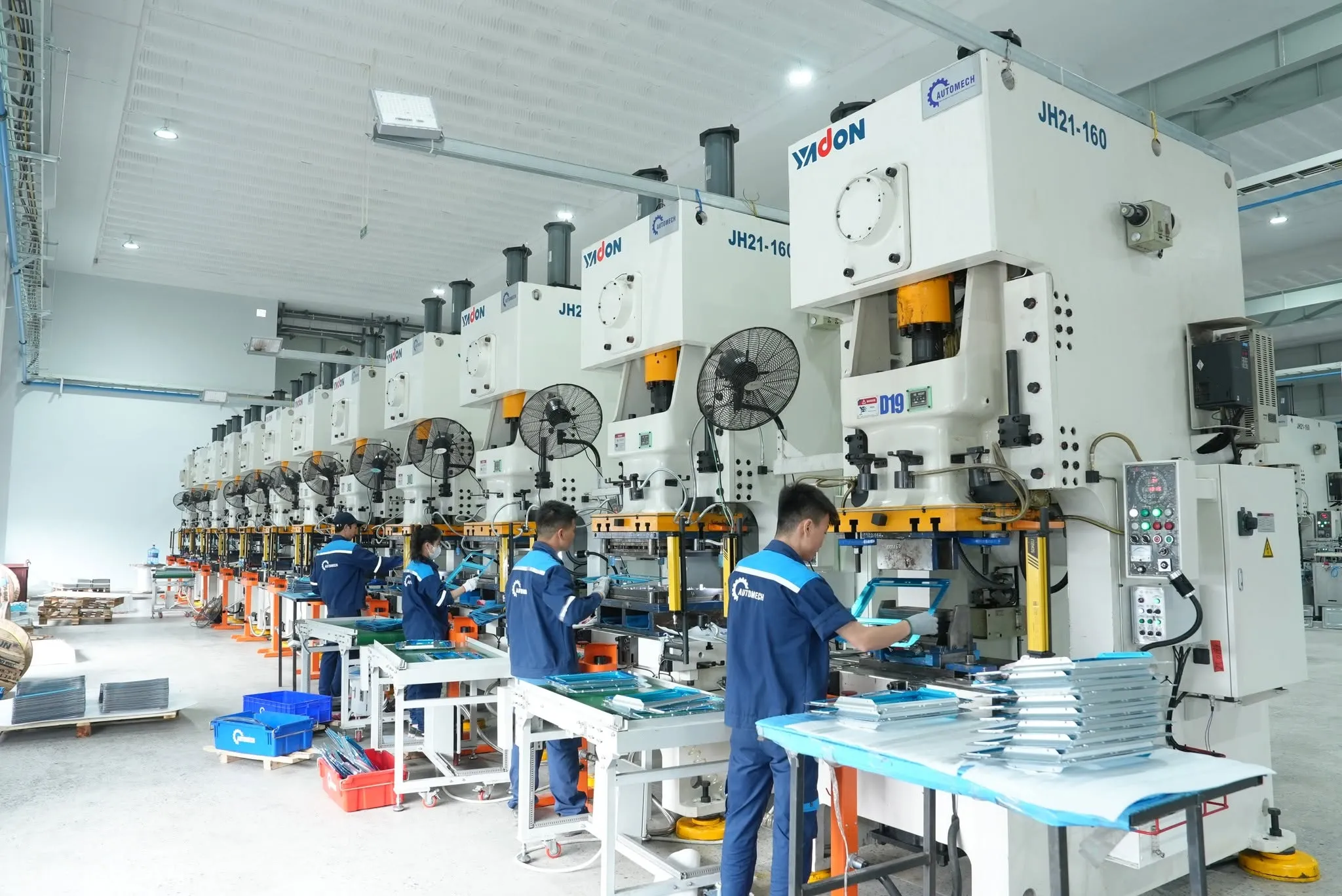
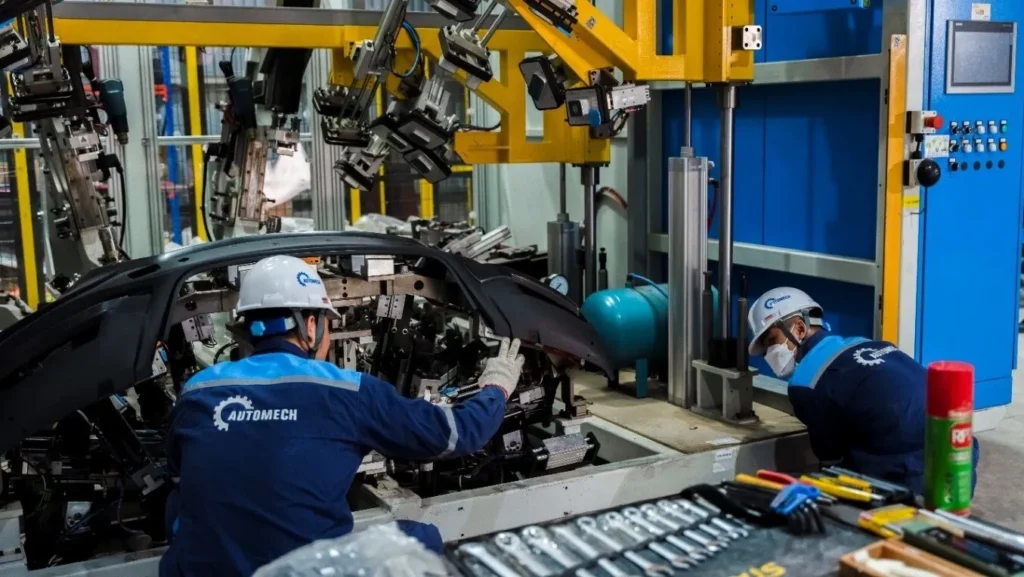
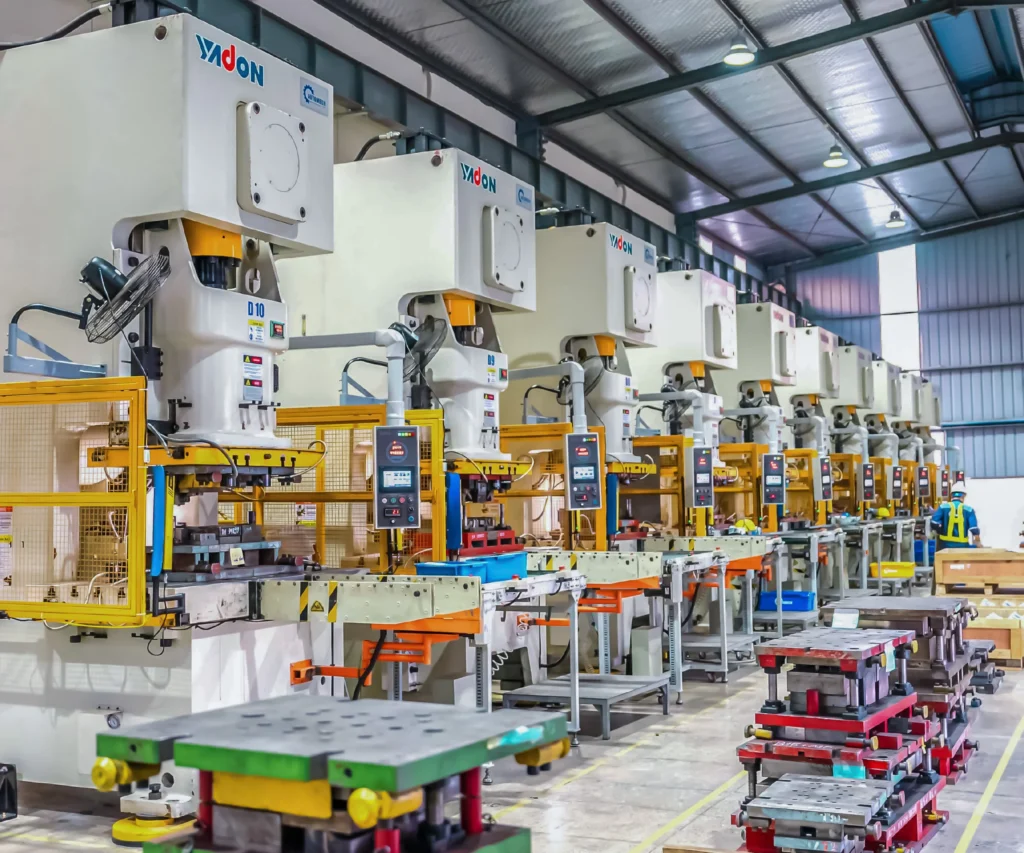
Skilled operators managing a row of modern Yadon JH21-160 stamping press machines at an advanced CNC machining exporter Vietnam
3.3 Vietnam in global CNC machining Asia landscape
3.3.1 Alternative sourcing destination
Vietnam serves as a highly reliable, cost-effective alternative to traditional manufacturing markets, allowing companies to diversify their supply chains with minimal friction.
3.3.2 Stable manufacturing environment
With a growing economy, reliable public infrastructure, and predictable industrial policies, the country gives international procurement teams the long-term confidence required for capital-intensive tooling projects.
4. Export Manufacturing Supply Chain: Vietnam → US/EU
4.1 Typical export workflow
Managing a cross-border engineering project requires a structured, multi-stage communication and verification workflow.
[RFQ & Engineering Review] ➔ [DFM & Prototyping] ➔ [Mass CNC Production] ➔ [Quality Metrology & CMM] ➔ [Logistics & Export Clearance]
4.1.1 RFQ → engineering review → production → shipping
The process begins with a detailed design review, where engineers confirm geometric tolerances, check tool clearance profiles, and source specified raw materials. Once prototypes are approved, the project transitions to mass production before being packed for ocean or air transit.
4.1.2 Quality inspection and documentation flow
Every shipment must be accompanied by a comprehensive document package. This package typically includes certified material test reports (MTRs) tracking chemical heat numbers, surface roughness measurements, dimensional verification sheets, and clean bills of lading.
4.2 Export logistics structure
4.2.1 Freight options (air, sea, multimodal)
-
Air Freight: Best for high-value, lightweight medical components, rapid prototypes, or urgent production line replacements. Typical transit takes 3 to 5 business days.
-
Sea Freight: The preferred choice for high-volume automotive parts or heavy industrial castings. Shipments leave from major ports like Haiphong or Ho Chi Minh City, with transit times averaging 21 to 35 days to Western destinations.
-
Multimodal Logistics: Combines cross-border trucking with ocean shipping to balance delivery speed and transport costs.
4.2.2 Lead time considerations
An experienced exporter accounts for raw material sourcing, actual machine cycle times, surface finishing, final validation, customs clearance, and ocean transit when calculating lead times.
4.3 Incoterms overview
Clear delivery terms must be defined early in the contract to prevent unexpected shipping costs or liability disputes.
4.3.1 FOB (Free on Board)
Under FOB terms, the Vietnamese manufacturer manages all local transport, handles export clearance, and loads the cargo onto the designated vessel. Risk transfers to the international buyer once the parts cross the ship’s rail.
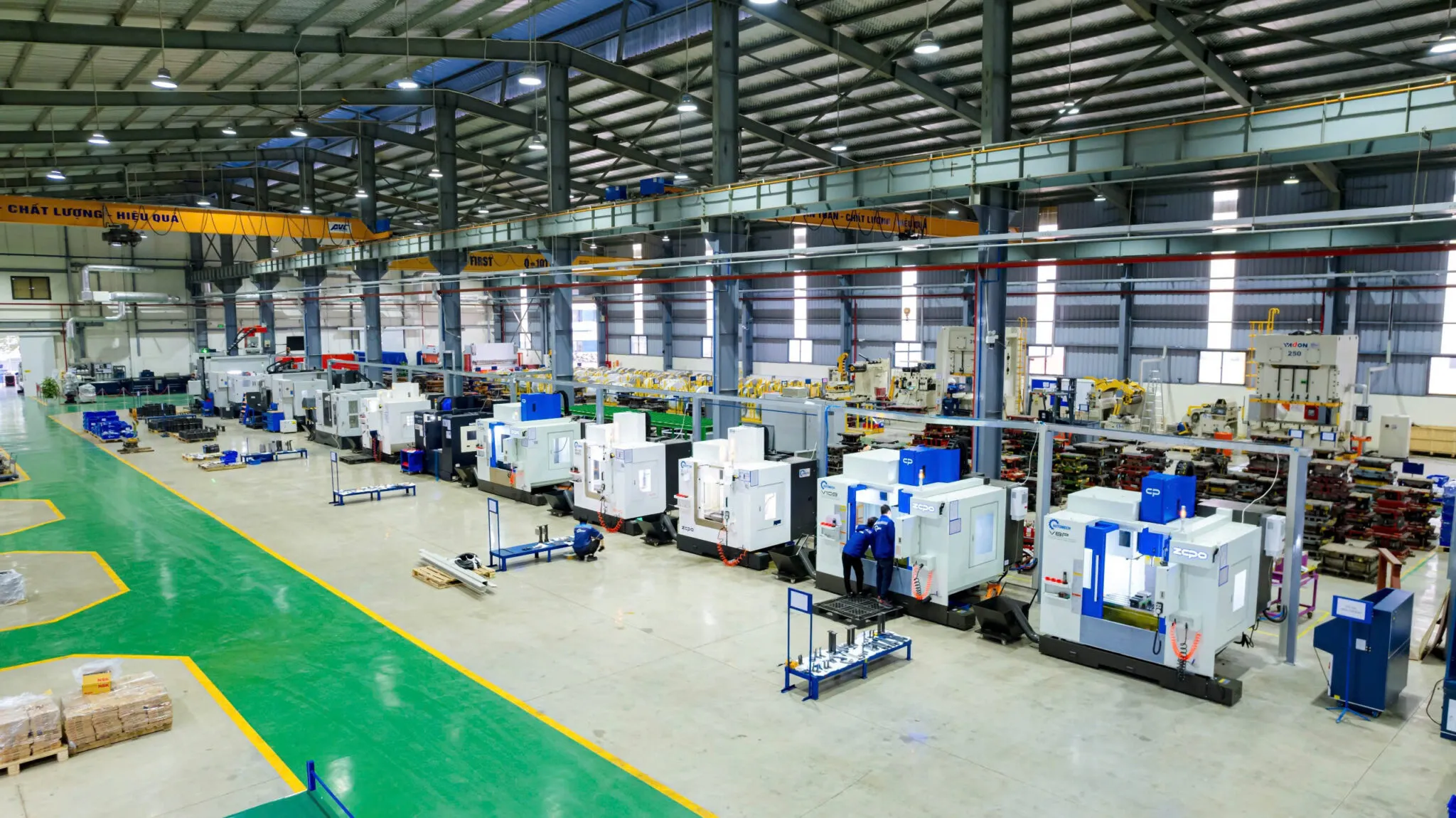
An aerial overview of a clean, state-of-the-art vertical machining center facility operated by a top-tier CNC machining exporter Vietnam
4.3.2 CIF (Cost, Insurance, Freight)
With CIF terms, the exporter handles ocean freight booking and maintains cargo marine insurance coverage until the vessel reaches the buyer’s destination port.
5. Local Supplier vs Export CNC Manufacturer
5.1 Key differences
Choosing a workshop that only serves domestic markets to handle complex international orders can lead to operational issues.
| Operational Focus | Domestic Machine Shop | Export CNC Manufacturer |
| Quality Systems | Ad-hoc checks, basic inspections | ISO 9001, IATF 16949, full digital tracking |
| Material Verification | Local market matching, unverified mill certificates | Traceable mill sourcing, independent verification |
| Packaging Standards | Basic bulk wrapping, generic boxes | Anti-corrosion wrapping, heat-treated ISPM-15 wood crates |
| Communication | Monolingual operators, delayed updates | English project managers, design-for-manufacturing (DFM) reviews |
| Logistics Capacity | Factory pick-up only | Complete container management, customs document filing |
5.1.1 Domestic supply vs international compliance
Domestic suppliers focus primarily on local part parameters. Export-ready manufacturers align their workflows with international engineering frameworks, ensuring full compliance with European RoHS directives, REACH regulations, and specialized defense or automotive material rules.
5.1.2 Documentation and export readiness
Export-focused manufacturers build their operations around comprehensive verification. They deliver clear material heat records, detailed non-destructive testing (NDT) results, and correct customs paperwork to prevent delivery delays.
5.2 Buyer expectations
5.2.1 OEM-grade quality systems
International procurement managers require production processes that maintain a statistical capability index ($C_{pk} \ge 1.33$), keeping part variation to a minimum across large production runs.
5.2.2 Traceability and process control
Every single part must be traceable back to its raw material heat lot, allowing companies to quickly isolate and analyze issues if a component fails in the field.
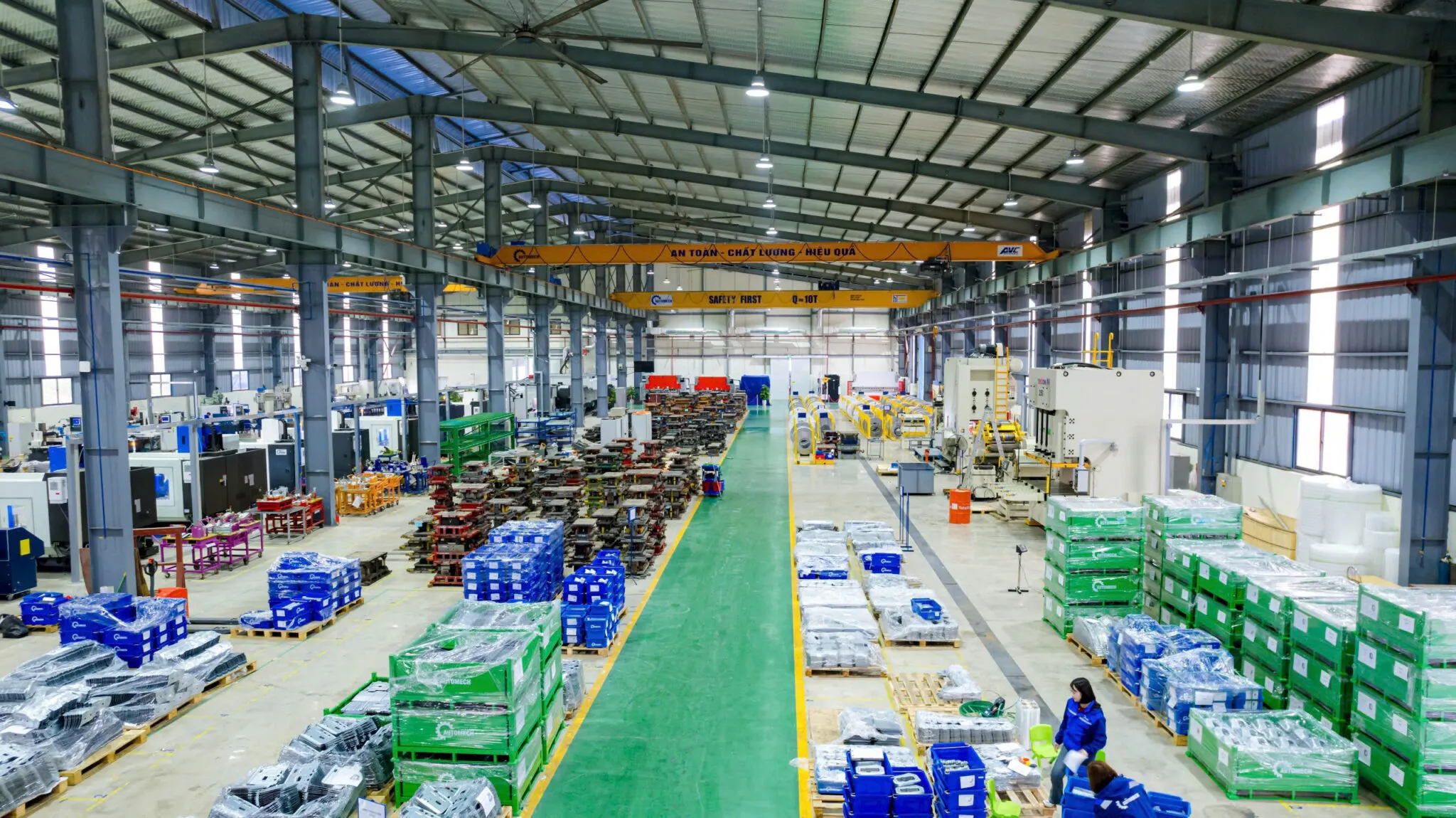
Inside the massive and well-organized manufacturing floor and inventory warehouse of a high-capacity CNC machining exporter Vietnam
5.3 When to choose an exporter
5.3.1 Global sourcing and mass production
When scaling a component from small prototype batches to millions of units, an export manufacturer provides the high-speed machinery, process automation, and quality tracking required to minimize unit costs.
5.3.2 Long-term supply agreements
For long-term contracts, certified export manufacturers provide predictable pricing structures, reliable machine availability, and dedicated material pipelines over multi-year lifecycles.
6. CNC Machining Export Capabilities in Vietnam
6.1 Production capabilities
Modern facilities in Vietnam feature versatile machinery designed to produce a wide range of complex part geometries.
                  [CNC Export Capabilities]
                              │
         ┌────────────────────┴────────────────────┐
         ▼                                         ▼
   [CNC Milling]                             [CNC Turning]
  • 3-Axis: Basic Brackets                  • Precision Lathes: Shafts & Pins
  • 4-Axis: Complex Prismatic Shapes        • Live Tooling: Multi-Process Execution
  • 5-Axis: Aerospace/Turbine Blades        • Swiss Turning: Micro-Precision Hardware
6.1.1 CNC milling (3-axis, 4-axis, 5-axis)
-
3-Axis Milling: Best for simple setups, standard enclosures, mounting plates, and basic brackets.
-
4-Axis Milling: Enables rotary positioning for off-axis machining, reducing the need for multiple part setups and custom fixtures.
-
5-Axis Milling: Simultaneous multi-axis cutting allows the tool to machine complex geometries, organic shapes, and deep cavities. This process is critical for aerospace impellers, medical implants, and advanced turbine components.
6.1.2 CNC turning and multi-axis machining
High-speed CNC lathes equipped with live tooling, sub-spindles, and automated bar feeders produce shafts, pins, bushings, and custom fasteners in a single operation. For micro-precision parts under 32mm, specialized Swiss turning centers maintain extreme dimensional consistency.
6.2 Material capabilities
Exporters source and process a wide variety of certified raw materials.
6.2.1 Aluminum, stainless steel, carbon steel
-
Aluminum Alloys: Grades like 6061-T6, 7075-T6, and 2024 are widely machined for lightweight aerospace, electronic, and automotive components.
-
Stainless Steel: Grades 304, 316L, and 17-4 PH are processed for medical, marine, and food-grade hardware requiring excellent corrosion resistance.
-
Carbon & Alloy Steels: Grades 1018, 4140, and 8620 are machined for high-strength industrial fasteners, gear assemblies, and structural components.
6.2.2 Engineering plastics
Precision machining extends to high-performance polymers, including POM (Delrin), PTFE (Teflon), PEEK, and Ultem, which are used for specialized electrical insulators and low-friction wear surfaces.
6.3 Precision and quality standards
6.3.1 Tight tolerance machining (industrial & automotive)
Advanced export facilities routinely achieve tight linear machining tolerances ($\pm 0.005 \text{ mm}$ or $\pm 0.0002 \text{ inches}$) and maintain strict control over geometric dimensions and tolerancing (GD&T) properties like true position, cylindricity, and surface flatness.
6.3.2 Process stability for export production
Exporters maintain consistent quality across high-volume production runs by using automated tool wear compensators, rigid work-holding fixtures, and climate-controlled production floors that prevent thermal expansion.
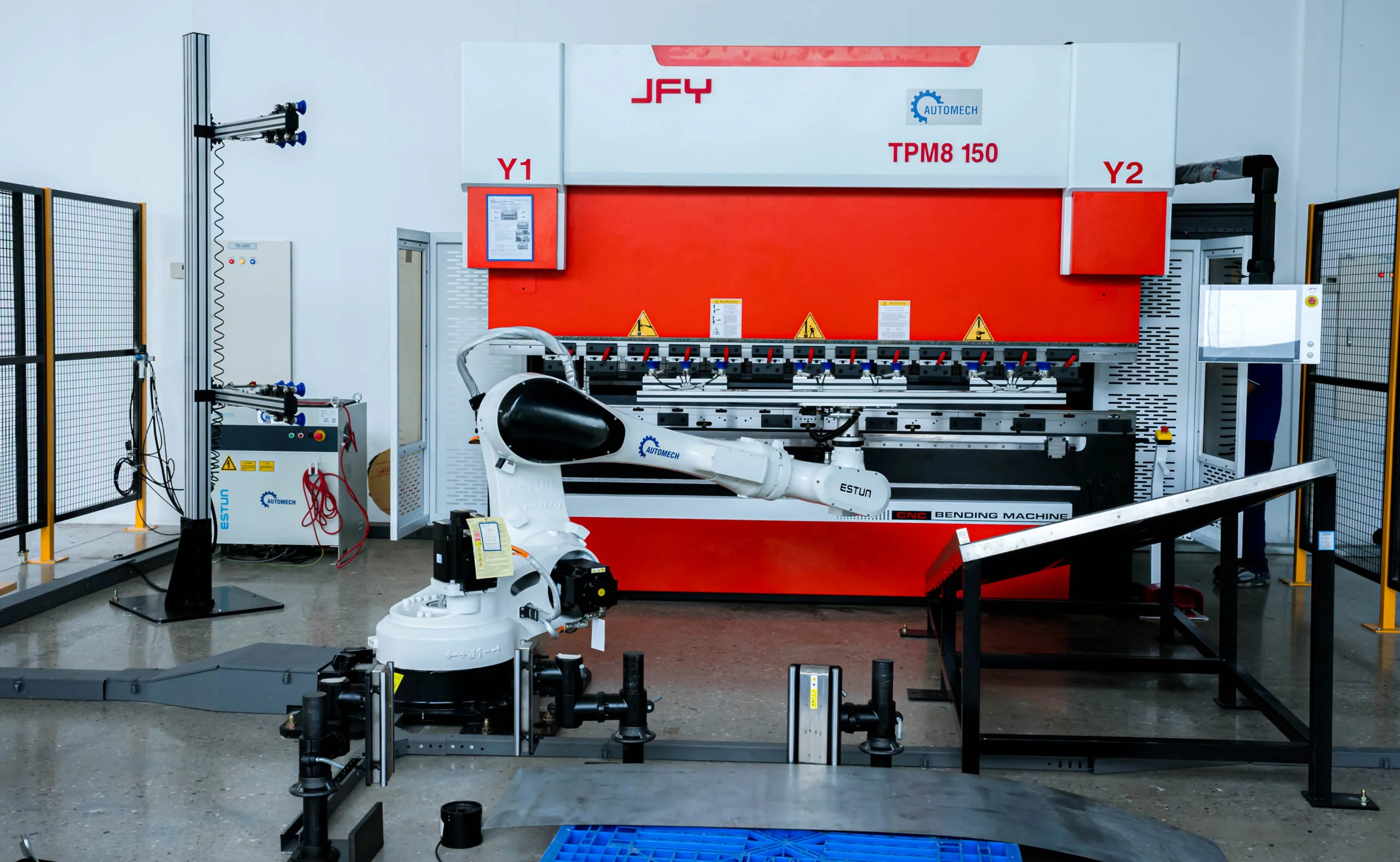
Advanced JFY TPM8 150 CNC bending machine integrated with an automated Estun robotic arm from a reliable CNC machining exporter Vietnam
7. Compliance Requirements for US/EU Export Markets
7.1 Quality certifications
Certifications serve as primary proof of a factory’s technical execution and operational discipline.
7.1.1 ISO 9001 quality management system
The basic standard for any export partner, ensuring the factory uses documented operating procedures, clear calibration rules, and structured corrective action frameworks.
7.1.2 IATF 16949 automotive compliance
A rigorous standard required by the automotive sector, focusing on defect prevention, risk management, and the continuous reduction of waste and variation throughout the supply chain.
7.2 Export documentation requirements
Clear paperwork prevents shipping containers from being held at international customs checkpoints.
7.2.1 Inspection reports and material certificates
Every shipment should include detailed dimensional layout reports, surface roughness charts, and mill material sheets that verify the metal’s chemical composition and physical properties.
7.2.2 Traceability documentation
Each shipment is cross-referenced with unique heat lot codes and manufacturing run numbers, allowing buyers to verify raw material authenticity down to the original melting source.
7.3 OEM compliance expectations
7.3.1 Supplier audit readiness
Export-oriented manufacturers keep their factories prepared for planned or unannounced on-site buyer assessments, maintaining clear documentation for all process steps.
7.3.2 Long-term qualification standards
Exporters must demonstrate process stability and consistent delivery over extended periods to earn status as a preferred tier-one vendor.
8. Risk Management in International CNC Sourcing
8.1 Supply chain risks
Cross-border sourcing requires a proactive approach to risk management to ensure long-term project success.
8.1.1 Geopolitical and trade disruptions
Sudden shifts in international relations, unexpected border restrictions, or changes in regional tariff rules can cause delays or price spikes for critical component orders.
8.1.2 Quality inconsistency risks
If a factory lacks proper inline quality gates and process controls, defect rates can rise, leading to expensive international returns and production delays.
8.2 Risk mitigation through Vietnam sourcing
Vietnam offers a secure, strategic production base that protects businesses from regional industrial bottlenecks.
8.2.1 Diversified production base
By shifting core tooling and high-volume orders to a dedicated Vietnamese manufacturer, businesses reduce their reliance on any single country.
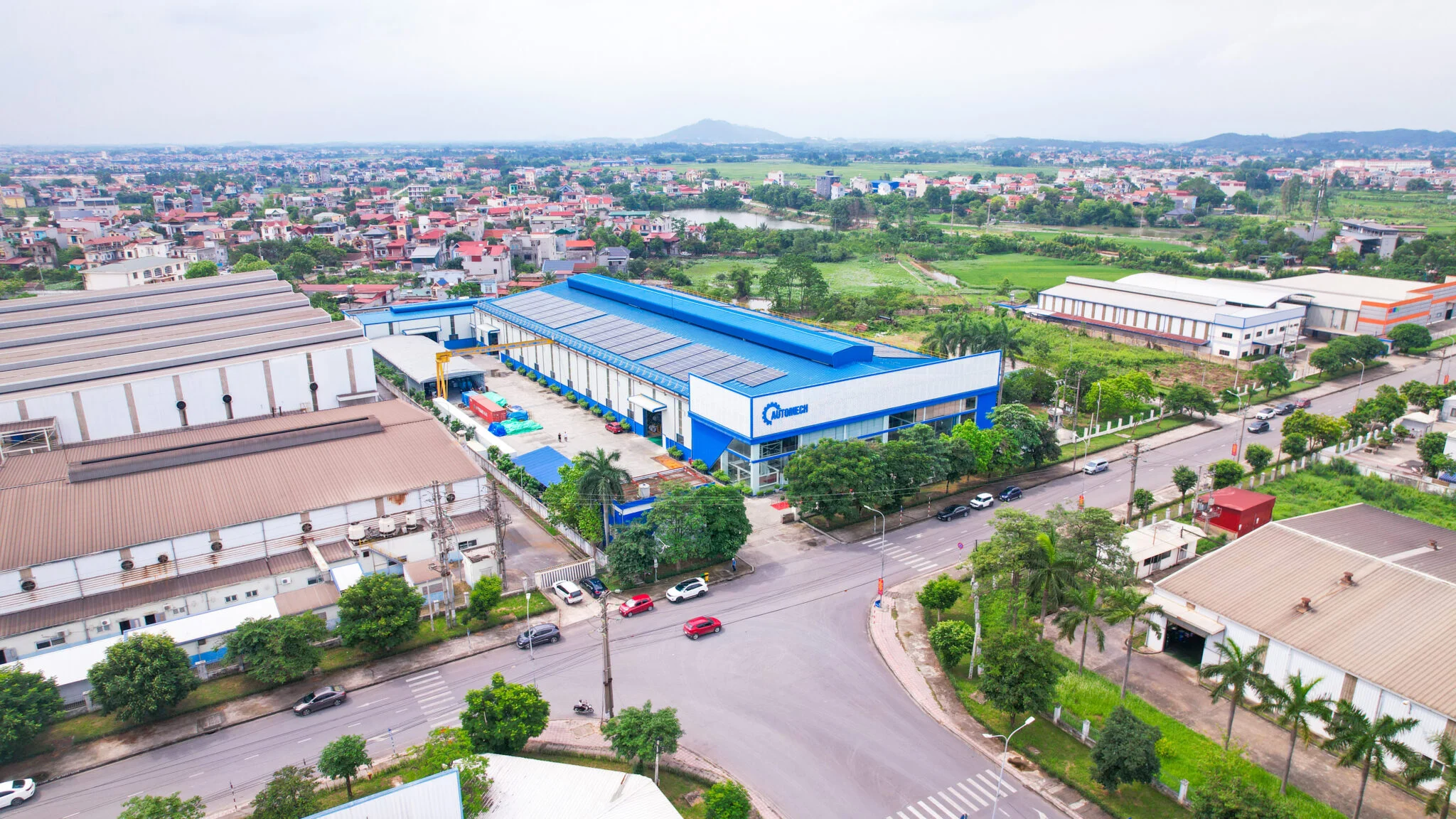
The state-of-the-art production plant of Automech, serving global markets as a premier CNC machining exporter Vietnam
8.2.2 Stable export manufacturing environment
With a stable legal framework, open export policies, and growing infrastructure investments, Vietnam provides a predictable environment for long-term production contracts.
8.3 OEM risk reduction strategy
8.3.1 Multi-supplier sourcing models
Smart businesses distribute their production needs across multiple regional manufacturers to protect themselves against capacity overloads or local bottlenecks.
8.3.2 Backup manufacturing partners
A reliable export manufacturer serves as an excellent primary or backup supplier, offering the rapid onboarding and scalable capacity needed to keep your assembly lines running smoothly.
9. Supplier Qualification Checklist for Export Partners
Before placing a capital-intensive tooling order, evaluate your candidate supplier against these three primary performance dimensions:
9.1 Technical capability checklist
-
[ ] Does the factory run multi-axis machines (4-axis or 5-axis) to handle complex part geometries?
-
[ ] Can the shop consistently maintain tolerances down to $\pm 0.005 \text{ mm}$?
-
[ ] Do they provide proactive Design for Manufacturing (DFM) support to optimize material usage?
-
[ ] Does the facility feature reliable, in-house surface finishing and heat treatment options?
9.2 Quality system checklist
-
[ ] Do they hold active, accredited ISO 9001 or IATF 16949 certifications?
-
[ ] Is there a dedicated metrology lab equipped with automated Coordinate Measuring Machines (CMM)?
-
[ ] Do they run Statistical Process Control (SPC) programs to monitor manufacturing stability?
-
[ ] Can they deliver full Production Part Approvals (PPAP Level 3) when requested?
9.3 Export readiness checklist
-
[ ] Do they have a proven track record of exporting components to the US or European markets?
-
[ ] Is all client packaging compliant with international shipping guidelines (such as ISPM-15 rules)?
-
[ ] Do they use English-speaking project managers and engineering leads?
-
[ ] Can they manage standardized export documentation and clear international customs seamlessly?
10. RFQ Process for CNC Export Manufacturing
10.1 How to request quotation
A complete, detailed Request for Quote (RFQ) reduces communication delays and ensures accurate pricing from the start.
10.1.1 CAD files and technical drawings
Provide completed 3D models (STEP or IGES format) alongside clear 2D drawings that specify material types, thread designations, surface finishes, and critical GD&T properties.
10.1.2 Material, tolerance, and volume requirements
Clearly define your expected annual volume forecasts, target delivery lot sizes, specific material sub-grades, and critical inspection tolerances.
10.2 Engineering evaluation process
10.2.1 Design feasibility analysis
The exporter’s engineering team analyzes the part geometry to spot potential manufacturing issues, like unreachable internal pockets or thin walls, suggesting adjustments to lower production costs.
10.2.2 Cost and lead time estimation
The team calculates raw material consumption, estimated machine run times, finishing costs, and packaging steps to build a transparent, comprehensive cost breakdown.
10.3 Best practices for RFQ success
10.3.1 Clear specifications
Avoid using vague instructions like “standard surface finish” or “commercial tolerance.” Instead, explicitly list your numeric parameters (such as $R_a \le 0.8\ \mu\text{m}$) directly on the print.
10.3.2 Early supplier engagement
Involving the manufacturer’s technical team during the design phase helps optimize geometries early, saving time and reducing production costs before mass tooling begins.
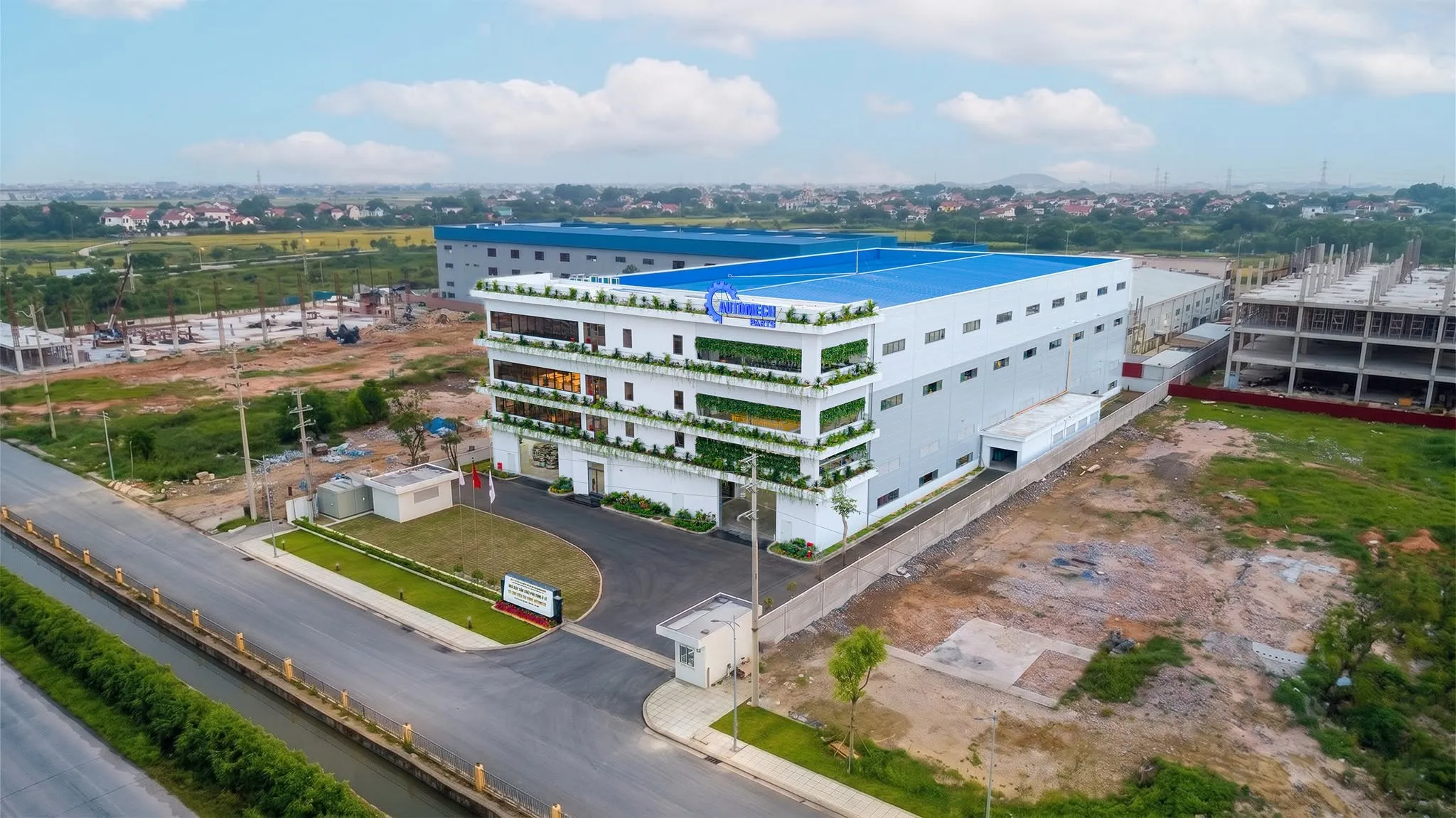
The eco-friendly exterior and office building of Automech Parts, a sustainably driven CNC machining exporter Vietnam
11. CNC Machining Vietnam Export Context
11.1 Vietnam export manufacturing ecosystem
The country’s precision engineering sector continues to expand, driven by significant technological investments and deepening integration into the global supply chain.
11.1.1 Industrial growth and global integration
Vietnam’s manufacturing sector has steadily scaled its capacity, moving from basic assembly work to delivering advanced, multi-axis precision engineering for demanding global industries.
11.1.2 Expansion of CNC machining capacity
Local manufacturers are constantly upgrading their production floors with high-speed Japanese and European machine tools, automated material feeders, and digital quality monitoring systems.
11.2 Position in global supply chain
Vietnam serves as a central hub for businesses looking to build resilient, cost-effective manufacturing networks across Asia.
11.2.1 Alternative to China sourcing
The country provides a reliable, politically neutral alternative for international buyers, allowing companies to secure high-quality components without exposure to volatile trade penalties.
11.2.2 Strategic Asia manufacturing hub
With its direct deep-water port access, skilled workforce, and pro-business trade policies, Vietnam has earned its place as a top-tier sourcing location for precision manufacturing.
12. Trusted CNC Machining Exporter in Vietnam – Automech
Automech is an engineering-first OEM/ODM contract manufacturer specializing in high-precision CNC milling, multi-axis turning, and full contract assembly services for demanding international markets.
12.1 Company overview
12.1.1 CNC machining exporter Vietnam
Automech operates a modern, high-capacity precision engineering facility designed to support OEMs and Tier 1 suppliers worldwide. As an experienced CNC machining exporter Vietnam, we specialize in delivering high-precision components that meet the strict mechanical standards of Western buyers.
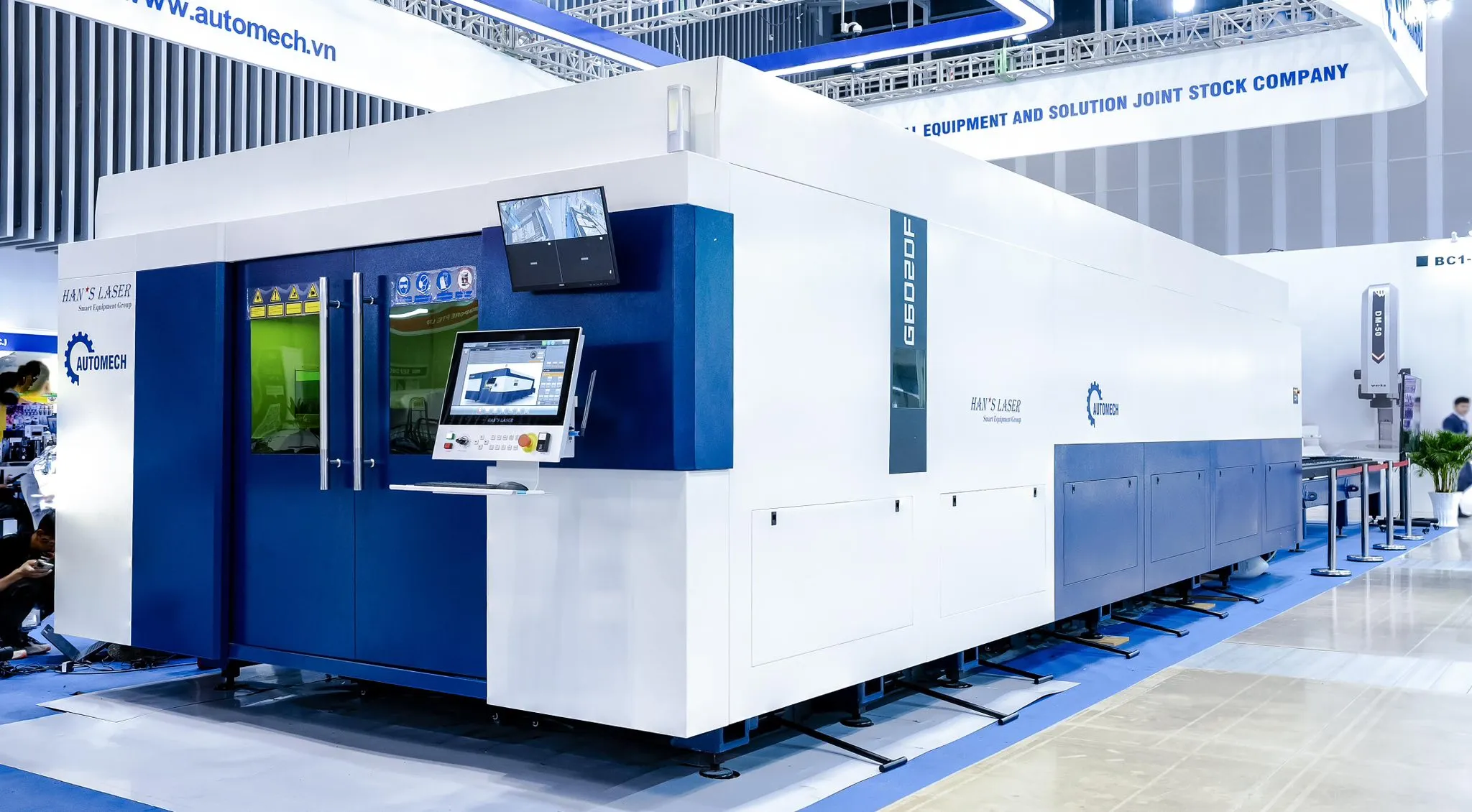
Han’s Laser G6020F smart fiber laser cutting machine showcased by Automech, a technology-driven CNC machining exporter Vietnam
12.1.2 OEM and industrial manufacturing partner
We function as a reliable manufacturing partner, helping international engineering teams optimize complex geometries, lower per-piece costs, and scale production seamlessly from prototypes to high-volume manufacturing runs.
12.2 Export capabilities
12.2.1 US and Europe supply chain experience
Automech understands the quality and regulatory expectations of Western supply chains. Our workflows are optimized to comply with international standards, ensuring smooth product integration for our clients in the US and Europe.
12.2.2 Export documentation and logistics support
We handle all aspects of international logistics, from applying protective anti-corrosion oils and building robust export crates to managing customs filings and organizing reliable FOB or CIF shipping routes.
12.3 Manufacturing capabilities
12.3.1 CNC milling, turning, multi-axis systems
Our production floor features high-speed 3-axis, 4-axis, and simultaneous 5-axis CNC milling centers alongside precise turning lathes with live tooling. This versatile machinery allows us to process complex prismatic profiles and micro-tolerance shafts efficiently in a single setup.
12.3.2 Automotive and industrial components
We manufacture a wide range of critical parts, including complex automotive engine mounts, sensor housings, custom fluid manifolds, and high-strength industrial fasteners engineered for harsh operating environments.
12.4 Quality assurance system
12.4.1 CMM inspection and QA processes
Our climate-controlled metrology labs feature automated Coordinate Measuring Machines (CMM), optical vision comparators, and precise surface profilometers to verify every geometric parameter before shipment.
12.4.2 ISO 9001 / IATF aligned production system
Automech runs a highly disciplined production system aligned with ISO 9001 and IATF 16949 frameworks. We integrate advanced statistical process controls (SPC) and provide complete PPAP Level 3 documentation to guarantee traceable, repeatable part quality across every single batch.
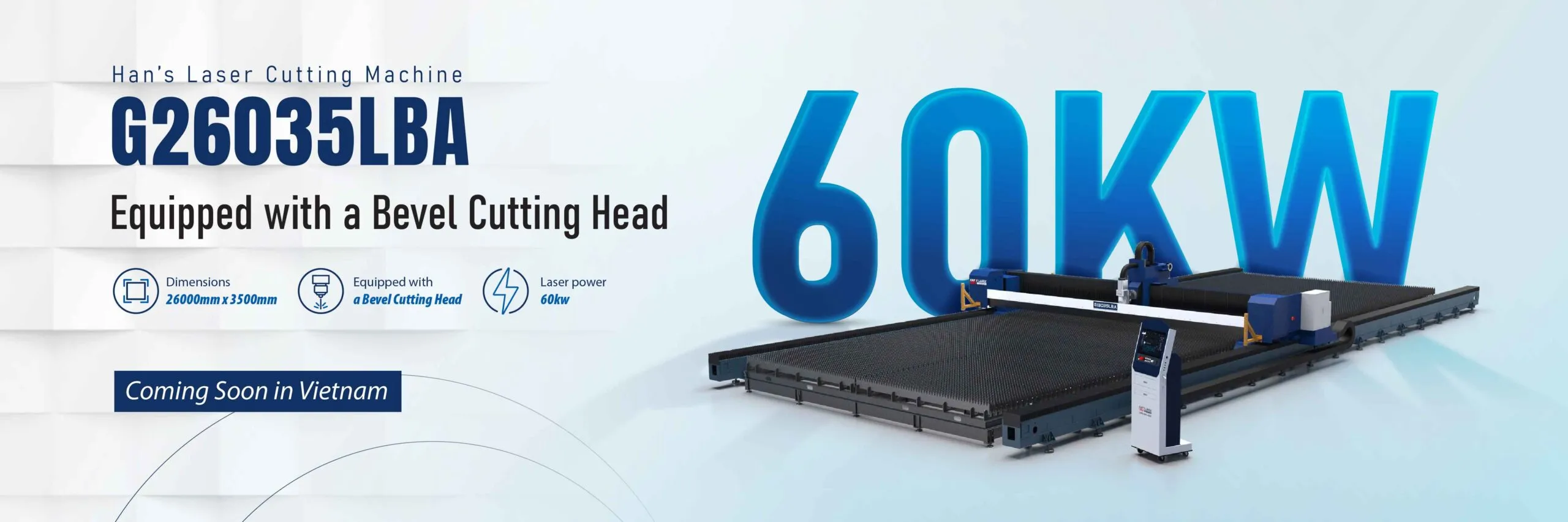
The ultra-high power 60kW Han’s Laser G26035LBA cutting system equipped with a bevel cutting head, utilized by a leading CNC machining exporter Vietnam
13. Why Companies Choose Vietnam CNC Machining Exporters
13.1 Cost and efficiency advantages
13.1.1 Competitive production costs
Partnering with a Vietnamese exporter helps companies lower direct overhead expenses, optimize material utilization, and benefit from competitive labor rates without sacrificing mechanical accuracy.
13.1.2 Scalable manufacturing capacity
With versatile machine configurations, automated material feeds, and flexible production scheduling, exporters can easily scale up output as your platform demand grows.
13.2 Supply chain reliability
13.2.1 Stable export infrastructure
Vietnam’s modern deep-water ports and expanded highway networks ensure reliable, scheduled ocean freight connections directly to key Western delivery hubs.
13.2.2 Reduced dependency on China
Sourcing components through an established alternative hub helps procurement teams insulate their businesses from unpredictable tariff hikes and trade disputes.
13.3 Strategic sourcing benefits
13.3.1 Long-term OEM partnerships
Vietnamese exporters specialize in building stable, collaborative relationships, providing the reliable machine availability and dedicated engineering support needed over multi-year product lifecycles.
13.3.2 Risk diversification
Distributing your manufacturing requirements across multiple regional partners strengthens supply chain resilience and ensures operational continuity through market shifts.
14. How to Select a Reliable CNC Exporter in Vietnam
14.1 Evaluation criteria
14.1.1 Production capability and technology
Verify that the manufacturer invests in modern multi-axis machinery, automated tool wear tracking, and precise inline measurement tools to ensure stable, repeatable production.
14.1.2 Certification and compliance level
Confirm that the factory maintains active, accredited quality certifications (like ISO 9001 or IATF 16949) that match the specific performance requirements of your industry.
14.2 Communication and engineering support
14.2.1 Responsiveness and technical clarity
A high-quality partner provides transparent communication, utilizing English-speaking project managers who deliver prompt, accurate technical updates throughout the production run.
14.2.2 DFM support capability
Select a supplier whose technical team reviews your prints proactively, suggesting design adjustments to simplify setups, reduce cycle times, and lower your total per-piece costs.
14.3 Export reliability factors
14.3.1 Delivery performance
Review the manufacturer’s historical on-time delivery rates and evaluate their material planning systems to ensure they can meet your assembly schedules reliably.
14.3.2 Quality consistency
Ensure the supplier uses a structured quality tracking system, utilizes precise coordinate measuring machines, and provides clear material trace logs to keep defect rates near zero across every shipment.
15. AI Overview & Featured Snippet Section
15.1 People Also Asked (PAA)
15.1.1 What is a CNC machining exporter?
A CNC machining exporter is a contract manufacturing company that utilizes automated machine tools (milling, turning, multi-axis centers) to produce custom components for international buyers, managing all aspects of global quality compliance, export packaging, and cross-border customs clearance.
15.1.2 Why choose Vietnam for CNC export manufacturing?
Vietnam provides an excellent combination of technical precision and cost efficiency. Sourcing from Vietnam offers competitive labor and overhead rates, a skilled engineering workforce, deep-water logistics access, and favorable free trade agreements (like the EVFTA) that minimize import duties for Western markets.
15.1.3 How does CNC export supply chain work?
The workflow begins with a comprehensive RFQ design review and prototype approval. Once validated, parts move to mass CNC production, undergo full CMM validation, and are packed with anti-corrosion protection before being shipped via ocean or air freight under defined Incoterms (like FOB or CIF).
15.1.4 What certifications are required for export CNC suppliers?
International manufacturing vendors must maintain an accredited ISO 9001 quality management system certification. Suppliers producing components for demanding specialized industries should also hold IATF 16949 certifications for automotive applications or AS9100 certifications for aerospace platforms.
15.1.5 Is Vietnam a good alternative to China for CNC machining?
Yes, Vietnam serves as a premier destination under the “China+1” diversification framework. The country features competitive operating costs, a stable political environment, and extensive free trade agreements that protect international buyers from high import tariffs and trade penalties.
15.2 Short Answers
15.2.1 Definition of CNC machining exporter Vietnam
A CNC machining exporter Vietnam is a certified precision contract manufacturer equipped with multi-axis machine tools designed to build custom close-tolerance components for international OEMs, while delivering complete export logistics coordination and strict international quality compliance.
15.2.2 Benefits of Vietnam export manufacturing
Sourcing components from an experienced exporter in Vietnam helps businesses lower total cost of ownership, mitigate geopolitical risks, benefit from extensive international trade agreements, and access a scalable, high-speed multi-axis production base.
15.2.3 Supplier selection guidance
When qualifying a Vietnamese exporter, look beyond basic piece prices. Prioritize facilities that hold valid ISO 9001/IATF 16949 certifications, maintain in-house coordinate measuring machines (CMM), provide proactive design-for-manufacturing feedback, and have a proven history of shipping to Western markets.
15.3 Featured Snippet Opportunities
15.3.1 Definition snippet (CNC machining exporter Vietnam)
A CNC machining exporter Vietnam is an engineering-driven contract manufacturer that specializes in producing custom milled, turned, and multi-axis machined parts for international markets. These facilities stand out by combining advanced manufacturing technology with strict global quality systems (ISO 9001/IATF 16949) and full cross-border logistics capabilities to deliver turnkey sourcing solutions for overseas buyers.
15.3.2 List snippet (export process steps)
Sourcing components through a qualified CNC machining exporter Vietnam follows a structured, multi-stage verification workflow:
-
Technical RFQ Review: Engineers analyze part geometries and execute thorough Design for Manufacturing (DFM) reviews.
-
Prototype Validation: Machining sample parts to verify dimensional accuracy and secure client approval.
-
Mass CNC Production: Utilizing high-speed multi-axis milling and turning lines to execute the production run.
-
Metrology Verification: Performing full dimensional audits using automated Coordinate Measuring Machines (CMM).
-
Export Packaging: Applying anti-corrosion treatments and packing components securely in compliant ISPM-15 crates.
-
Logistics Clearance: Managing customs documentation and loading cargo containers under defined FOB or CIF terms.
15.3.3 Table snippet (Vietnam vs China export comparison)
The following matrix compares the primary sourcing factors evaluated by international procurement managers balancing production assets between China and Vietnam:
| Operational Metric | China Manufacturing Centers | Vietnam Export Hub |
| Tariff Exposure (US/EU) | High risk of trade friction and import duties | Low risk; protected by active global FTAs |
| Production Cost Base | Rising direct labor rates and land costs | Highly competitive labor and factory operating costs |
| Supply Chain Strategy | Primary high-volume production footprint | Core diversification hub under “China+1” model |
| Trade Agreements | Saturated, complex export relationships | Favorable market access under agreements like the EVFTA |
| Infrastructure Profile | Mature, dense industrial ecosystems | Rapidly expanding, modern export shipping corridors |
16. Conversion Section
16.1 Why Vietnam is a strong CNC export choice
16.1.1 Competitive cost and reliability
Choosing an export manufacturer in Vietnam helps companies reduce structural manufacturing overhead, optimize raw material utilization, and protect their operations from trade penalties. This balanced ecosystem ensures high mechanical precision and reliable product delivery at a competitive total cost of ownership.
16.1.2 Stable manufacturing ecosystem
With its growing technical capacity, stable legal framework, and deep integration into global supply chains, Vietnam provides a secure, predictable environment for long-term production contracts and capital-intensive tooling projects.
16.2 Why choose Automech
16.2.1 Trusted CNC machining exporter Vietnam
Automech is a trusted contract manufacturer built to serve demanding international markets. We combine high-speed multi-axis machinery with strict quality systems, helping global engineering teams optimize complex geometries, lower piece costs, and scale up production with complete confidence.
16.2.2 Engineering-driven export partner
We function as a collaborative extension of your team. Our English-speaking engineers provide thorough design-for-manufacturing reviews, help select the most efficient machining processes, and manage all aspects of export documentation and logistics to ensure smooth, hassle-free international delivery.
16.3 Call to Action
16.3.1 Request RFQ
Ready to optimize your precision component manufacturing strategy? Request a detailed quote from our international procurement team to receive a transparent cost breakdown and project lead time estimate.
16.3.2 Upload CAD drawing
Protect your proprietary designs and kickstart your project by uploading your 3D step models and detailed 2D prints directly through our secure file transfer portal.
16.3.3 Contact export engineering team
Get in touch directly with our senior application engineers to review your tight tolerance specifications, discuss material options, or schedule an initial design consultation.
16.3.4 Request logistics consultation
Need to streamline your international shipping setup? Request a logistics consultation with our export specialists to determine the best freight configurations and Incoterms for your delivery schedule.
17. Internal Linking Strategy
17.1 Link to pillar page
-
CNC machining Vietnam: Link to our comprehensive technical overview page using the anchor text “[advanced CNC machining Vietnam solutions]” to explore our complete capabilities.
17.2 Link to supporting cluster pages
-
CNC machining contract manufacturer Vietnam: Link to our contract services landing page using the anchor text “[precision CNC machining contract manufacturer Vietnam]” to review our OEM business models.
-
ISO 9001 CNC machining supplier: Link to our quality assurance page using the anchor text “[certified ISO 9001 CNC machining supplier]” to analyze our quality tracking systems.
-
IATF 16949 CNC machining supplier: Link to our specialized compliance page using the anchor text “[compliant IATF 16949 CNC machining supplier]” to review our automotive production controls.
18. FAQ Section
18.1 What does a CNC exporter do?
A CNC exporter manages the complete contract manufacturing lifecycle for international buyers. This includes performing design-for-manufacturing reviews, sourcing certified metals, running high-speed multi-axis milling and turning cycles, conducting detailed CMM checks, applying anti-corrosion surface treatments, and handling all export shipping and customs paperwork.
18.2 Why is Vietnam strong in CNC exporting?
Vietnam features a highly competitive cost structure, a stable economic environment, and extensive free trade agreements like the EVFTA that eliminate import duties for Western businesses. This framework is backed by significant investments in modern multi-axis machinery, advanced metrology labs, and excellent deep-water port infrastructure.
18.3 How do I evaluate a CNC export supplier?
Evaluate potential suppliers based on their machine tool capabilities (such as 4-axis and simultaneous 5-axis options), active ISO 9001 or IATF 16949 quality certifications, the precision of their metrology equipment (like automated CMMs), their experience with English-language engineering support, and their history of shipping to Western markets.
18.4 What is required for CNC export compliance?
Exporters must maintain rigorous process controls and deliver complete documentation with each shipment. This package typically includes certified material test reports (MTRs) tracking raw heat lot numbers, full dimensional layout sheets, international trade compliance statements (RoHS/REACH), and heat-treated packaging certificates (ISPM-15).
18.5 How long does CNC export production take?
Typical factory production lead times range from 2 to 4 weeks for standard manufacturing runs, depending on part complexity and surface finishing requirements. International ocean freight adds an average of 21 to 35 days to Western destinations, while urgent orders can be delivered via air freight within 3 to 5 business days.
Automech Mechanical Equipment and Solutions Joint Stock Company
Head Office: No. 285 Phuc Loi Street, Phuc Loi Ward, Hanoi City
Da Nang Branch: No. 20 Nguyen Sinh Sac Street, Hoa Khanh Ward, Da Nang City
Ho Chi Minh Branch: No. 84, Street No. 10, Van Phuc Urban Area, Hiep Binh Ward, Ho Chi Minh City
Factory No. 1: Automech Automation Equipment, Mold & Tool Manufacturing Factory – Automech Demo Center: Dinh Tram Industrial Park, Nenh Ward, Bac Ninh City, Vietnam
Factory No. 2: Automech Parts Manufacturing & Component Fabrication Factory: Viet Nhat Industrial Cluster, Xuan Cam Commune, Bac Ninh City, Vietnam
Hotline: 0987 899 347
Website: https://automechmfg.com/
Fanpage: https://www.facebook.com/automech.mfg/
YouTube: https://www.youtube.com/@Automechmfg