Selecting a dependable Vietnam CNC machining supplier for Europe has become a strategic imperative for procurement managers, design engineers, and tier-1 industrial buyers. As Western and Northern European OEMs face compounding supply chain pressures, rising energy tariffs, and the imperative to de-risk single-country dependencies, Vietnam’s precision manufacturing sector offers an optimal balance: European-grade quality (ISO 9001, IATF 16949), advanced multi-axis milling and turning capabilities, tight tolerance execution down to $\pm 0.005\text{ mm}$, and significant duty advantages under the EU–Vietnam Free Trade Agreement (EVFTA).
1. Introduction: Why European Buyers Choose Vietnam CNC Machining Suppliers
1.1 Europe’s growing demand for reliable overseas CNC machining partners
European engineering sectors—including automotive, industrial automation, medical equipment, and renewable energy—require precision metal and polymer components machined to exact standards. Sourcing strategies across Germany, France, Italy, the United Kingdom, and the Benelux region have evolved from localized job-shop purchasing to resilient, globally diversified supply chains.

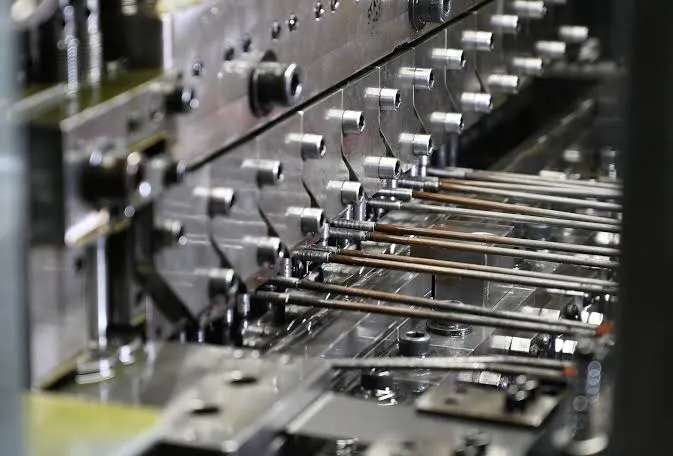
Automated robotic stamping and pressing line delivering high-volume output as a reliable Vietnam CNC machining supplier for Europe
1.1.1 Cost pressure in European manufacturing supply chains
-
Surging Operational Overhead: Industrial electricity tariffs, strict environmental surcharges, and rising labor rates across Western Europe have sharply increased the cost-per-hour on 3-axis and 5-axis machining centers.
-
Domestic Machine Shop Backlogs: Capacity constraints among European machine shops result in extended lead times for medium-to-high volume production runs.
-
Margin Preservation: Sourcing machined components from qualified overseas partners allows OEMs to cut unit production costs by 25% to 45% without sacrificing mechanical integrity or geometric dimensional accuracy.
1.1.2 Need for stable, qualified suppliers outside China
-
Geopolitical Risk Mitigation: Strategic reliance on single-source origins exposes European manufacturers to trade disruptions, freight volatility, and sudden regulatory shifts.
-
The China+1 Strategy: Procurement leaders actively balance Chinese manufacturing exposure by shifting production allocations to Southeast Asia.
-
Regulatory & Tariff Predictability: Vietnam offers a stable political and macroeconomic climate backed by bilateral trade agreements with the European Union, guaranteeing long-term supply chain security.
1.2 Why buyers search “Vietnam CNC machining supplier for Europe”
When European technical buyers input this targeted commercial query, they are seeking validated, export-capable machining facilities that understand European engineering norms (such as DIN ISO standards, metric GD&T, and EN 10204 material certification).
                        EUROPEAN OEM SOURCING FUNNEL

   [ Macro Cost & Supply Pressures ]  --->  [ Search: "Vietnam CNC Machining Supplier for Europe" ]
                                                               |
                                                               v
   [ Engineering & Commercial Validation ] <--- [ Match: ISO/IATF, 5-Axis, DFM, EVFTA ]
                 |
                 v
   [ RFQ / CAD / 2D Drawing Submission ]  --->  [ Pilot Batch / FAI / Series Mass Production ]
1.2.1 Supplier sourcing and export validation intent
-
Audited Quality Infrastructure: Buyers need confirmation that the supplier operates modern Coordinate Measuring Machines (CMM), optical profile projectors, and ISO-certified Quality Management Systems (QMS).

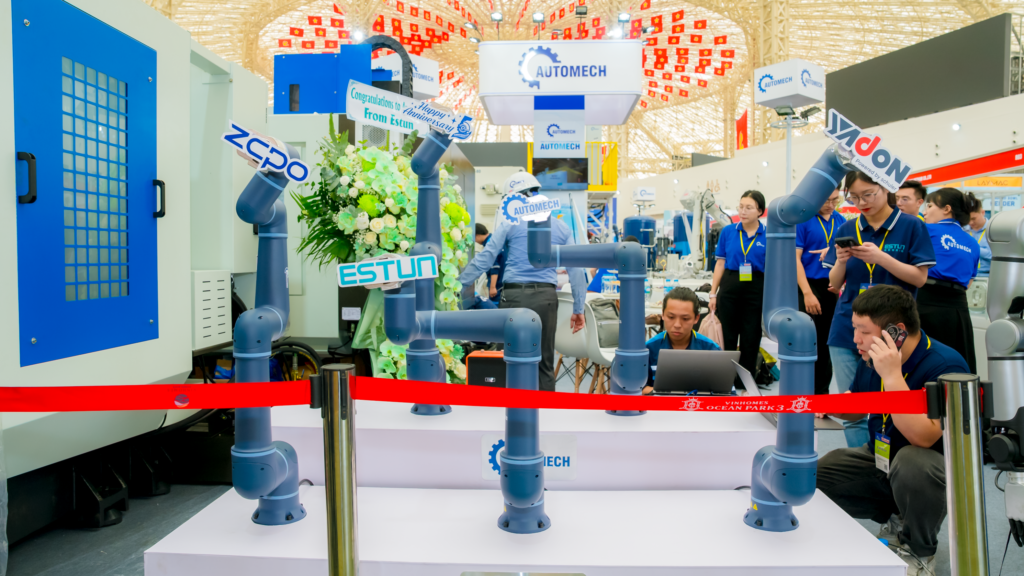
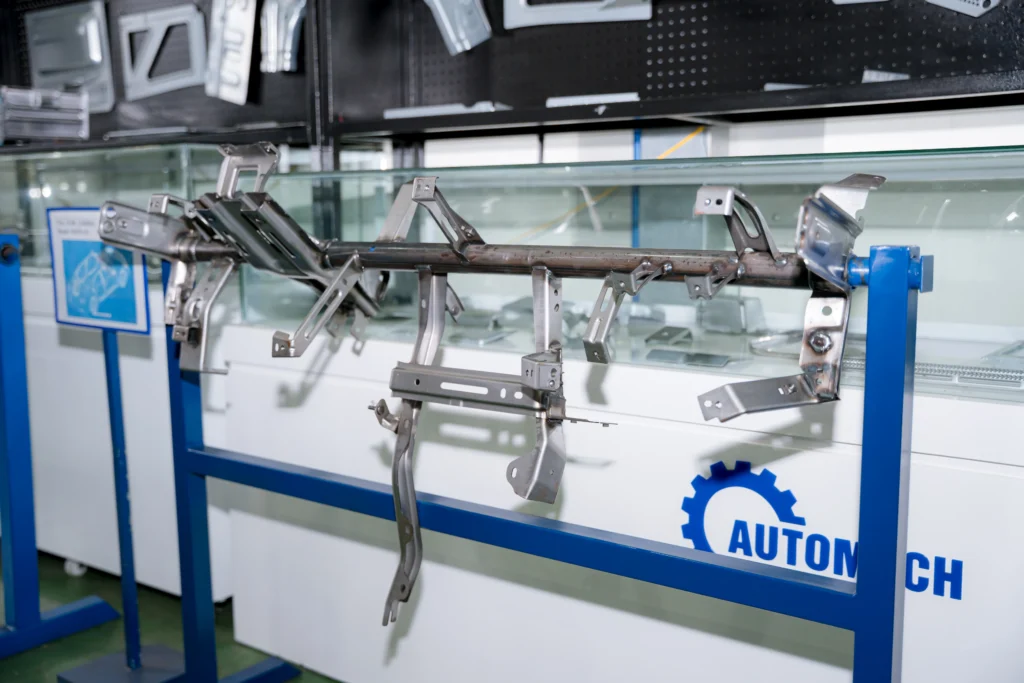
KUKA robotic arms integrated with stamping presses to ensure high-precision, automated sheet metal forming for European OEM standards.
-
Direct Export Logistics: Buyers seek manufacturers with verified track records of shipping via sea freight (FCL/LCL) and air freight directly to major European hubs (Rotterdam, Hamburg, Antwerp, Frankfurt).
-
Regulatory Compliance: Assurance that all supplied parts comply with European chemical and environmental mandates, specifically RoHS (2011/65/EU) and REACH (EC 1907/2006).
1.2.2 RFQ-driven search behavior from European OEMs
-
Immediate Project Readiness: Search queries are typically initiated with finalized 2D technical drawings (PDF format with GD&T) and 3D CAD files (STEP, IGES, Parasolid) ready for quoting.
-
Technical Feasibility Verification: Sourcing teams require fast Design for Manufacturability (DFM) feedback to validate cycle times, tooling access, and surface finishing specifications.
-
Direct Factory Engagement: Preference for integrated OEM/ODM manufacturing facilities over trading intermediaries to secure direct technical dialogue with machining application engineers.
2. Vietnam CNC Machining Supplier for Europe: Market Overview
2.1 Vietnam’s role in global CNC machining supply chains
Over the past decade, Vietnam has transitioned from basic mechanical assembly to high-precision subtractive manufacturing. Foreign direct investment (FDI) from Japan, South Korea, Europe, and the United States has accelerated the modernization of precision machine shops across key industrial corridors in Northern and Southern Vietnam.
2.1.1 Growth of Vietnam precision manufacturing ecosystem
-
Modern Machine Tool Fleet: Machine shops in Vietnam utilize high-end CNC equipment from DMG Mori, Mazak, Makino, Fanuc, Haas, and Doosan.
-
Local Supply Base Maturation: Improved domestic availability of certified tooling, fixtures, custom cutting inserts, and metallurgical testing laboratories.
-
Skilled Engineering Workforce: Technical universities and vocational institutions graduate thousands of mechanical, mechatronics, and CNC programming engineers annually.
2.1.2 Vietnam as a China+1 sourcing destination
-
Bilateral Trade Advantage: The EU–Vietnam Free Trade Agreement (EVFTA) eliminates up to 99% of customs duties over a phased schedule, giving Vietnamese exporters a direct tariff edge over other Asian manufacturing hubs.
-
Global Integration: Vietnam is an active member of international trade frameworks (CPTPP, RCEP, ASEAN), simplifying customs clearance and rules-of-origin documentation.
-
Supply Chain Clustering: Co-location of precision machining, sheet metal fabrication, injection molding, and surface treatment facilities in industrial clusters (Binh Duong, Dong Nai, Bac Ninh, Hai Phong).
2.2 Why Vietnam is attractive to European buyers
Vietnam delivers a balanced manufacturing value proposition: low operating expenditure paired with high technical precision and export support.
+-----------------------------------------------------------------------------------------+
|                        VIETNAM CNC VALUE PROPOSITION FOR EUROPE                         |
+-----------------------------+-----------------------------+-----------------------------+
|    Competitive Operations   |   Export-Driven Logistics   |     Advanced Precision      |
|                             |                             |                             |
| • 25–45% cost efficiency    | • EVFTA 0% preferential     | • 3, 4, and 5-axis milling  |
| • Optimized labor rates     |   tariffs (Form EUR.1)      | • Turning with live tooling |
| • Stable power & production | • Direct deep-sea shipping  | • Tolerances to ±0.005 mm   |
|   infrastructure            |   (Lach Huyen, Cai Mep)     | • Zeiss/Mitutoyo CMM QA     |
+-----------------------------+-----------------------------+-----------------------------+
2.2.1 Competitive production cost
-
Favorable Labor Economics: Highly skilled machinist wages remain competitive relative to regional alternatives, lowering the cost burden on high-cycle-time, complex geometries.
-
Reduced Total Landed Cost (TLC): Lower unit manufacturing prices combined with EVFTA duty preferences yield an overall lower landed cost at European receiving docks.

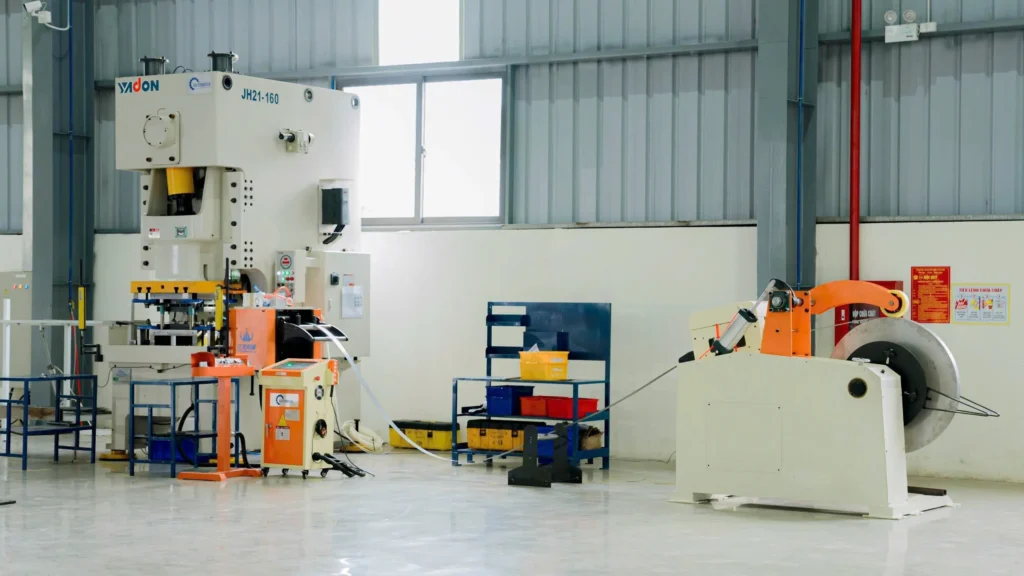
Skilled technicians operating heavy-duty JH21 mechanical stamping presses for custom metal parts production
2.2.2 Export-oriented manufacturing capability
-
Deep-Water Port Access: Modern terminal infrastructure at Lach Huyen (Hai Phong) and Cai Mep (Ba Ria-Vril/Vung Tau) provides direct container vessel routes to Western Europe without intermediate feeder transshipment delays.
-
Standardized Export Packaging: Machine shops routinely apply industrial export packaging standards: vacuum sealing, VCI anti-corrosion barrier protection, and ISPM-15 compliant heat-treated wood crating.
2.2.3 Increasing technical capability in CNC machining
-
Complex Multi-Axis Capabilities: Widespread deployment of 4-axis simultaneous and 5-axis continuous milling centers capable of cutting aerospace, automotive, and medical-grade contours.
-
Surface Finishing Integration: On-site and partnered finishing services including Type II/III anodizing, electroless nickel plating, zinc phosphating, black oxide, passivation, and automated powder coating.
3. What European Buyers Expect from a CNC Machining Supplier
Procurement teams and mechanical engineers from the DACH region (Germany, Austria, Switzerland), Scandinavia, France, and the UK evaluate overseas suppliers against three core pillars: technical accuracy, commercial predictability, and communication transparency.
       +------------------------------------------------------------------+
       |               EUROPEAN OEM SUPPLIER AUDIT PILLARS                |
       +---------------------------------+--------------------------------+
                                         |
         +-------------------------------+-------------------------------+
         |                               |                               |
         v                               v                               v
  [ TECHNICAL CORE ]            [ COMMERCIAL CORE ]           [ COMMUNICATION ]
  • DIN ISO 2768-m/f            • Transparent Cost Models     • Direct English DFM
  • ±0.005 mm Precision         • Fixed Production Windows    • < 24-Hour RFQ Turnaround
  • Zeiss CMM Inspection        • Stable Series Scaling       • Bi-Weekly WIP Reports
  • EN 10204 3.1 Certs          • Incoterms: FOB/CIF/DDP      • Root-Cause 8D Reports
3.1 Technical expectations
3.1.1 Precision machining capability
-
Adherence to European geometric dimensioning and tolerancing (GD&T) according to ISO 1101 and DIN ISO 2768 (fine to medium grades).
-
Surface roughness control down to $Ra\ 0.4\ \mu\text{m}\ (16\ \mu\text{in})$ for ground/turned critical bearing surfaces, and $Ra\ 0.8\text{–}1.6\ \mu\text{m}$ for general milled surfaces.
3.1.2 CNC milling, turning, and multi-axis machining
-
Equipment capabilities must cover high-speed CNC milling (up to 15,000–20,000 RPM spindles for aluminum), Swiss-type turning for small turned pins and fittings, and heavy-duty turning centers for large shafts.
-
Machining of diverse stock formats: bar stock, extruded profiles, cold-rolled plate, forgings, and high-pressure die-cast (HPDC) blanks.
3.1.3 Tight tolerance control for industrial components
-
Bore diameter, concentricity, parallelism, and true position tolerances maintained consistently at $\pm 0.005\text{ mm to } \pm 0.010\text{ mm}$.
-
Process capability indices ($C_{pk} \ge 1.33$ to $1.67$) verified during statistical process control (SPC) series runs.

Precision sheet metal bending using multi-ton CNC press brake machines for high-tolerance fabrication.
3.2 Commercial expectations
3.2.1 Clear quotation process
-
Detailed Cost Breakdown: Transparency regarding raw material costs, machine hourly rates, tooling setup fees, surface treatment pricing, quality inspection surcharges, and export packaging.
-
Transparent yield estimations and raw material scrap allocations.
3.2.2 Competitive lead time
-
Rapid Prototyping / DFM Sample Batches: 7 to 14 business days.
-
Pilot Production Runs (50–500 pcs): 3 to 4 weeks.
-
Series Mass Production: 4 to 6 weeks repeat order turnaround with buffered buffer-stock / safety-stock agreements (Kanban/VMI).
3.2.3 Stable long-term supply capacity
-
Floor space and machine-hour capacity reservation models to handle seasonal volume spikes without quality degradation.
-
Long-term supply agreements (LTSA) with price indexing mechanisms tied to public metal indices (LME).
3.3 Communication expectations
3.3.1 English technical communication
-
Direct access to bilingual mechanical engineers capable of evaluating drawing redlines, engineering change orders (ECO), and material substitution queries.
-
Elimination of commercial intermediaries that introduce translation lag or technical misinterpretation.
3.3.2 Fast RFQ response
-
Standard Request for Quotation (RFQ) responses delivered within 24 to 48 hours, including standard DFM optimization notes.
3.3.3 Transparent project updates
-
Work-in-Progress (WIP) tracking reports with clear photographic verification of tooling setup, first-article inspection (FAI), and final crate packing.
-
Immediate notification of schedule variances paired with actionable 8D root-cause corrective action protocols.
4. CNC Machining Capabilities for European OEMs
Modern Vietnamese contract manufacturing plants house versatile machining centers engineered to process complex geometries across various lot sizes.
+---------------------------------------------------------------------------------------+
|                       VIETNAMESE CNC MACHINING FLEET MATRIX                           |
+-------------------+-----------------------------+-------------------------------------+
| Machine Type      | Target Geometries           | Typical Applications                |
+-------------------+-----------------------------+-------------------------------------+
| 3-Axis & 4-Axis   | Prismatic parts, enclosures,| Heat sinks, mounting plates, sensor |
| CNC Milling       | rotary-indexed bolt circles | brackets, industrial chassis        |
+-------------------+-----------------------------+-------------------------------------+
| CNC Turning &     | Cylindrical profiles, shafts| Valve spools, drive shafts, fluid   |
| Swiss-Type Lathes | threads, precise bores      | connectors, threaded bushings       |
+-------------------+-----------------------------+-------------------------------------+
| 5-Axis Continuous | Complex freeform surfaces,  | Impellers, turbine components,      |
| Machining Centers | undercut aerospace contours | 5-sided prismatic automotive blocks |
+-------------------+-----------------------------+-------------------------------------+
4.1 CNC milling capabilities
4.1.1 3-axis and 4-axis CNC milling
-
3-Axis Machining: Ideal for high-speed machining of large plate-based components, heat sinks, electronic enclosures, and locating plates.
-
4-Axis Machining (Rotary A/B Tables): Enables continuous circumferential milling, angled hole drilling, and multi-sided machining in a single clamping setup, reducing datum reference errors.
4.1.2 Complex part machining
-
Processing of complex structural brackets, hydraulic manifold blocks, engine mountings, and thin-walled aluminum castings without mechanical chatter or thermal distortion.
-
Application of high-pressure through-spindle coolant (TSC) systems for deep-hole drilling and chip evacuation in gummy materials (e.g., Stainless 316L, Titanium).
4.2 CNC turning capabilities
4.2.1 Shaft and cylindrical components
-
Single-point turning, internal boring, external grooving, single-point threading (metric, BSPP, NPT), and precision knurling.
-
Diameters handled from small pins ($\varnothing 1.0\text{ mm}$) on Swiss lathes up to heavy industrial shafts ($\varnothing 450\text{ mm}\times 1500\text{ mm}$) on horizontal turning centers.

Advanced multi-axis CNC machinery fleet—including 5-axis gantry and vertical machining centers—engineered for complex industrial components.
4.2.2 High-repeatability production
-
Multi-turret, twin-spindle CNC lathes with automated bar feeders enable lights-out, continuous manufacturing of precision turned components.
-
Integration of live tooling (driven tools) to execute milling, cross-drilling, and off-axis tapping on the turning center without secondary re-clamping.
4.3 Multi-axis machining capability
4.3.1 Complex geometry components
-
Simultaneous 5-axis continuous milling handles complex organic profiles, fluid flow impellers, turbine blades, and automotive molds.
-
Advanced CAM toolpath programming (using Siemens NX, Mastercam, or Hypermill) optimizes cutting engagement angles, minimizes cutter deflection, and enhances surface finish.
4.3.2 Reduced setup and improved accuracy
-
“Done-in-One” machining: 5-sided part processing completed in a single fixture clamping.
-
Eliminates cumulative tolerance stack-up caused by manual part repositioning across multiple operations, ensuring tight concentricity and true position limits.
4.4 Production flexibility
4.4.1 Prototype production
-
Low-barrier NPI (New Product Introduction) services: 1 to 20 prototype units manufactured for functional bench testing, assembly fit validation, and mechanical stress analysis.
4.4.2 Low-volume and medium-volume batches
-
High-Mix, Low-Volume (HMLV) configurations: Batches from 50 to 2,500 pieces supported by quick-change zero-point clamping systems.
4.4.3 Mass production for OEM programs
-
High-Volume Production: 10,000 to 500,000+ pieces annually managed via automated cell layouts, dedicated hydraulic fixtures, and statistically validated quality control plans.
5. Materials and Tolerances in CNC Machining for Europe
Achieving precision outcomes requires verified metallurgical inputs and stable machine-tool dynamics to hold tight tolerances across varying thermal and mechanical conditions.
5.1 Common materials
Vietnamese CNC manufacturers source high-grade, certified raw materials from qualified domestic mills and international producers (Japan, South Korea, Taiwan, Germany).
+-------------------------------------------------------------------------------------------------+
|                       MATERIAL SPECIFICATIONS & APPLICATION MATRIX                              |
+--------------------+-------------------------+--------------------------------------------------+
| Material Category  | Standard Grades Used    | Key Properties & European Target Use Cases       |
+--------------------+-------------------------+--------------------------------------------------+
| Aluminum Alloys    | 6061-T6, 7075-T651,     | Lightweight, high strength-to-weight ratio,      |
|                    | 5083-H111, 2024-T3      | excellent anodizing response. Automotive & Aero. |
+--------------------+-------------------------+--------------------------------------------------+
| Stainless Steels   | AISI 304/304L (1.4301), | High corrosion resistance, chemical stability,   |
|                    | 316/316L (1.4404), 17-4PH| food-grade & marine hardware, medical shafts.    |
+--------------------+-------------------------+--------------------------------------------------+
| Carbon/Alloy Steel | C45 (1.0503), 4140      | High yield strength, excellent wear resistance,  |
|                    | (42CrMo4), 1018, S235JR | heat treatable. Structural gears, heavy shafts.  |
+--------------------+-------------------------+--------------------------------------------------+
| Engineering        | POM-C (Delrin/Acetal),  | Low friction coefficient, dimensional stability, |
| Plastics           | PEEK, PTFE, Nylon PA6/66| electrical insulation. Bushings, medical mounts. |
+--------------------+-------------------------+--------------------------------------------------+
5.1.1 Aluminum alloys
-
EN AW-6061 / 6082: High-strength, versatile alloys with good machinability and corrosion resistance; ideal for automotive structural parts and industrial framing.
-
EN AW-7075-T651: High-strength zinc-aluminum alloy offering tensile strength comparable to medium-grade steels; widely used in aerospace, robotics, and high-stress racing components.
5.1.2 Stainless steel
-
AISI 304 / 304L (1.4301 / 1.4307): General-purpose austenitic stainless steel with excellent weldability and atmospheric corrosion resistance.
-
AISI 316 / 316L (1.4401 / 1.4404): Molybdenum-bearing stainless steel designed for aggressive marine, chemical processing, and hygienic medical environments.
-
17-4 PH (1.4542): Precipitation-hardened martensitic stainless steel delivering high hardness (up to 44 HRC after H900 heat treatment) and yield strength.
5.1.3 Carbon steel
-
C45 / 1.0503: Medium carbon unalloyed engineering steel used for machined pins, keyed shafts, and standard structural components.
-
42CrMo4 / AISI 4140: High-strength chromium-molybdenum alloy steel suitable for high-load gears, drive axles, and heavy-duty mechanical transmission elements.
5.1.4 Engineering plastics
-
POM-C (Polyoxymethylene / Acetal): High mechanical stiffness, low friction, and exceptional dimensional stability; zero moisture absorption issues during machining.
-
PEEK (Polyetheretherketone): High-performance thermoplastic capable of continuous operation up to $250^\circ\text{C}$; replaces metals in chemical, semiconductor, and medical applications.
5.2 Tolerance requirements
Precision contract machining facilities operate within standard metric baseline limits while sustaining micrometer-level precision on mission-critical features.
                               TOLERANCE CAPABILITY SPECTRUM

   Standard Machining (ISO 2768-m)        Precision CNC Turning/Milling        Ultra-Precision Automotive
  |-------------------------------------|-----------------------------------|----------------------------|
  ±0.100 mm                             ±0.020 mm                           ±0.005 mm (5 µm)
  • General enclosures & brackets       • Bearing journals & pilot steps    • Fuel injector bodies
  • External clearances                 • Dowel pin press-fits (H7/g6)      • High-speed spindle sleeves
5.2.1 Standard precision machining tolerances
-
General linear dimensions conform to DIN ISO 2768-m (medium) or DIN ISO 2768-f (fine).
-
Standard CNC milling/turning tolerances: $\pm 0.025\text{ mm to } \pm 0.050\text{ mm}$.
5.2.2 Tight tolerance machining for automotive and industrial parts
-
Critical features (bearing bores, dowel pin locating holes, ground shaft diameters): $\pm 0.005\text{ mm}$ ($\pm 5\ \mu\text{m}$).
-
Geometric tolerances: Cylindricity, flatness, runout, and perpendicularity held within $0.005\text{–}0.010\text{ mm}$ total indicator reading (TIR).
5.3 Material documentation
European engineering compliance mandates end-to-end documentation confirming physical, chemical, and dimensional compliance.
5.3.1 Material certificates
-
Provision of EN 10204 Type 3.1 Inspection Certificates directly from the raw material mill detailing exact chemical spectrometry and mechanical tensile/hardness tests.
5.3.2 Traceability records
-
Heat lot number tagging, mill source identification, raw billet lot marking, and batch segregation throughout cutting, machining, and surface treatment.
5.3.3 Inspection reports
-
Full dimensional First Article Inspection Reports (FAIR) per AS9102 / ISO 9001 formats, detailing nominal values, allowable tolerances, measured data, and pass/fail indicators.

ndustrial Han’s Laser high-power fiber laser cutting system for fast, burr-free sheet metal profiling.
6. Quality Standards and Certifications for European Buyers
Quality management systems (QMS) must prevent non-conformance upstream rather than simply filtering defects at final inspection.
       +------------------------------------------------------------------+
       |               QUALITY CONTROL & TRACEABILITY FLOW                |
       +------------------------------------------------------------------+
                                         |
     [ Raw Material Inward (MTC EN 10204 3.1 Check + Spectrometry Verification) ]
                                         |
                                         v
       [ First Piece Approval (Full Dimensional Verification via CMM / FAI) ]
                                         |
                                         v
       [ In-Process Quality Control (SPC Sampling, $C_{pk} \ge 1.33$ Tracking) ]
                                         |
                                         v
       [ Final Inspection & Testing (100% Critical Dimensions + Surface Finish) ]
                                         |
                                         v
       [ Serialization, VCI Packaging & Export Documentation Package Finalization ]
6.1 ISO 9001 CNC machining supplier requirements
6.1.1 Quality management system
-
Certification to ISO 9001:2015 covering the full manufacturing scope: CNC programming, production scheduling, maintenance calibration, and customer service.
-
Documented Standard Operating Procedures (SOP) across all machining work centers.
6.1.2 Process control and continuous improvement
-
Application of PDCA (Plan-Do-Check-Act) cycles, Corrective and Preventive Actions (CAPA), and continuous 5S workplace organization.
-
Annual calibration of all measuring equipment traceable to national metrology institutes (VMI / NIST).
6.2 IATF 16949 CNC machining supplier relevance
For automotive OEM and Tier-1 programs, baseline ISO 9001 compliance is extended with automotive-specific risk management frameworks.
6.2.1 Automotive quality management requirements
-
Implementation of IATF 16949:2016 Core Tools:
-
APQP (Advanced Product Quality Planning)
-
FMEA (Failure Mode and Effects Analysis)
-
MSA (Measurement System Analysis – Gage R&R $< 10\%$)
-
SPC (Statistical Process Control)
-
PPAP (Production Part Approval Process Level 1 to Level 3)
-
6.2.2 Tier 1 and Tier 2 supplier qualification
-
Ability to satisfy rigorous customer-specific requirements (CSR) from European automotive groups (e.g., Volkswagen Group, BMW, Stellantis, Bosch, Continental).
6.3 Quality inspection systems
+--------------------------------------------------------------------------------------+
|                         METROLOGY EQUIPMENT BENCHMARK                                |
+------------------------------+---------------------------+---------------------------+
| Metrology Device             | Measurement Capabilities  | Primary QA Function       |
+------------------------------+---------------------------+---------------------------+
| Bridge CMM (Zeiss / Mitutoyo)| Volumetric accuracy down  | Complex 3D GD&T, spatial  |
|                              | to $(1.5 + L/350)\ \mu\text{m}$| features, true position   |
+------------------------------+---------------------------+---------------------------+
| Optical Vision Measuring     | Non-contact optical       | Micro-features, 2D profiles|
| Systems (Keyence / Mitutoyo) | profile scans down to 1 µm| small turned grooves, burrs|
+------------------------------+---------------------------+---------------------------+
| Surface Roughness Testers    | Contact stylus tracing    | Quantitative surface $Ra,$ |
| (Mitutoyo Surftest)          | down to $0.01\ \mu\text{m}$ | $Rz,$ and $Rmax$ analysis |
+------------------------------+---------------------------+---------------------------+
| Air Gauges & Thread Gages    | Sub-micron ID/OD bore     | Fast in-process cycle     |
|                              | comparator checks         | verification on the floor |
+------------------------------+---------------------------+---------------------------+
6.3.1 CMM inspection
-
Air-conditioned, temperature-controlled ($20^\circ\text{C} \pm 1^\circ\text{C}$) metrology laboratories housing bridge Coordinate Measuring Machines.
-
Direct CAD-to-part inspection routines using automated multi-probe styli systems.
6.3.2 In-process quality control
-
Shop-floor inspection routing: Machine operators verify critical control points every $n$-th piece using digital micrometers, bore gauges, and custom go/no-go fixtures.
-
Real-time control charting tracking tool wear and thermal drift to trigger automatic tool-offset adjustments.
6.3.3 Final inspection reports
-
100% check of safety-critical characteristics and AQL-based statistical sampling (per ISO 2859-1) for general features.
-
Complete FAI dossier provided with every export shipment.
6.4 Traceability requirements
6.4.1 Batch-level traceability
-
Each production job is tagged with a unique Traveler Job Card linking raw material ingot lots to machine IDs, operator IDs, cutting tool serials, and QC sign-offs.
6.4.2 Material and process traceability
-
Archiving of heat-treatment furnace graphs, plating bath chemical titration logs, and raw material chemical certificates for a minimum of 5 to 10 years.
6.4.3 Documentation for European OEM audits
-
Complete audit readiness supporting on-site VDA 6.3 Process Audits and remote visual verifications.
7. Export Process from Vietnam to Europe
Exporting precision components across global logistics lanes requires streamlined workflows, thorough trade documentation, and robust transit packaging.
       +------------------------------------------------------------------+
       |               VIETNAM-TO-EUROPE EXPORT WORKFLOW                  |
       +------------------------------------------------------------------+
                                         |
     [ RFQ & 3D DFM Engineering Sign-Off (24–48h Quoting, Material Lock) ]
                                         |
                                         v
     [ Production, Multi-Axis Machining, Surface Finishing & QA (CMM Check) ]
                                         |
                                         v
     [ Anti-Corrosion VCI Packing + Custom Trays + ISPM-15 Heat-Treated Crates ]
                                         |
                                         v
     [ Customs Export Filing (Form EUR.1 Certificate of Origin for 0% Tariff) ]
                                         |
                                         v
     [ Ocean Freight (28–35 Days via Cai Mep) / Air Freight (3–5 Days via HAN/SGN) ]
                                         |
                                         v
     [ Landed Delivery to European OEM Dock (FOB, CIF, or DDP Terms Applied) ]
7.1 Typical export workflow
7.1.1 RFQ and engineering review
-
Technical intake: 2D drawing analysis, tolerance review, material availability check, and DFM recommendations.
-
Quotation submission, sample delivery schedule, and tooling/fixture agreement.
7.1.2 Production and inspection
-
Machining pilot run, First Article Inspection (FAI) validation, and customer sign-off.
-
Series production execution under verified QMS and final metrology verification.
7.1.3 Packaging and shipping
-
Application of anti-corrosion oils, individual part wrapping, desiccant placement, and palletization.
-
Container loading and export customs processing at local ports.
7.2 Export documentation
Accurate documentation guarantees rapid customs clearance at EU ports of entry (Rotterdam, Antwerp, Hamburg, Le Havre).
7.2.1 Commercial invoice
-
Detailed breakdown of part numbers, descriptions, HS Codes (Harmonized System, typically Chapter 84 or 87), unit prices, and total project value.
7.2.2 Packing list
-
Gross weight, net weight, outer carton dimensions, box counts, and individual part serial allocations.
7.2.3 Certificate of origin if required
-
Issuance of Certificate of Origin Form EUR.1 issued by the Ministry of Industry and Trade (MOIT) of Vietnam to claim 0% preferential tariffs under the EVFTA.
7.2.4 Material and inspection documentation
-
Accompanying MTC EN 10204 3.1, RoHS/REACH compliance letters, CMM dimensional reports, and surface treatment plating certificates.
7.3 Incoterms overview
+--------------------------------------------------------------------------------------+
|                         EXPORT INCOTERMS SELECTION GUIDE                             |
+-------------------+-----------------------------------+------------------------------+
| Incoterm          | Supplier Responsibility           | Buyer Responsibility         |
+-------------------+-----------------------------------+------------------------------+
| FOB (Free on Board| Delivers goods cleared for export | Pays ocean/air freight, EU   |
| Hai Phong/Cai Mep)| on board the vessel at VN port    | customs clearance, import tax|
+-------------------+-----------------------------------+------------------------------+
| CIF (Cost,        | Pays export clearance, ocean      | Pays EU port handling,       |
| Insurance, Freight| freight, and marine transit       | import customs clearance,    |
| Rotterdam/Hamburg)| insurance to European base port   | final inland EU trucking     |
+-------------------+-----------------------------------+------------------------------+
| DDP (Delivered    | Manages full end-to-end transport,| Accepts delivery at factory  |
| Duty Paid)        | EU customs clearance, duty payment| dock; zero logistics burden  |
+-------------------+-----------------------------------+------------------------------+
7.3.1 FOB for buyer-controlled shipping
-
FOB (Free on Board): Common choice for large European OEMs with established global 3PL forwarding contracts (e.g., Kuehne+Nagel, Schenker, DHL Global Forwarding).
7.3.2 CIF for supplier-supported shipping
-
CIF (Cost, Insurance, and Freight): Supplier books and finances the maritime transport and insurance up to the European destination port.
7.3.3 DDP if applicable to project requirements
-
DDP (Delivered Duty Paid): Complete turnkey delivery to the buyer’s warehouse doors, with all duties and EU import value-added tax handled by the exporter’s logistics partners.

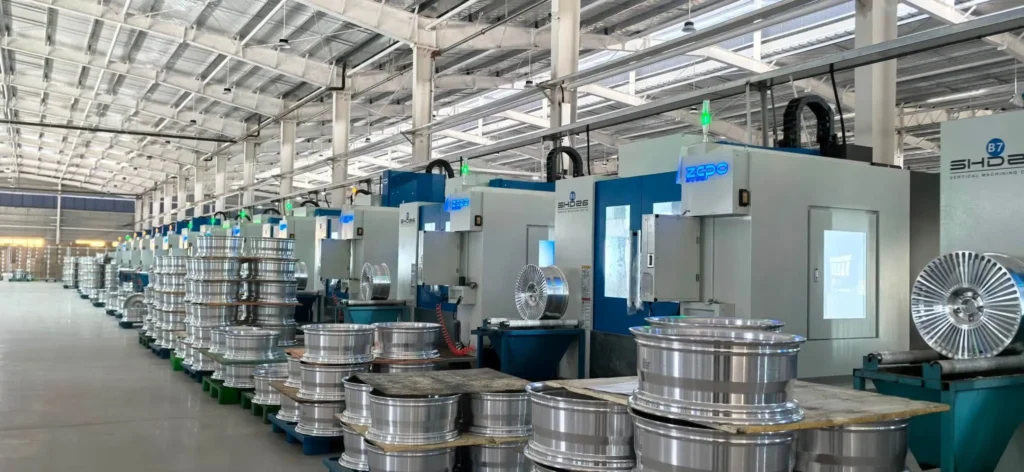
High-capacity production bay with a dedicated line of SVT 500 CNC milling centers for mass manufacturing
7.4 Packaging requirements for Europe
Precision machined surfaces and tight-tolerance threads can be damaged by moisture, marine salt air, and rough handling during ocean transit.
7.4.1 Export-safe packaging
-
Individual compartments using custom thermoformed blister trays, compartmentalized EPE (Expanded Polyethylene) foam inserts, or heavy-duty partitioned corrugated boxes.
7.4.2 Corrosion protection
-
Application of light evaporative rust-preventative oils, volatile corrosion inhibitor (VCI bags/paper), and silica gel desiccant packs inside hermetically heat-sealed polybags.
7.4.3 Labeling and part identification
-
Outer cartons and pallets marked with high-contrast, waterproof labels featuring European standard Barcode / DataMatrix codes, customer part numbers, PO numbers, and batch IDs.
8. EU Compliance Considerations for CNC Machined Parts
European directives require strict control over hazardous substances and environmental impact.
       +------------------------------------------------------------------+
       |                  EU REGULATORY COMPLIANCE SUITE                  |
       +---------------------------------+--------------------------------+
                                         |
         +-------------------------------+-------------------------------+
         |                               |                               |
         v                               v                               v
    [ RoHS 3 ]                      [ REACH ]                    [ VDA 6.3 AUDIT ]
  (2015/863/EU)                   (EC 1907/2006)                (German VDA QMC)
  • Lead (Pb) < 0.1%              • SVHC Candidate List         • P2–P7 Process Audits
    (Exemption 6c brass: <4%)     • Full chemical disclosure    • Corrective action plans
  • Cadmium (Cd) < 0.01%          • Safe use instructions       • Robust Poka-Yoke error
  • Mercury & Hexavalent Cr       • SCIP database readiness       proofing controls
8.1 European documentation expectations
8.1.1 Inspection records
-
Retention of physical and digitized dimensional logs, CMM 3D scan data, and calibrated hand-gauge measurements for every production lot.
8.1.2 Material certificates
-
Verification of chemical composition, heat numbers, tensile strength, yield point, and elongation percentages directly mapped to European metallurgical specifications (EN / DIN).
8.1.3 Traceability files
-
Full lot genealogy enabling rapid containment in the event of an engineering change or field failure.
8.2 REACH and RoHS considerations
8.2.1 When REACH may apply
-
REACH Regulation (EC 1907/2006): Applies to all components imported into the EU. Suppliers must ensure parts contain no Substances of Very High Concern (SVHC) above the 0.1% weight-by-weight (w/w) threshold.
8.2.2 When RoHS may apply
-
RoHS Directive (2011/65/EU and amendment 2015/863 – RoHS 3): Crucial for CNC parts intended for electrical, electronic, or automotive systems. Restricts Lead (Pb), Cadmium (Cd), Mercury (Hg), Hexavalent Chromium ($Cr^{6+}$), PBBs, PBDEs, and phthalates.
-
Note on Machining Alloys: Specific standard exemptions apply, such as Exemption 6(c) allowing up to 4% lead by weight in copper alloys (machining brass like CuZn39Pb3 / CW614N).
8.2.3 Project-specific compliance verification
-
Suppliers must provide signed Declarations of Conformity (DoC) supported by third-party laboratory test reports (e.g., SGS, TÜV Rheinland, Intertek).
8.3 Supplier audit readiness
8.3.1 Quality system review
-
Verification of standard operational procedures, internal audit schedules, calibration records, and management review outputs.
8.3.2 Process control verification
-
Evaluation of Poka-Yoke (mistake-proofing) mechanisms, tool management software, automated tool-wear compensation, and dynamic maintenance programs.
8.3.3 Long-term supplier qualification
-
Structured vendor rating systems evaluating on-time delivery (OTD), parts-per-million (PPM) defect rates, and engineering support responsiveness.
9. Automotive and Industrial Applications for European Customers
9.1 Automotive CNC machining applications
Vietnamese precision manufacturers supply Tier-1 and Tier-2 automotive suppliers delivering parts to European automotive platforms.
+--------------------------------------------------------------------------------------+
|                    AUTOMOTIVE CNC MACHINING USE CASES                                |
+------------------------------+---------------------------+---------------------------+
| Automotive Subsystem         | Critical Machined Parts   | Engineering Requirements  |
+------------------------------+---------------------------+---------------------------+
| Powertrain & Transmission    | Valve bodies, oil pump    | Leak-tight sealing faces, |
|                              | shafts, shift forks       | micro-drilled fluid ports |
+------------------------------+---------------------------+---------------------------+
| EV & Battery Architecture    | Inverter cold plates,     | High thermal transfer,    |
|                              | busbar clamps, connectors | thin-wall milling, 0-burr |
+------------------------------+---------------------------+---------------------------+
| Structural & Chassis Systems | Suspension pivot brackets,| High strength-to-weight,  |
|                              | steering knuckles, mounts | 100% UT crack testing     |
+------------------------------+---------------------------+---------------------------+
9.1.1 Engine and transmission components
-
High-pressure common rail fuel system components, turbocharger wastegate actuators, precision sensor housings, and variable valve timing (VVT) spools.
9.1.2 EV and battery system components
-
Extruded aluminum battery enclosure frames, liquid cooling distributor manifolds, electric drive unit (EDU) motor end-plates, and high-voltage copper busbar connectors.
9.1.3 Precision brackets and housings
-
ADAS radar and LiDAR aluminum sensor brackets, cast-iron steering gear housings, and high-strength suspension control-arm links.
9.2 Industrial equipment applications
European machinery manufacturers source high-precision structural and moving elements for automated production lines.
9.2.1 Machinery components
-
Heavy machine bed plates, linear guide mounting rails, ball-screw bearing blocks, and pneumatic manifold sub-plates.
9.2.2 Automation system parts
-
Robotic end-effector grippers, pick-and-place indexing arms, servo motor adapter plates, and custom pneumatic cylinder caps.
9.2.3 Mechanical assemblies
-
Multi-component sub-assemblies consisting of CNC milled bodies, press-fit bronze bushings, dowel pins, dynamic O-ring seals, and helicoil thread inserts.
9.3 High precision CNC machining for automotive
9.3.1 Tight tolerance automotive components
-
Fuel injection nozzles, hydraulic brake valve spools, and transmission fluid shafts requiring sub-micron dimensional tolerances and Ra $< 0.2\ \mu\text{m}$ finishes.
9.3.2 Quality-critical OEM applications
-
Zero-defect manufacturing protocols governed by strict statistical process validation ($C_{pk} \ge 1.67$), with 100% automated optical or air-gauge verification for critical dimensions.
10. Vietnam vs China CNC Machining for European Buyers
Selecting between Vietnam and China requires a balanced assessment across total landed costs, supply chain security, technical capability, and logistics flexibility.
+---------------------------------------------------------------------------------------+
|                    VIETNAM VS CHINA: SOURCING COMPARISON MATRIX                       |
+----------------------+-----------------------------+----------------------------------+
| Feature / Parameter  | Vietnam Precision CNC       | China Precision CNC              |
+----------------------+-----------------------------+----------------------------------+
| Labor & Shop Overhead| 20–35% lower operating base | Higher labor & overhead costs    |
+----------------------+-----------------------------+----------------------------------+
| EU Import Tariffs    | EVFTA 0% preferential rate  | Standard MFN rates (3–6%+) +     |
|                      | (Form EUR.1)                | potential anti-dumping duties    |
+----------------------+-----------------------------+----------------------------------+
| Supply Chain Risk    | Low geopolitical risk;      | Elevated geopolitical friction;  |
|                      | strong diversification      | single-source dependency         |
+----------------------+-----------------------------+----------------------------------+
| Machining Precision  | Advanced 3/4/5-Axis to      | Comprehensive 3/4/5-Axis,        |
| & Equipment Fleet    | ±0.005 mm (DMG, Mazak, Haas)| broad local machine availability |
+----------------------+-----------------------------+----------------------------------+
| Direct Shipping      | 28–35 days (Cai Mep /       | 25–32 days (Shanghai /           |
| Ocean Transit to EU  | Hai Phong to Rotterdam)     | Ningbo to Rotterdam)             |
+----------------------+-----------------------------+----------------------------------+
10.1 Cost comparison
10.1.1 Labor and operating cost differences
-
Vietnam’s average manufacturing labor cost remains 30% to 50% lower than primary coastal Chinese industrial hubs (Shenzhen, Suzhou, Ningbo).
-
Factory operating overheads, industrial land lease rates, and utilities in Vietnam offer stable cost predictability.
10.1.2 Total landed cost considerations
-
Elimination of import duties under the EVFTA (compared to standard 2.7%–6.5% Most-Favored-Nation duties or anti-dumping tariffs on select Chinese metal articles) directly reduces landed costs.
10.2 Supply chain risk comparison
10.2.1 China dependency risks
-
Concentrating mechanical component manufacturing in a single geography exposes European OEMs to cross-border trade friction, shipping disruptions, and sudden regulatory mandates.
10.2.2 Vietnam as an alternative China CNC machining supplier
-
Establishing a qualified precision machining base in Vietnam delivers operational redundancy without requiring capital expenditure in domestic European machine shops.
10.3 Quality and capability comparison
10.3.1 Precision machining capability
-
Leading Vietnamese facilities operate top-tier Japanese, German, and American CNC machining centers and coordinate measuring machines, matching the dimensional capability of Tier-1 Chinese suppliers.
10.3.2 Certification and audit readiness
-
Widespread adoption of ISO 9001, IATF 16949, and ISO 14001 across export-focused industrial zones in Vietnam.
10.4 Logistics comparison
10.4.1 Shipping routes to Europe
-
Direct deep-water port calls from Cai Mep (Vung Tau) and Lach Huyen (Hai Phong) connect directly to Northern European base ports via the Suez Canal route.
10.4.2 Lead time and flexibility considerations
-
Air Freight Transit: 3 to 5 days door-to-door via Noi Bai (HAN) or Tan Son Nhat (SGN) international airports.
-
Ocean Container Transit: 28 to 35 days port-to-port, aligning with standard supply chain forecasting and ERP buffer management models.
11. How to Select a Reliable CNC Machining Supplier in Vietnam
To ensure a seamless sourcing transition, European procurement teams should apply a structured supplier qualification process.
       +------------------------------------------------------------------+
       |               4-STAGE SUPPLIER SELECTION PROTOCOL                |
       +------------------------------------------------------------------+
                                         |
     [ STAGE 1: Technical & Machine Capacity Audit (Fleet, Spindle RPM, Axes) ]
                                         |
                                         v
     [ STAGE 2: Engineering & DFM Rigor (2D/3D Evaluation, Tolerance Checks) ]
                                         |
                                         v
     [ STAGE 3: Quality Metrology & Export Systems (CMM, ISO/IATF, EUR.1) ]
                                         |
                                         v
     [ STAGE 4: Pilot Batch Verification & Series Scalability Risk Audit ]
11.1 Supplier qualification checklist for European OEMs
11.1.1 CNC machine capability
-
Verify the actual age, brand, axis count, spindle power, and travel limits ($X/Y/Z$) of in-house machine tools.
-
Confirm tool-room support and in-house fixture fabrication capabilities.
11.1.2 Material and tolerance capability
-
Verify raw material sourcing channels and review sample mill test certificates.
-
Confirm that the supplier routinely holds tolerances down to $\pm 0.005\text{ mm}$ on comparable production components.
11.1.3 Quality certification validation
-
Request active ISO 9001:2015 / IATF 16949:2016 certificates and verify their validity directly with the issuing accreditation body (e.g., TÜV, DNV, Bureau Veritas, SGS).
11.2 Engineering capability evaluation
11.2.1 DFM review support
-
Assess whether the supplier’s engineering team provides constructive Design for Manufacturability insights (e.g., tool radius optimizations, undercut adjustments, clamping strategies) to lower unit costs.
11.2.2 Tolerance feasibility analysis
-
Examine how the supplier identifies tight geometric tolerances and determines whether secondary grinding, lapping, or EDM will be required.
11.2.3 Technical communication quality
-
Evaluate how clearly and quickly the supplier’s application engineers communicate in technical English regarding drawing revisions, GD&T questions, and manufacturing notes.
11.3 Export readiness evaluation
11.3.1 Export documentation capability
-
Confirm the supplier routinely generates Commercial Invoices, Packing Lists, Form EUR.1 Certificates of Origin, and complete FAI metrology packages.
11.3.2 Packaging and logistics experience
-
Inspect sample packaging configurations: vacuum sealing, VCI protective liners, part separation trays, and ISPM-15 certified wooden pallets.
11.3.3 Experience with European customers
-
Assess the supplier’s track record in managing repeat shipments to Western European destinations and their familiarity with European engineering standards (DIN, ISO, EN).
11.4 Risk assessment
11.4.1 Quality consistency
-
Review historical scrap rates, internal defect logs, customer return rates (PPM), and standard operating procedures for handling non-conforming materials.
11.4.2 Lead time reliability
-
Evaluate supplier On-Time In-Full (OTIF) delivery metrics over the prior 12 to 24 months.
11.4.3 Long-term production scalability
-
Verify available floor capacity, power supply stability, backup generation, and willingness to invest in dedicated machine tools for long-term supply programs.

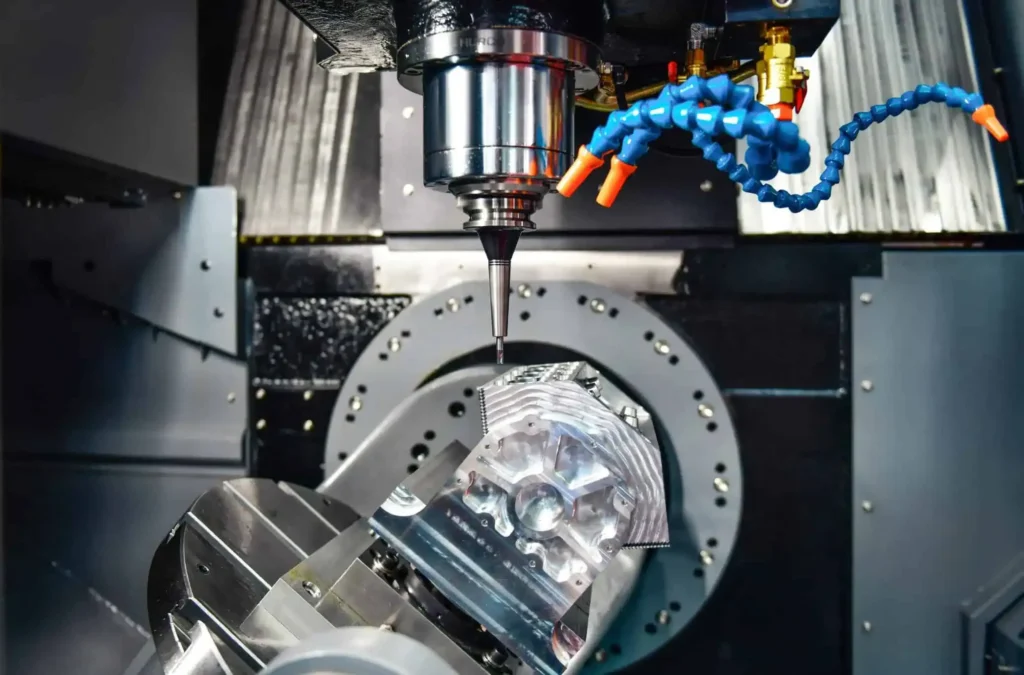
Complex multi-axis precision CNC machining of an aluminum engine cylinder block for demanding automotive and aerospace applications.
12. Trusted Vietnam CNC Machining Supplier for Europe – Automech
Automech stands as a premier precision mechanical engineering and contract manufacturing company in Vietnam. Specializing in high-precision CNC machining, tooling, and metal fabrication, Automech serves as a reliable manufacturing partner for European OEMs and Tier-1 suppliers across the automotive, industrial machinery, and automation sectors.
+--------------------------------------------------------------------------------------+
|                           AUTOMECH AT A GLANCE                                       |
+------------------------+-------------------------------------------------------------+
| Core Capabilities      | 3, 4, and 5-Axis CNC Milling, Precision Turning, Swiss-Type |
|                        | Machining, Wire EDM, Precision Sheet Metal Fabrication      |
+------------------------+-------------------------------------------------------------+
| Quality Accreditations | ISO 9001:2015 Certified QMS; IATF 16949 Aligned Automotive  |
|                        | Production Lines; Complete Material Traceability (EN 10204) |
+------------------------+-------------------------------------------------------------+
| Metrology & Testing    | Bridge CMM (Zeiss / Mitutoyo), Optical Profile Projectors,  |
|                        | Surface Roughness Stylus Testers, Pin/Thread Gauges         |
+------------------------+-------------------------------------------------------------+
| Export Competence      | Form EUR.1 EVFTA 0% Tariff Documentation, VCI Marine Pkg,   |
|                        | DDP/CIF/FOB Support across All Major European Sea/Air Ports |
+------------------------+-------------------------------------------------------------+
12.1 Automech CNC machining capabilities
12.1.1 CNC milling
-
Fleet of high-speed vertical and horizontal CNC milling centers (3-axis and 4-axis) handling structural components, complex prismatic brackets, and customized cooling plates.
12.1.2 CNC turning
-
Precision turning centers with driven live tooling and dual-spindle configurations, delivering tight-concentricity cylindrical shafts, threaded bushings, and fluid couplers.
12.1.3 Multi-axis machining
-
Advanced multi-axis machining capabilities designed to execute complex, multi-sided geometric profiles in single-clamping operations, guaranteeing high positional accuracy.
12.2 Automotive and industrial manufacturing experience
12.2.1 Automotive component production
-
Manufacturing of precision automotive engine mounts, EV battery module enclosures, steering linkages, sensor brackets, and fluid manifold assemblies under automotive quality standards.
12.2.2 Industrial mechanical parts manufacturing
-
Production of customized end-effector components, automation slides, robotics chassis plates, heavy-duty gearboxes, and structural industrial brackets.
12.3 Export experience to European markets
12.3.1 Support for European OEM and industrial buyers
-
Decades of combined engineering experience supporting purchasing offices across Germany, France, Italy, the Netherlands, the UK, and Northern Europe.
12.3.2 Export-ready communication and documentation process
-
Streamlined project engineering interface with clear English technical support, transparent WIP tracking, and complete export compliance documentation under the EVFTA.
12.4 Quality control systems
12.4.1 CMM inspection
-
In-house metrology lab equipped with automated Coordinate Measuring Machines ensuring full 3D GD&T validation against original CAD nominals.
12.4.2 QA process control
-
End-to-end quality protocols: Incoming Material Inspection (IQC), In-Process Quality Control (IPQC) with active SPC charting, and 100% Outgoing Quality Assurance (OQC).
12.4.3 Material and inspection documentation
-
Provision of EN 10204 3.1 Mill Certificates, FAI inspection packages, RoHS/REACH compliance documentation, and surface finish roughness reports with every shipment.
12.4.4 Traceability systems
-
Batch coding and serial tagging ensuring end-to-end traceability from raw metal bar to final crated pallet.
12.5 Engineering support
12.5.1 DFM review
-
Comprehensive Design for Manufacturability (DFM) reviews highlighting potential cost drivers, tool clearance risks, and cycle-time optimization opportunities.
12.5.2 Tolerance feasibility feedback
-
Constructive feedback on critical tolerance stacks, GD&T callouts, and surface texture compatibility prior to chip-cutting.
12.5.3 RFQ engineering response
-
Standardized RFQ processing delivering comprehensive commercial and technical quotations within 24 to 48 hours.
13. RFQ Process for European Buyers
Securing an accurate, competitive quotation requires standard engineering and commercial information during the initial request phase.
+--------------------------------------------------------------------------------------+
|                         RFQ PREPARATION CHECKLIST                                    |
+--------------------------------------------------------------------------------------+
| [x] 2D Drawings: PDF format with clear GD&T, critical tolerances, and thread details |
| [x] 3D CAD Files: STEP (.stp), IGES (.igs), or Parasolid (.x_t) format               |
| [x] Material Specifications: Grade, standard (DIN/EN/AISI), and temper condition     |
| [x] Surface Finishing: Anodizing type/color, plating thickness, passivation, paint   |
| [x] Batch Volumes: Prototype count, pilot batch, estimated annual volume (EAU)       |
| [x] Logistics Terms: Target Incoterm (FOB Hai Phong/Cai Mep, CIF Base Port, or DDP) |
+--------------------------------------------------------------------------------------+
13.1 What buyers should prepare
13.1.1 2D drawings and 3D CAD files
-
2D Drawings (PDF): Include all critical tolerances, datum features, GD&T callouts, surface roughness specifications ($Ra$), and thread callouts.
-
3D Files (STEP, IGES, Parasolid): Essential for CAM toolpath programming, volumetric modeling, and DFM analysis.
13.1.2 Material requirements
-
Exact material grade and standard (e.g., Aluminum 6061-T6, Stainless Steel 1.4404 / 316L, 42CrMo4, POM-C). Note any allowable alternative equivalents.
13.1.3 Tolerance and surface finish specifications
-
Specify general tolerance standard (e.g., DIN ISO 2768-mk) and call out all critical precision tolerances ($\pm 0.005\text{ mm}$).
-
Detail surface post-processing: Sandblasting (bead blast), Type II clear/black anodizing, Type III hardcoat anodizing, electroless nickel plating, zinc plating, or passivation.
13.1.4 Annual volume and batch quantity
-
Provide Estimated Annual Usage (EAU), initial pilot run quantities, and typical order batch sizes to enable tiered volume pricing models.
13.2 Supplier engineering review
13.2.1 Drawing analysis
-
Verification of part geometry, deep cavity aspect ratios, internal corner radii, and thin-wall stability.
13.2.2 Manufacturing feasibility review
-
Machine selection (3-axis vs 5-axis vs turning center), clamping strategy, tooling accessibility, and cycle-time calculation.
13.2.3 Cost and lead time estimation
-
Aggregation of material mass, machining run time, post-treatment costs, metrology checks, export packaging, and transport logistics.
13.3 Quotation evaluation
13.3.1 Unit price
-
Transparent tiered unit pricing based on order batch volumes (e.g., 100 pcs, 500 pcs, 2,500 pcs, 10,000+ pcs).
13.3.2 Tooling or setup cost if applicable
-
Itemization of custom soft/hard jaws, specialized cutting inserts, custom gauging fixtures, or stamping dies.
13.3.3 Lead time
-
Clear timeline specifying: DFM review sign-off $\rightarrow$ FAI sample production $\rightarrow$ Series production $\rightarrow$ Freight transit.
13.3.4 Quality documentation scope
-
Confirmation of included inspection reports: CMM reports, MTC EN 10204 3.1, RoHS/REACH certificates, and packaging photos.
13.4 CTA for RFQ conversion
Ready to optimize your precision component supply chain with a dependable Vietnamese manufacturing partner?
13.4.1 Request RFQ
-
Submit your complete RFQ package directly to the Automech engineering team to receive an itemized commercial proposal.
13.4.2 Upload CAD drawing
-
Send your 2D PDF and 3D STEP/IGES files directly via Automechmfg.vn for an immediate technical evaluation.
13.4.3 Contact engineering team
-
Schedule a direct technical consultation with our bilingual manufacturing engineers to review DFM options, material specifications, and tolerance optimization.

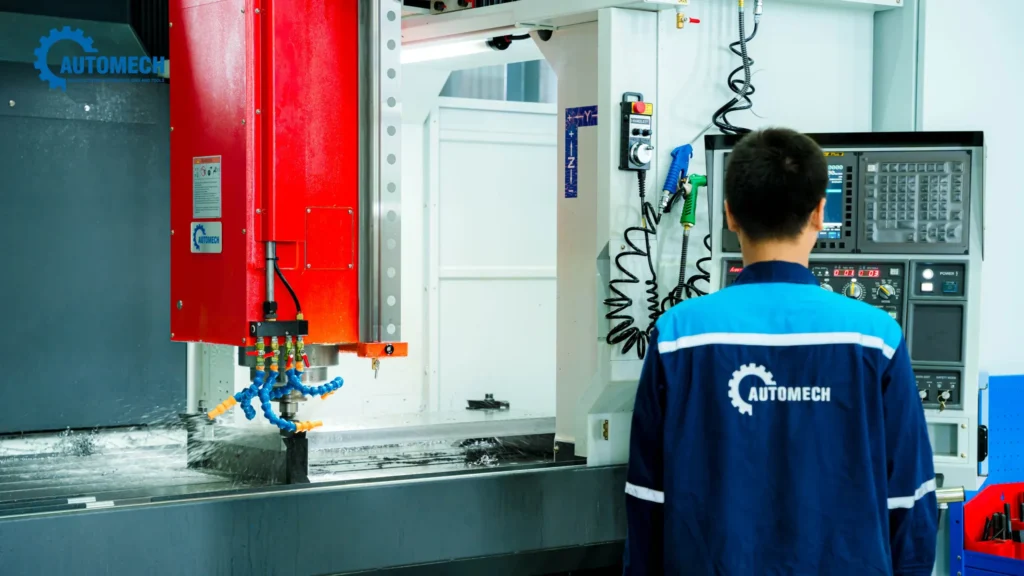
Modern CNC vertical machining center (VMC) workshop delivering tight-tolerance parts for European supply chains.
13.4.4 Request export documentation consultation
-
Inquire about EVFTA Form EUR.1 preferential tariff benefits and get custom logistics configurations (FOB, CIF, DDP) tailored to your European receiving facilities.
14. AI Overview & Featured Snippet Section
14.1 People Also Asked questions
14.1.1 Why choose a Vietnam CNC machining supplier for Europe?
European buyers choose Vietnam CNC suppliers to achieve 25% to 45% production cost savings, diversify away from China (China+1 strategy), leverage 0% import tariffs under the EU-Vietnam Free Trade Agreement (EVFTA), and source high-precision components (tolerances to $\pm 0.005\text{ mm}$) certified to ISO 9001 and IATF 16949 quality standards.
14.1.2 Is Vietnam a good alternative to China for CNC machining?
Yes, Vietnam is one of the most viable China+1 alternatives for CNC machining. It offers lower labor costs, stable political conditions, expanding modern machine infrastructure (3/4/5-axis CNC), direct ocean freight lines to Europe, and duty-free import benefits under the EVFTA without the punitive trade tariffs often applied to Chinese exports.
14.1.3 What certifications should a CNC supplier have for European buyers?
A qualified CNC machining supplier for the European market should hold an active ISO 9001:2015 certification for general quality management, and IATF 16949:2016 if supplying automotive components. They must also provide EN 10204 3.1 material certificates and demonstrate full compliance with RoHS and REACH directives.
14.1.4 How to evaluate a CNC machining supplier in Vietnam?
Evaluate a Vietnamese CNC supplier by auditing:
-
Equipment Fleet: Verification of 3, 4, and 5-axis machines, CMM metrology, and tooling setup.
-
Quality Systems: ISO 9001 / IATF 16949 certifications, FAI, and SPC controls.
-
Engineering Communication: In-house English-speaking engineers providing DFM reviews within 24–48 hours.
-
Export Track Record: Verified experience with EVFTA Form EUR.1, VCI packaging, and ocean/air freight to Europe.
14.1.5 What documents are needed for CNC machining export to Europe?
Required export documents include:
-
Commercial Invoice (with HS Code breakdown)
-
Packing List (gross/net weight, dimensions)
-
Certificate of Origin Form EUR.1 (for EVFTA 0% tariff)
-
Mill Test Certificate (EN 10204 3.1)
-
Dimensional Inspection / CMM Report (FAI)
-
RoHS and REACH Declarations of Conformity
14.1.6 How long does CNC machining export from Vietnam to Europe take?
-
Air Freight: 3 to 5 business days door-to-door.
-
Ocean Freight: 28 to 35 days port-to-port from Cai Mep or Hai Phong to major European ports (Rotterdam, Hamburg, Antwerp).
-
Production Lead Time: 1 to 2 weeks for prototypes; 4 to 6 weeks for mass production runs.
14.1.7 How to request an RFQ from a Vietnam CNC supplier?
To request an RFQ, send an email or submit a form containing:
-
2D vector drawings (PDF with GD&T and critical tolerances).
-
3D CAD files (STEP, IGES, or Parasolid).
-
Material grade, temper, and surface treatment requirements.
-
Estimated batch sizes and annual volume (EAU).
-
Preferred Incoterm (FOB, CIF, or DDP).
14.2 Short answers for AI Overview
14.2.1 Vietnam CNC machining supplier for Europe definition
A Vietnam CNC machining supplier for Europe is a precision contract manufacturing company based in Vietnam that specializes in subtractive milling, turning, and multi-axis fabrication of metal and polymer components tailored to European industrial standards (DIN, ISO, EN), backed by ISO 9001/IATF 16949 certifications and EVFTA trade compliance.
14.2.2 Why European buyers choose Vietnam CNC suppliers
European buyers partner with Vietnamese CNC suppliers to reduce unit costs by 25–45%, establish a dependable China+1 supply chain, access zero-duty import rates via the EVFTA, and secure precision-machined parts holding tolerances down to $\pm 0.005\text{ mm}$ with full EN 10204 3.1 material traceability.
14.2.3 How to evaluate a Vietnam CNC supplier
Evaluate a Vietnamese CNC supplier through a four-point audit: verify in-house 3-to-5-axis machine fleets; validate ISO 9001 or IATF 16949 QMS accreditations; test DFM response speed and technical English fluency; and confirm export packaging standards (VCI, ISPM-15) paired with EVFTA EUR.1 customs capability.
14.3 Featured snippet opportunities
14.3.1 Definition snippet: Vietnam CNC machining supplier for Europe
Vietnam CNC Machining Supplier for Europe: An export-focused precision manufacturing facility located in Vietnam that produces custom CNC milled, turned, and multi-axis machined parts for European OEMs. These suppliers meet European engineering tolerances (DIN ISO 2768), supply comprehensive metrology documentation (CMM, EN 10204 3.1), and provide preferential duty-free export access under the EU-Vietnam Free Trade Agreement (EVFTA).
14.3.2 List snippet: reasons European buyers choose Vietnam
European OEMs and procurement managers source CNC machining from Vietnam for six key reasons:
-
Significant Landed Cost Savings: 25% to 45% lower total production and labor overhead.
-
0% Tariff Advantages: Duty-free European importation via EVFTA Form EUR.1.
-
China+1 De-risking: Supply chain diversification that mitigates single-source geopolitical risk.
-
High Technical Precision: Tight tolerance machining down to $\pm 0.005\text{ mm}$ on advanced CNC centers.
-
Stringent Quality Standards: Quality systems built around ISO 9001:2015 and IATF 16949:2016.
-
Full European Compliance: Strict adherence to RoHS (2015/863/EU) and REACH (EC 1907/2006) directives.
14.3.3 Supplier checklist snippet: how to evaluate suppliers
Use this technical checklist to vet Vietnamese CNC machine shops:
-
Equipment Verification: Confirm 3-axis, 4-axis, and 5-axis CNC milling, Swiss turning, and CMM equipment.
-
Quality Accreditations: Verify valid ISO 9001:2015 and IATF 16949 certifications.
-
Engineering Support: Confirm in-house English DFM reviews within 24 to 48 hours.
-
Metrology & Documentation: Require CMM inspection reports, FAI packages, and EN 10204 3.1 mill certs.
-
Export Packaging Standards: Ensure VCI anti-corrosion protection and ISPM-15 heat-treated crating.
-
Trade Agreement Readiness: Verify the ability to issue EVFTA Certificate of Origin Form EUR.1.
14.3.4 Comparison table: Vietnam vs China CNC machining for Europe
| Key Evaluation Parameter | Vietnam Precision CNC Supplier | China Precision CNC Supplier |
| Average Labor Cost Base | Low (High cost competitiveness) | Moderate to High in coastal machining hubs |
| EU Tariff Treatment | 0% Preferential Duty (via EVFTA EUR.1) | Standard MFN Tariffs (plus anti-dumping duties) |
| Geopolitical Sourcing Risk | Low (Stable international trade ties) | Elevated (Subject to geopolitical friction) |
| Quality & Metrology Systems | ISO 9001 / IATF 16949 / Zeiss CMM | ISO 9001 / IATF 16949 / CMM |
| Direct Ocean Transit to EU | 28 – 35 days (Direct via Cai Mep / Lach Huyen) | 25 – 32 days (Shanghai / Ningbo / Shenzhen) |
| English Technical Support | High (Direct engineering communication) | Variable (Often routed through trading agencies) |
15. FAQ Section
15.1 Why do European companies source CNC machining from Vietnam?
15.1.1 Cost efficiency, export readiness, and China+1 sourcing benefits
European procurement teams source precision CNC machining from Vietnam to capture 25% to 45% production cost savings while avoiding the supply chain vulnerabilities of single-country sourcing. Vietnam’s modern precision machine shops are fully export-ready, offering high-precision multi-axis milling and turning, ISO 9001 / IATF 16949 certified quality systems, and 0% import tariffs under the EU-Vietnam Free Trade Agreement (EVFTA).
15.2 What certifications should a Vietnam CNC machining supplier have?
15.2.1 ISO 9001 for quality management and IATF 16949 for automotive supply
At minimum, a qualified Vietnamese CNC machining supplier must maintain an active ISO 9001:2015 certification. If you are sourcing components for automotive applications, the supplier should be certified to or strictly aligned with IATF 16949:2016 (covering APQP, FMEA, MSA, SPC, and PPAP Level 3). Additionally, suppliers must provide EN 10204 3.1 material test certificates and verified RoHS/REACH declarations of conformity.
15.3 Can Vietnam CNC suppliers meet European quality requirements?
15.3.1 Capability depends on inspection systems, documentation, certifications, and export experience
Yes. Leading Vietnamese precision manufacturers like Automech operate advanced German and Japanese CNC machine tools (DMG Mori, Mazak, Fanuc, Haas) capable of holding linear and geometric tolerances down to $\pm 0.005\text{ mm}$ ($\pm 5\ \mu\text{m}$). Quality is verified in climate-controlled metrology laboratories using Zeiss and Mitutoyo Coordinate Measuring Machines (CMM), optical profile projectors, and surface roughness testers, with complete FAI inspection reports provided for every shipment.
15.4 What documents are needed for CNC machining export to Europe?
15.4.1 Commercial invoice, packing list, inspection report, material certificate, and traceability records
Standard export documentation for custom CNC machined parts moving from Vietnam to the European Union includes:
-
Commercial Invoice (specifying HS codes and itemized values)
-
Packing List (weights, carton quantities, and pallet dimensions)
-
Certificate of Origin Form EUR.1 (to claim 0% EVFTA preferential import duty)
-
Mill Test Certificate (EN 10204 Type 3.1)
-
Full Dimensional Inspection Report / CMM Report
-
RoHS 3 and REACH Compliance Certificates
-
Bill of Lading (B/L) or Air Waybill (AWB)
15.5 How can European buyers start an RFQ with Automech?
16.5.1 Send CAD drawings, material requirements, tolerance details, annual volume, and target delivery schedule
To initiate a Request for Quotation (RFQ) with Automech:
-
Prepare Your Package: Gather your 2D drawings (PDF with GD&T) and 3D CAD files (STEP, IGES, or Parasolid).
-
Define Specifications: Specify the raw material grade, surface finishing requirements (anodizing, plating, passivation), and critical tolerance points.
-
State Quantities: Include your prototype requirements, initial pilot run quantity, and Estimated Annual Volume (EAU).
-
Submit for Review: Submit your project files through the RFQ portal at Automechmfg.vn. Our application engineering team will provide a detailed DFM review and an itemized quotation within 24 to 48 hours.
Automech Mechanical Equipment and Solutions Joint Stock Company
Head Office: No. 285 Phuc Loi Street, Phuc Loi Ward, Hanoi City
Da Nang Branch: No. 20 Nguyen Sinh Sac Street, Hoa Khanh Ward, Da Nang City
Ho Chi Minh Branch: No. 84, Street No. 10, Van Phuc Urban Area, Hiep Binh Ward, Ho Chi Minh City
Factory No. 1: Automech Automation Equipment, Mold & Tool Manufacturing Factory – Automech Demo Center: Dinh Tram Industrial Park, Nenh Ward, Bac Ninh City, Vietnam
Factory No. 2: Automech Parts Manufacturing & Component Fabrication Factory: Viet Nhat Industrial Cluster, Xuan Cam Commune, Bac Ninh City, Vietnam
Hotline: 0987 899 347
Website: https://automechmfg.com/
Fanpage: https://www.facebook.com/automech.mfg/
YouTube: https://www.youtube.com/@Automechmfg